
US Navy Deploys Warships to Venezuela Amid Anti-Drug Push
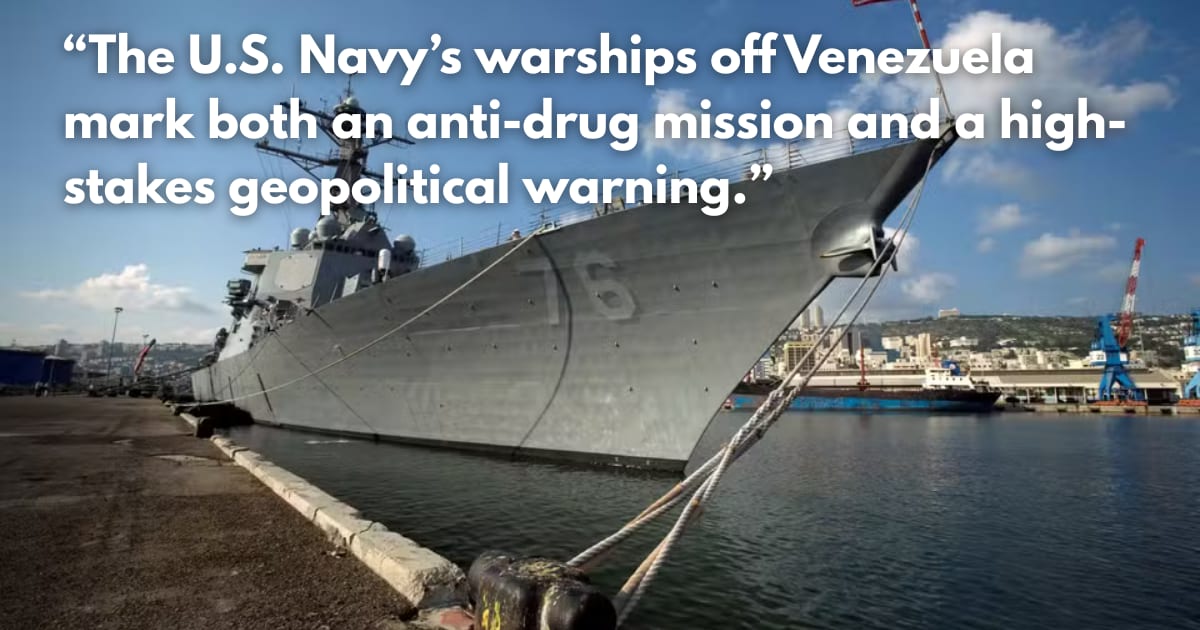
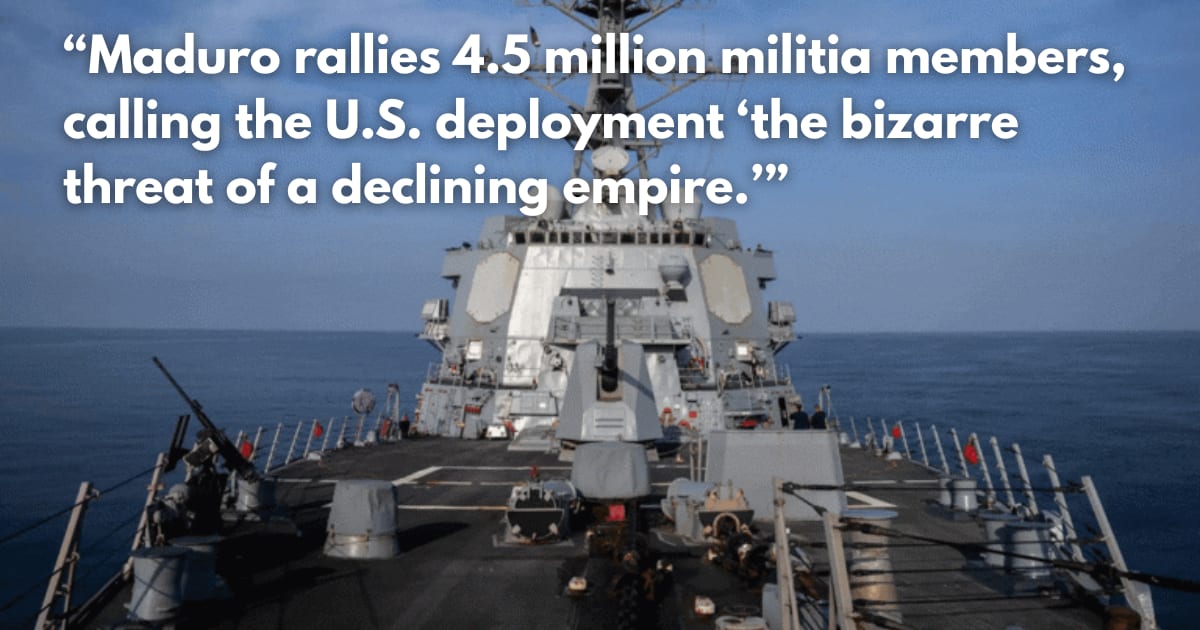

FazTimes Media: The United States is increasing its military presence in the southern Caribbean by sending warships, marines, and advanced surveillance planes near Venezuela. The U.S. says this move is part of a new effort to stop drug trafficking groups that operate through Latin America. However, many experts think this military action also has a stronger political message, directed at Venezuelan President Nicolás Maduro and his government.
Reuters reports that the naval force includes at least three strong Arleigh Burke-class guided missile destroyers, a submarine, and three amphibious ships carrying almost 4,000 marines and sailors. Together, they are part of the USS Iwo Jima Amphibious Ready Group, a unit often sent to high-risk areas to show strength and carry out quick military actions.
These ships are supported by P-8 Poseidon aircraft, which are used for spying, watching, and targeting. U.S. officials have suggested that while the official mission is about stopping drug smuggling, the warships are ready for “targeted military actions” if the U.S. government decides to use them.
This military move happens during a time of long-standing political tension between the U.S. and Venezuela. The U.S. has accused Maduro’s government of having strong links to drug gangs and rebel groups, especially the Colombian group FARC. In 2020, the U.S. Justice Department charged Maduro with “narco-terrorism”, saying his government helped send large amounts of cocaine to North America.
According to BBC News, the U.S. even offered a $50 million reward for information that could lead to Maduro’s arrest—showing how serious the U.S. is about the alleged criminal connections of the Venezuelan leader.
For the U.S., this military move is not just about stopping drugs. Experts say it’s also a political statement: a way to remind the world that the U.S. still has the power to act in the Western Hemisphere, especially as Russian and Chinese influence grows in the region.
Venezuela’s Reaction: “A Threat from a Declining Empire”
President Nicolás Maduro responded with strong words, blaming Washington for trying to pressure his country using military strength. In a televised speech, he called the situation “the strange and dangerous threat of a declining empire” and said Venezuela would stand up for its land, sea, and air.
As a direct response, Maduro announced the use of 4.5 million militia volunteers. These are part-time fighters who help the regular military during times when the country feels under threat from outside forces.
According to Al Jazeera, Venezuelan officials say the U.S. operation breaks international rules and is just another way to weaken the country.
What Is the Official U.S. Line?
Even though the U.S. sent a strong naval force, the Pentagon says this isn’t an invasion. Instead, it’s part of a larger anti-drug campaign. A Defence Department spokesperson stated that the warships will remain in international waters and airspace, conducting activities such as surveillance and monitoring. But they didn’t say it’s impossible that they might take action if they find big drug shipments heading to North America. This mix of a defensive mission with weapons ready has made people wonder about the real goals of the U.S.
A Region on Edge
Latin America has seen a lot of U.S. military actions before, like the 1989 attack on Panama and long-running anti-drug efforts in Colombia. Washington has often used its military to control the region. But now, the situation is different. Venezuela has grown closer to Russia, China, and Iran, which don’t agree with U.S. power. By sending such a big navy to the Caribbean, the U.S. is clearly saying that other countries can’t use Venezuela as a base for their own interests.
Defence expert Michael Shifter toldBBC News that “the military buildup acts as both a warning and a way to stop Maduro. It also reminds Moscow and Beijing that the U.S. is still active in the hemisphere.”
The Risk of Escalation
Even though the U.S. says this is a mission to fight drug trafficking, some experts are worried it could lead to bigger fights. Venezuelan leaders are afraid that the U.S. naval actions could be the first step toward changing their government. This isn’t new — in the past, U.S. leaders have considered ways to change the government in Venezuela.
Even though President Joe Biden has been speaking more carefully in public, this military action was started under Trump and is still happening now.
The Human Angle: Venezuelans Caught in the Middle
Beyond all the political moves, regular people in Venezuela are still dealing with a lot of problems. Millions of people are struggling just to survive. Based on UN reports, more than 7 million Venezuelans have left the country in recent years, making it one of the biggest refugee crises in the world.
What Happens Next?
Right now, the U.S. Navy is still near the coast of Venezuela, doing patrols and flying around to gather information. Officials in Washington say the mission might last for several months, depending on what the intelligence shows and how the situation in Venezuela changes.
Venezuela’s military is staying ready, and President Maduro has called for support from other countries against what he calls American “aggression”. Meanwhile, nearby nations like Colombia and Brazil are watching closely, fearing that the situation could cross their borders.
According to Al Jazeera, diplomats from Latin America are quietly asking for calm, saying that a war would make things worse for the whole region, especially since many countries are still recovering from the effects of the pandemic.
Conclusion
For Venezuela, this action makes them worry more about U.S. interference. For the U.S., it’s a way to push back on Maduro, control drug movements, and warn other countries. As things develop, the world will be paying attention. The Caribbean could once again be a place where local issues clash with bigger global conflicts.
Our primary goals at FazTimes Media are to be accurate and confident and adhere to the highest journalistic standards. We check every news story we share against several trustworthy and separate sources to ensure its accuracy.
We have reviewed this report, along with articles from major news outlets worldwide, including BBC News, Reuters, Bloomberg, Al Jazeera, NDTV, The Economic Times, and The Indian Express.
We want to keep the highest standards in global journalism so that our readers can trust the information they acquire.


Discussion0
Join the conversation on this story
Loading comments...