
Uttarakhand as a 'Hindutva Laboratory': Policies & Political Shifts
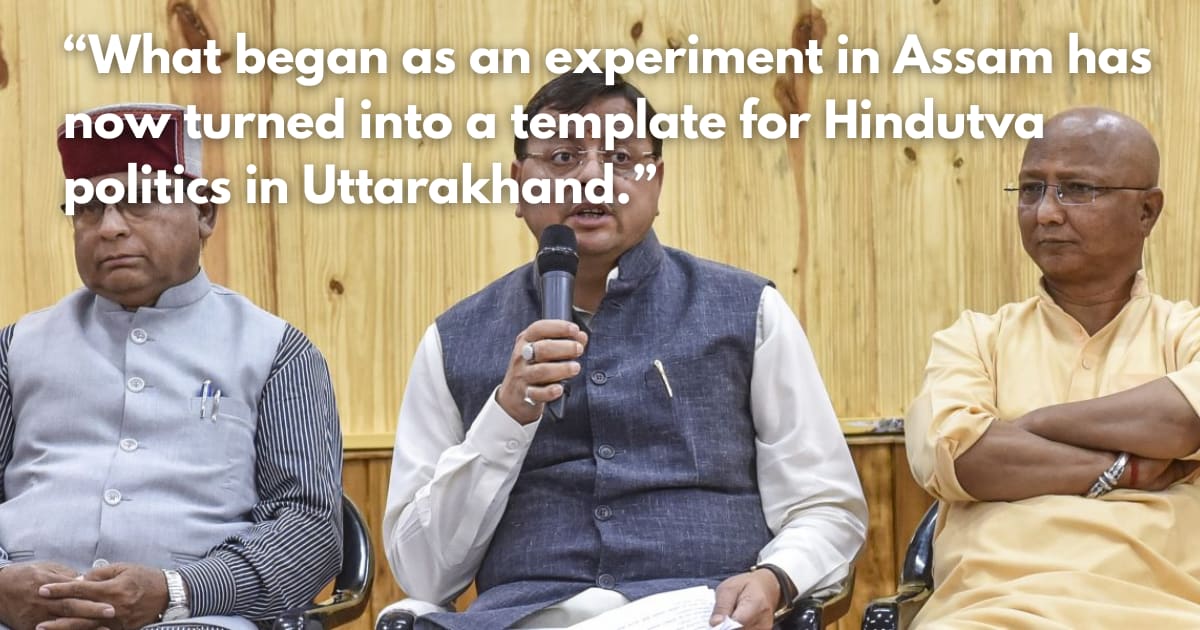

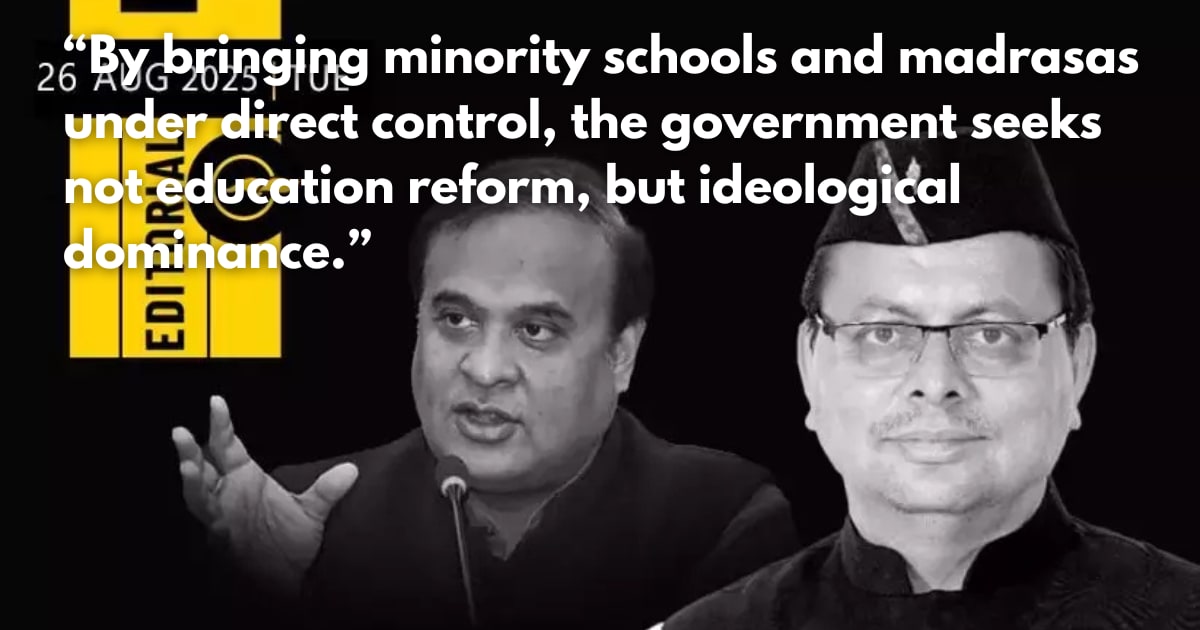

FazTimes Media, Dehradun: In recent years, Uttarakhand has become a place where political changes are being tested, and the ruling Bharatiya Janata Party (BJP) is accused of introducing laws and policies that aim to change the state's social and cultural environment. Many political experts say that what is happening in Uttarakhand today is similar to what happened in Assam, where the government of Chief Minister Himanta Biswa Sarma introduced controversial rules that targeted minority groups.
According to Al Jazeera, Assam has long been known as a place where policies promoting a Hindu identity have been tested. Since the BJP took control in 2016, the state has seen a lot of discussion about citizenship, land ownership, and religious identity. Now, similar actions are happening in Uttarakhand, where Chief Minister Pushkar Singh Dhami has passed three controversial laws, raising concerns about the future of Indian democracy.
The first major law was the Freedom of Religion Act, also known as the anti-conversion law, introduced in 2018. The law was meant to stop forced religious conversions, but critics say it is written in a way that makes it possible to punish even people who change religion on their own. At first, the punishment for “forced conversion” was up to ten years in prison and a fine of ₹50,000. But later changes increased the penalty to life imprisonment and a fine of ₹1 lakh in some cases. The law also gives police the power to arrest people without a warrant and not let them go until a court decides.
Activists say the provision is particularly dangerous because the law uses a very vague definition of “force”. Even offering free education, scholarships, or jobs through a religious group could be considered coercion. A local human rights lawyer in Dehradun said, “This law creates a situation where minorities are always worried about being falsely accused.”
BBC News reports that India already has some of the strictest anti-conversion laws in the world, but the laws in Uttarakhand are seen as setting new examples that could be used in other states ruled by the BJP.
Minority Education Bill: Increasing Control
Last week, the Uttarakhand Assembly approved another controversial law—the Minority Education Bill. This law will create a state-level council that will oversee schools run by religious minorities, such as Christian schools and Islamic madrasas.
On the surface, the bill says it aims to “improve the quality” of education. In reality, it gives more power to the government by letting the council check the teaching methods, curriculum, and even the management of minority schools.
A local academic said, “This law puts madrasas under government control. Although checking for accountability is necessary, the law also opens the door for interference in religious and cultural education.” In the past few months, several madrasas in Uttarakhand have been destroyed because of alleged building code violations. This approach is similar to what happened in Assam, where many such schools were also bulldozed. By passing this bill, Dhami’s government is setting the ground for more control over the education system run by minority groups.
Uniform Civil Code: The Third Major Step
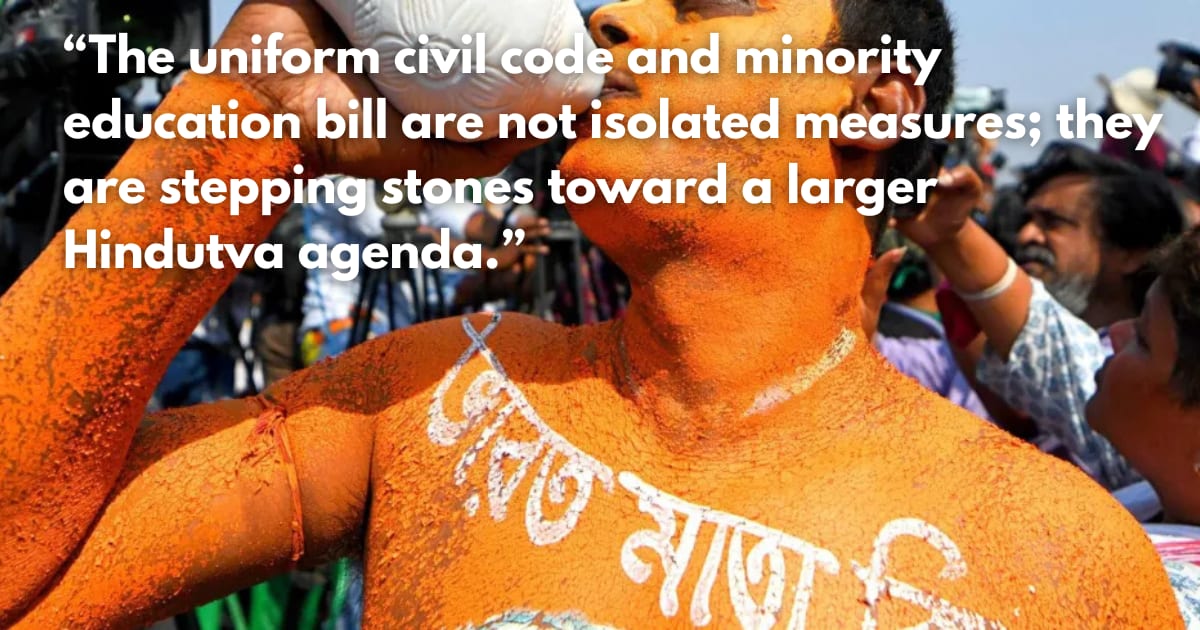
One of the most noticeable actions by the Dhami government is the introduction of the Uniform Civil Code (UCC). This is a long-standing demand from the Hindutva community. The UCC replaces different personal laws based on religion with a common set of rules for issues like marriage, divorce, and inheritance.
While some view the idea of uniformity as progressive, minority groups believe this law negatively affects their cultural traditions. The law also includes rules that make certain “live-in” relationships illegal and allow the government to cancel marriage registrations in some cases.
Political analysts note that the UCC in Uttarakhand is being presented as a model for other states ruled by the BJP, such as Madhya Pradesh and Gujarat. According to The Hindu, several states are now looking at Uttarakhand’s UCC to follow suit. In that sense, the law serves not only as a local reform but also as a national political experiment.
The Assam Connection
People often compare Uttarakhand with Assam. In Assam, the National Register of Citizens (NRC) and the Citizenship Amendment Act (CAA) were introduced with the idea of removing “illegal immigrants”. But in reality, many Muslims and Bengali-speaking Hindus were targeted and questioned.
In Uttarakhand, the situation is a bit different but follows a similar pattern. Political speeches often use terms like “love jihad”, “land jihad”, and “population explosion” to spread fear among the majority group. As reported by The Indian Express, these ideas have become more popular in recent years, helping the BJP gain more support while making minorities feel unsafe.
Political Strategy Behind the Moves
Why is the BJP focusing so much on Uttarakhand?
Experts say there are both symbolic and practical reasons. Uttarakhand, known as “Devbhoomi” (the land of the gods), is very important to Hindus. By making the state a centre for Hindutva-driven policies, the BJP is sending a strong message about its main beliefs.
Also, the upcoming 2027 Assembly elections are influencing the BJP’s plan. By highlighting issues like the Uniform Civil Code (UCC) and anti-conversion laws, the party is setting the stage for its campaign. A political commentator from Delhi said, “These laws aren’t just about running the government—they’re about bringing people together.”
Reactions from the Opposition
The opposition, including the Congress and regional parties, has strongly opposed these actions. Congress leader Harish Rawat called the anti-conversion law “a tool to harm minorities.” Activists have warned that these laws could cause more religious conflict in a state that has generally stayed peaceful.
There is also national-level criticism. According to Al Jazeera, several international human rights groups have pointed out that India is using state laws more to limit religious freedom. Uttarakhand’s new rules are being closely watched by global observers as an example of how local laws can affect national politics.
Voices from the Ground
As political arguments continue, regular people in Uttarakhand are dealing with the effects. Minority groups, especially Muslims, who are about 14% of the state’s population, are feeling more worried. “Each time we hear about a new law, we feel less safe,” said a teacher at a madrasa in Haridwar.
At the same time, many Hindu people support these measures, believing they are needed to protect their traditions. “Why should personal laws be different for different groups? A single law is fair for everyone,” said a shopkeeper in Dehradun.
This split shows the bigger differences in Indian society, where one group’s push for equality is often seen by another as a threat to their identity.
The Road Ahead
Uttarakhand’s current direction clearly shows how Hindutva politics is changing in India. With little room in Parliament to push for changes to the constitution, the BJP is using state governments more and more as a way to test sensitive laws.
What starts as a local effort—like the NRC in Assam or the UCC in Uttarakhand—often becomes part of national discussions, influencing the conversation before important elections. Right now, the question remains: are these laws really about change and fairness, or are they just tools to gain more power? As reported by BBC News, the answer isn’t clear yet, but the impact will surely affect India’s future in big ways.
Our primary goals at FazTimes Media are to be accurate and confident and adhere to the highest journalistic standards. We check every news story we share against several trustworthy and separate sources to ensure its accuracy.
We have reviewed this report, along with articles from major news outlets worldwide, including BBC News, Reuters, Bloomberg, Al Jazeera, NDTV, The Economic Times, and The Indian Express.
We want to keep the highest standards in global journalism so that our readers can trust the information they acquire.


Discussion0
Join the conversation on this story
Loading comments...