
Red Sea Cable Cuts Cause Internet Disruptions in Middle East & Asia

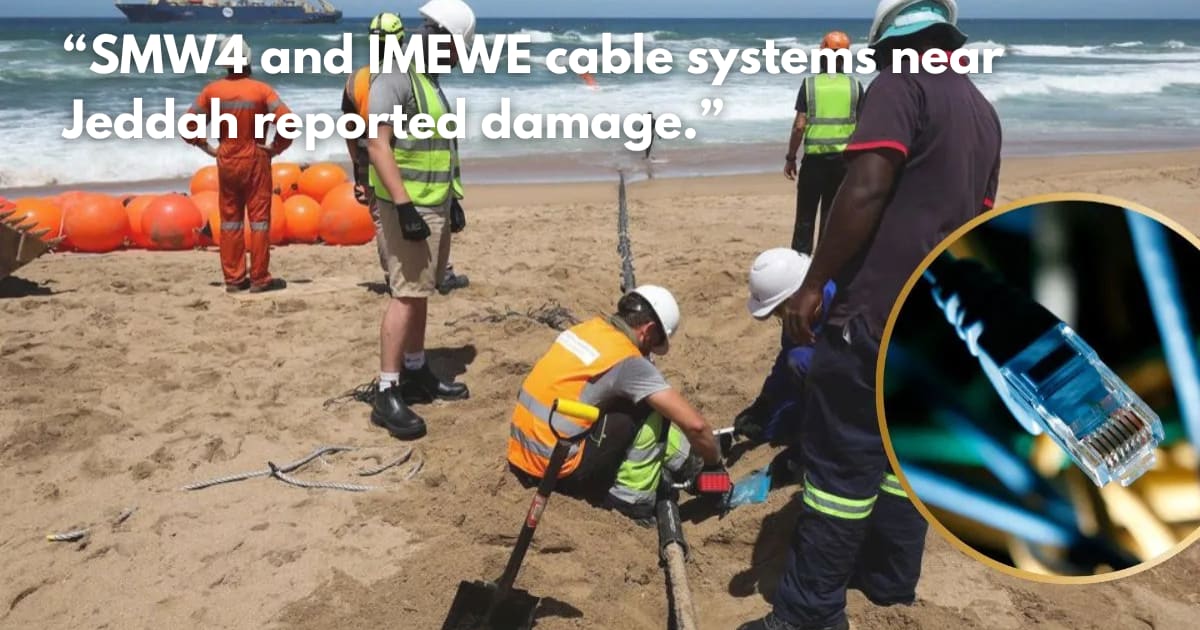



FazTimes Media, Red Sea: A sudden break in the internet lines under the Red Sea has caused major problems with the internet in many places, such as parts of South Asia and the Middle East. The disruption happened earlier this week and shows how quickly contact around the world can be harmed when major digital systems are damaged without warning.
NetBlocks, an international tracking group, says that the internet slowed down or stopped working in India, Pakistan, and some parts of the Middle East. Indian internet traffic was more stable because of backup lines, but the problem was worse for people in other countries.
The city of Jeddah in Saudi Arabia was the first to notice what was wrong. Indian telecom companies said their backup systems helped lessen the effects, but people in Pakistan and nearby areas had trouble with cloud services being slow, video calls breaking, and web viewing slowing down.
BBC News says it's hard to fix underwater lines in the Red Sea because there are many ships going through, and there are political problems in the area. Fixing these cables immediately could have more serious effects on internet links worldwide.
Indian phone companies reported minimal disruption to their customers. Tata Communications and most other big telecom companies use more than one system of cables under the sea. Traffic instantly shifts to another route if one of the cables becomes damaged.
Pakistan experienced more difficulties during the outage. Service providers in that area confirmed that the problem made it take longer to connect to social media, cloud storage, and even foreign banking services. The outage caused short-term problems for small companies that depend on real-time global communication.
Tech companies that run cloud services around the world have also moved quickly. It said on the page for its Azure service that people in the Middle East might have slower internet speeds. They said, "Beginning at 5:45 UTC on September 6, 2025, network traffic going through the Middle East may have longer waiting times because of broken fibre optic cables in the Red Sea."
A lot of fiber-optic lines run under the water, linking parts of Asia with Europe and Africa. Al Jazeera says that this area is where more than 17% of all internet traffic in the world goes. If these lines get broken, it could lead to issues all over the world.
Many important things in today's economy rely on these cables, say experts. Disruptions that last only a short time could cost billions of dollars in lost work.
The Big Picture: How Global Internet Depends on Fragile Underwater Cables
A lot of people think of satellites when they think of the internet, but most of the data we send across borders still goes through fiber-optic lines that lie at the bottom of the ocean. This is where more than 95% of all internet data goes.
It might take a while to fix these wires. To get broken parts from the bottom, special ships with divers or robots are sent. Ships can't always go to certain places because of politics, which makes fixes even harder. One break can cost millions of dollars to fix, according to the New York Times. It depends on how deep and where the damage is. The costs are high for companies that run the internet, but the bigger problem is that when things go wrong, they lose trust and money.
Local Effects and Responses: Communities and Businesses Struggle to Cope
Over the weekend, people in Mumbai and Delhi started to complain about their internet speeds being slower. A lot of people noticed that online games, banking apps, and foreign video calls were much slower. Officials said it was just a "small problem".
There was more trouble in Pakistan. Businesses in Karachi that use real-time software tools had trouble with computers in North America and Europe. Freelancers working on projects around the world missed deadlines by even a few hours.
Corporate networks in the Gulf, especially in Saudi Arabia and the UAE, had trouble connecting to the rest of the world quickly. Some financial companies had to put on hold work involving big foreign deals until the network was back up and running.
A Look Ahead: Securing the Future of Undersea Internet Infrastructure
The failure of the Red Sea cable has put more pressure on countries to find other ways for internet data to travel around the world. A lot of money has already been spent by countries like India to make new paths through the Arabian Sea. Furthermore, there are new plans to connect Asia to Europe via Central Asia and Russia so that the path through the Red Sea is not used as much.
However, experts say that these plans are still not quite done. At the moment, telecom companies and states need to keep the current cables in good shape. BBC News says that cybersecurity experts are saying that wars could target cables under the ocean in the future. Military forces are very good at protecting satellites, but it's much easier to damage cables on the ocean bottom, either on purpose or by accident.
Conclusion: Strengthening Digital Lifelines in a Connected World
The Red Sea cable loss isn't just a technical issue; it also shows how weak our digital world is. It was a warning to millions of people in South Asia and the Middle East that the internet is built on something very fragile. Many people take it for granted as an endless resource.
Our primary goals at FazTimes Media are to be accurate and confident and adhere to the highest journalistic standards. We check every news story we share against several trustworthy and separate sources to ensure its accuracy.
We have reviewed this report, along with articles from major news outlets worldwide, including BBC News, Reuters, Bloomberg, Al Jazeera, NDTV, The Economic Times, and The Indian Express.
We want to keep the highest standards in global journalism so that our readers can trust the information they acquire.



Discussion0
Join the conversation on this story
Loading comments...