
Xi Jinping's BRICS Speech Slams Protectionism & Hegemonism


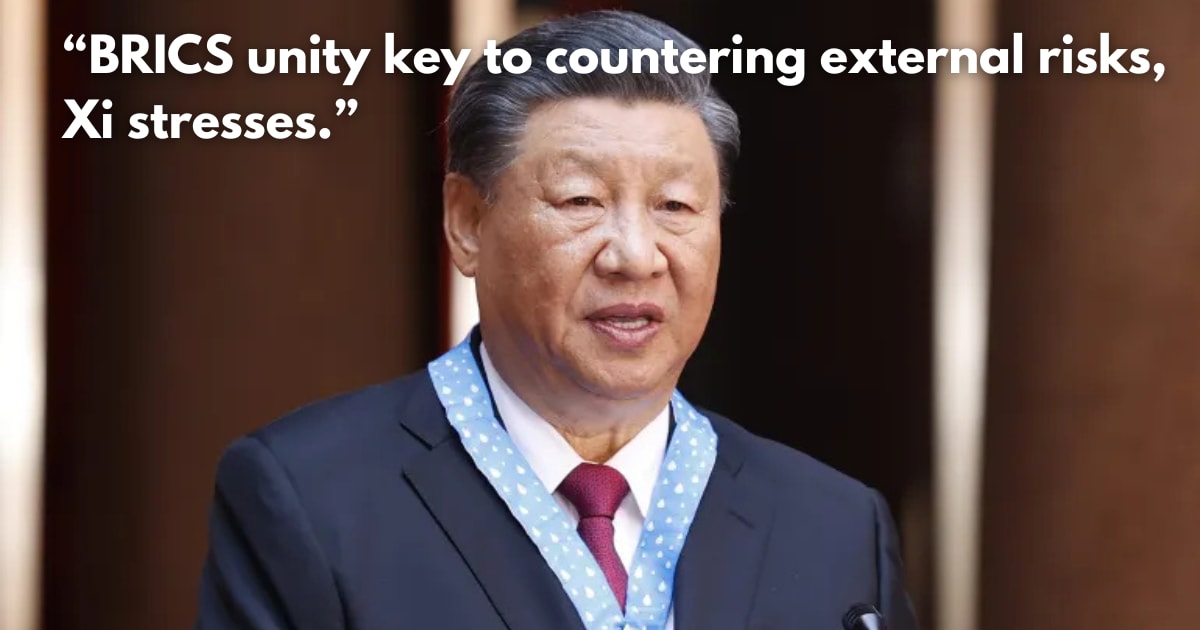

FazTimes Media, New Delhi/Beijing – Chinese President Xi Jinping has once again asked the BRICS countries to work together against what he calls increasing global protectionism and domination. At a virtual BRICS meeting on Monday, Xi encouraged the member nations to support each other, protect international trade, and oppose actions that harm open markets.
Speaking through a video call, Xi explained how ongoing trade conflicts, especially with the United States, are affecting the world economy. “No matter what happens in the world, we need to stay strong in supporting an open global economy, share chances, and gain benefits through openness,” Xi said, according to a report from China’s state news agency, Xinhua.
Calling for multilateralism, Xi said the BRICS—Brazil, Russia, India, China, and South Africa—should protect the international trading system based on the World Trade Organisation (WTO). He warned that actions taken unilaterally, like tariffs and sanctions, by big countries are making international trade rules weaker.
Although he didn’t mention the United States directly, Xi criticised what he called “a series of trade and tariff wars” by some countries, which he said have “seriously damaged global economic stability.” According to BBC News, Xi’s speech was considered a subtle way of criticising the United States, especially for its trade policies against China, India, and Brazil.
The Context: Growing Tensions With the United States Shape Global Politics
The summit is happening at a time when BRICS member countries are facing strong trade pressure from the United States. The U.S. has placed heavy tariffs on several countries, citing reasons like human rights issues and political alliances.
Brazil has seen tariffs as high as 50 per cent on most of its exports to the U.S. Former President Jair Bolsonaro had close ties with Donald Trump, which has made it challenging for his successor, President Luiz Inácio Lula da Silva, to fix the relationship.
Lula, who led Monday’s BRICS meeting, is also pushing for more cooperation between southern countries.
India has faced a 50 per cent tariff on many goods since August 27. The U.S. linked this decision to New Delhi's continued buying of Russian oil, which, from America's perspective, helps fund Russia's actions in Ukraine.
China, on the other hand, is facing an average tariff of about 42 per cent, according to Morgan Stanley. Trade discussions between Beijing and Washington are still shaky, with both sides acting cautiously and trying to avoid conflict.
Speaking with NBC News on Sunday, U.S. Treasury Secretary Scott Bessent hinted that Washington might work with Europe to impose more sanctions on countries that keep importing Russian oil.
BRICS as the Voice of the Global South: Challenging Western Dominance
Xi's message shows Beijing's effort to make BRICS the main voice for the Global South. The Chinese leader pointed out that the five-member group represents almost half the world's population, contributes 30 per cent of global GDP, and is part of 20 per cent of world trade.
“BRICS must stay open, inclusive, and cooperative to stand up for fairness and justice in the world,” Xi said.
As reported by Al Jazeera, Xi used a Chinese saying—“Strong winds test tough grass; fierce fire reveals pure gold”—to show that the current challenges will only make BRICS more united if countries work together.
China has been working hard to build stronger relationships with other BRICS countries to reduce the pressure from the U.S. In May, Beijing welcomed President Lula with a large, formal event. During this meeting, they signed agreements on topics like mining, artificial intelligence, currency exchanges, and working together on climate change.
Last year, Xi Jinping also visited Brazil, showing his interest in strengthening ties in South America, where the U.S. has had a strong presence. India is trying to manage its relationships carefully. At the recent Shanghai Cooperation Organisation summit, Indian Prime Minister Narendra Modi had friendly talks with both Xi and Russian President Vladimir Putin. However, Modi didn’t attend the BRICS virtual meeting. Instead, he sent his foreign minister, S. Jaishankar, even though India is set to take over as the group’s leader in 2026.
Despite having different opinions on some global issues, BRICS countries are united in their goal to change international systems they believe are controlled by Western nations. Dr. Meera Krishnan, an international relations expert from New Delhi, said, “BRICS isn’t about having the same views on everything, but it helps emerging economies like India and Brazil speak up without being overshadowed by the U.S. or Europe.”
The trade wars have had real impacts on BRICS countries:
In Brazil, farmers are saying that American tariffs are hurting their exports of soybeans and beef.
In India, small businesses that rely on selling textiles and steel are worried that high tariffs will make them less competitive in the world market.
In China, factories in provinces like Guangdong and Zhejiang have seen lower demand for products such as electronics, machinery, and home appliances. According to BBC News, officials from Brazil and India believe that these tariffs are hurting regular workers and businesses, not just governments.
Xi Jinping called on BRICS countries to move beyond just opposing Western power and instead focus on strengthening their unity. He outlined four main areas where BRICS should work closely together:
Trade and Finance – increasing trade among BRICS members, improving currency exchange agreements, and cutting down their reliance on the U.S. dollar.
Science and technology — working together on research, artificial intelligence, and renewable energy projects.
Food and energy security — sharing resources to keep supply chains steady even during global crises.
Cultural exchange aims to foster stronger connections among individuals, particularly among students and young professionals. Xi stated, “The more closely BRICS countries work together, the more confident they will be in dealing with outside challenges.”
A Voice for Developing Nations: Pushing Fairer Representation in Global Forums
A spokesperson from China’s Foreign Ministry, Lin Jian, called BRICS a “steady force for positive change in global affairs.” He noted that the group has consistently resisted one-sided sanctions and has worked to give more say to developing countries in world matters.
“Despite growing trends of unilateralism and protectionism, BRICS countries have stood together to support multilateralism, fairness, and justice,” Lin said during a press conference. According to Al Jazeera, experts see BRICS not just as a political group but also as an economic idea – a new way of looking at the world, where developing countries have more influence.
A Test of Unity: Can BRICS Hold Together Amid Diverse Interests?
Xi’s speech shows both hope and worry. Beijing wants BRICS to represent a new global system with more than one major power. But worry comes from protectionist policies and international competition, which risk the stability of trade systems that have helped many developing countries grow.
Currently, whether BRICS can work together as one will decide if Xi’s vision of a “fairer global economy” becomes a reality. Even though there are still differences among BRICS countries, their shared concern about Western dominance keeps them connected.
As BBC News reports, the world will be watching closely, not just in Washington and Brussels, but also in African, Asian, and Latin American capitals, where many countries hope BRICS can truly provide a better global system. In Xi’s own words, BRICS is at a “key moment”. Whether it grows stronger or fails under pressure will have a big impact on the world economy in the years to come.
Our primary goals at FazTimes Media are to be accurate and confident and adhere to the highest journalistic standards. We check every news story we share against several trustworthy and separate sources to ensure its accuracy.
We have reviewed this report, along with articles from major news outlets worldwide, including BBC News, Reuters, Bloomberg, Al Jazeera, NDTV, The Economic Times, and The Indian Express.
We want to keep the highest standards in global journalism so that our readers can trust the information they acquire.


Discussion0
Join the conversation on this story
Loading comments...