
UN: Afghanistan Quake Destroys 5,230 Homes; Aid Hindered


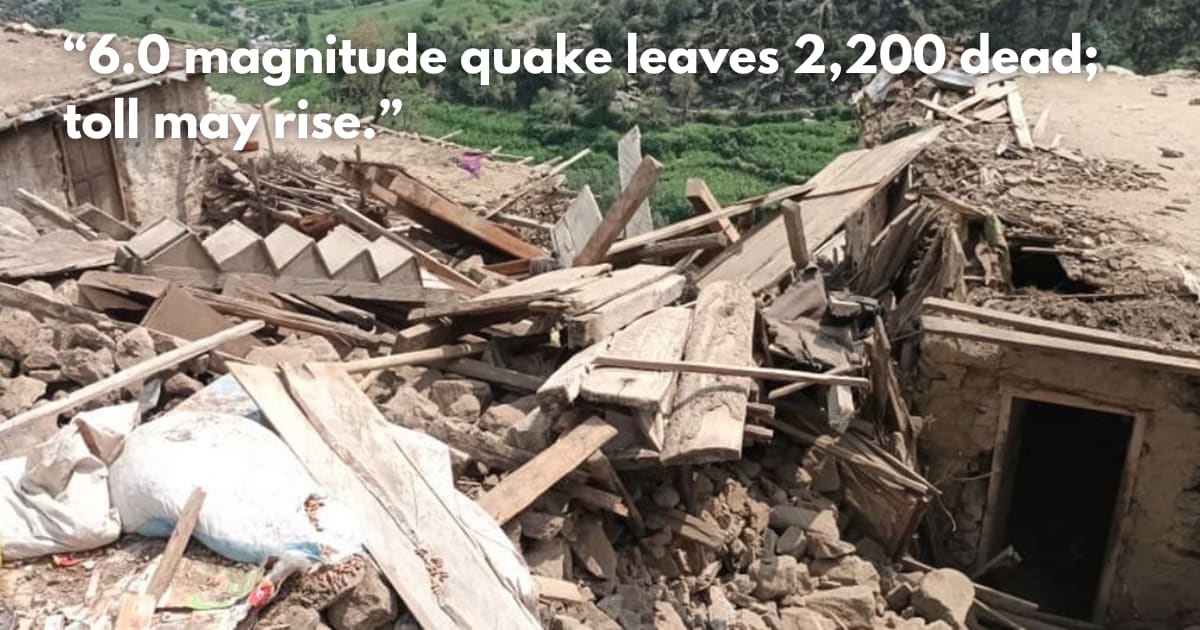


FazTimes Media, based in Kabul, Afghanistan, is once again facing a major natural disaster. The United Nations says a powerful earthquake hit the eastern parts of the country on August 31. It destroyed over 5,230 homes and damaged at least 672 more across 49 villages. The earthquake was measured at 6.0 on the Richter scale. It caused a lot of damage, killing at least 2,200 people and injuring thousands. Officials worry that more people could die as rescue teams try to reach difficult areas. The UN cautions that this disaster could potentially affect up to 500,000 people, with over half of them being children.
The disaster has cut off remote villages. Shannon O’Hara, who leads the UN’s humanitarian efforts in Afghanistan, said that rough land and broken roads are making it challenging for help to get through. "We have only checked a small part of the 441 villages that were hit," she said.
The roads to the affected areas are either broken or blocked by landslides, so many families can't get emergency supplies. Helicopters and donkeys are delivering aid in some places, but their progress is slow. "As reported by BBC News, a series of smaller earthquakes, from 5.2 to 5.6 on the Richter scale, have made people's situation even worse and have also put rescuers in danger while they work."
The earthquake has hit the eastern provinces, which are already poor, have shortages of food, and lack proper medical care. Rubble has buried many families, leaving survivors in the cold without shelter after they lost their homes. Aid workers have seen heartbreaking scenes: children looking for their parents, mothers crying for their lost children, and families staying together under temporary shelters as the nights get colder.
The UN reports that over 3,000 families have had to flee their homes. Due to the overwhelming number of injured individuals, local hospitals are facing significant challenges. Often, doctors are treating patients in open areas or under tarps because the buildings are unsafe.
Al Jazeera reports that years of fighting and reduced foreign help have severely damaged Afghanistan's healthcare system, leaving it barely able to cope. There is a shortage of medicines, doctors, and operational clinics. Families have to travel for long distances just to get medical help.
Struggles with Shelter and Food: Survival at Stake
With thousands of homes destroyed, finding shelter is the top priority for many people. Relief groups are trying to give out tents, blankets, and plastic tarps, but there isn’t enough to go around. Food is also in short supply. The earthquake not only damaged homes but also ruined stored food, animals, and farmland. In rural Afghanistan, where families depend on small harvests and animals for survival, the quake has taken away their main way of living.
The villager, who used to share bread and tea with their neighbours, now stands in long lines for a few packets of flour or a bottle of water. Many families are only eating once a day, according to aid workers. “As reported by Reuters, the World Food Programme has started flying supplies into hard-to-reach areas, but it will take weeks or even months to get aid to every affected family.”
Children Bear the Brunt: The Youngest Victims of Crisis
Children make up more than half of Afghanistan’s population, and they are once again the most at risk. Many have lost their parents or siblings in the earthquake, while others are now living in unsafe places where diseases could spread easily.
Psychologists say the trauma from surviving such a disaster, combined with being displaced, will affect these children for a long time. Without schools, places to play, and help from counsellors, it will be even harder for them to recover.
UNICEF, the UN’s children’s agency, has already sent teams to give out clean water, hygiene supplies, and emergency education. However, the need is much bigger than the resources available.
International Response: Aid, Promises, and Gaps
Around the world, people are starting to offer help. Pakistan has sent trucks filled with food, tents, and medical supplies. Humanitarian groups from Turkey, Qatar, and Iran have also offered support. The European Union has given €2 million in emergency money, and the US Agency for International Development (USAID) has promised quick aid. But aid workers say there’s still not enough to fully rebuild the broken villages.
According to The Guardian, one of the biggest problems is getting aid to people fast without facing delays from government processes or political issues. Since the Taliban took over in 2021, many foreign countries have cut back on direct help for Afghanistan, making it harder to get assistance.
Afghanistan is located on a big fault line where the Indian and Eurasian tectonic plates meet, which makes it very likely to experience earthquakes. In the past 20 years, thousands of Afghans have lost their lives in earthquakes, especially in the mountainous areas where the buildings are not strong enough.
This recent earthquake shows how little there is in the way of safe homes and disaster plans. Most of the houses in the affected areas were made of mud bricks, which break apart easily during shaking. Experts assert that without increased investment in safer housing and improved infrastructure, these tragedies will persist.
"The pattern is clear—earthquake after earthquake destroys Afghan villages because people have no choice but to live in weak homes," said a disaster expert in Kabul. The survivors are sharing their stories about how they made it through the disaster. A 10-year-old girl named Fatima was pulled from the rubble after being stuck for almost 20 hours. She told reporters she thought she would die. Her parents and brother did not survive.
In another village, a man named Rahmatullah said he lost 14 family members in the earthquake. "I dug with my hands until they bled. "I couldn’t save anyone," he cried. These stories show the deep sadness across the country. Funerals are happening every day, and mosques are full of people mourning. The graveyards are now full and have no more space.
Humanitarian groups are asking for quick help to provide shelter, food, water, and medical care. The UN has asked for $110 million to support the people affected by the earthquake. But experts say that just giving aid isn’t enough. There also needs to be long-term plans to rebuild stronger homes, better roads, and improved healthcare in earthquake-prone areas.
"As reported by BBC News, Afghanistan’s disaster is not just a natural event—it is also caused by human factors. Years of war, poor government, and not enough money spent on buildings have left Afghans at risk. If we don't address these issues, the people will remain vulnerable to future disasters."
Conclusion: A Humanitarian Test for the World
The earthquake on August 31 in Afghanistan shows how fragile the country is. Thousands of homes were destroyed, whole villages were flattened, and over half a million people were impacted, making the humanitarian situation worse.
As the world tries to send help, the strength and determination of ordinary Afghans are once again clear. However, for those trying to rebuild their lives from the ruins, aid is not enough. This disaster points to the need for better housing, stronger buildings, and healthcare systems that can handle big emergencies.
Currently, Afghanistan is grieving the loss of lives and hoping for help. More bodies will emerge from the wreckage in the coming days, revealing the true extent of this tragedy.
Our primary goals at FazTimes Media are to be accurate and confident and adhere to the highest journalistic standards. We check every news story we share against several trustworthy and separate sources to ensure its accuracy.
We have reviewed this report, along with articles from major news outlets worldwide, including BBC News, Reuters, Bloomberg, Al Jazeera, NDTV, The Economic Times, and The Indian Express.
We want to keep the highest standards in global journalism so that our readers can trust the information they acquire.


Discussion0
Join the conversation on this story
Loading comments...