
8.7 Magnitude Quake Off Russia Triggers Pacific Tsunami Alerts
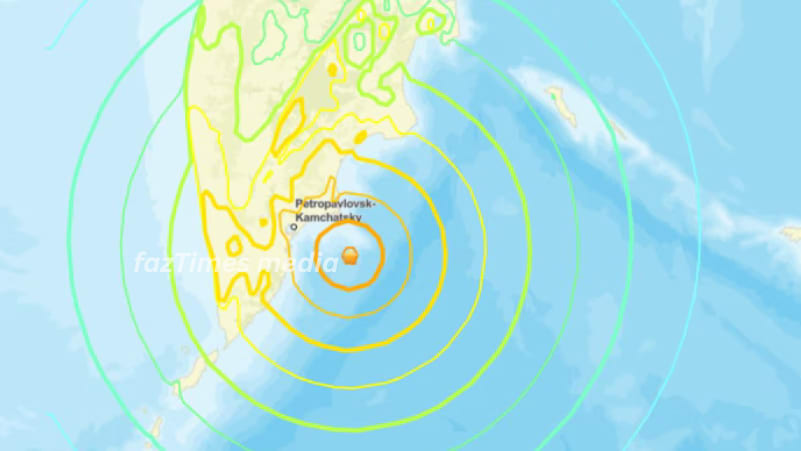
fazTimes media: A big earthquake shook Russia's Far East and caused waves across the Pacific. On July 30, a huge undersea quake measuring 8.7 (later changed to 8.8)hit about 120 km east of Petropavlovsk-Kamchatsky on the Kamchatka Peninsula. This strong and unusual earthquake led to tsunami warnings from Japan to Hawaii and emergency alerts in many coastal countries.
Kamchatka: A Place Where a Very Strong Earthquake Happened After Many Years
The United States Geological Survey (USGS) said the earthquake happened at a shallow depth of about 19 km—this makes a tsunami more likely. The governor of Kamchatka, Vladimir Solodov, called it “the strongest in many years.” He said some buildings were damaged, especially a kindergarten. A few people got small injuries, but no one died. People were told to leave Severo-Kurilsk because waves up to 4 meters (13 feet) came in and flooded the town.
Echoes of history remind us of a past disaster: the 1952 Severo-Kurilsk earthquake, which was estimated to be a magnitude 9.0 event. The earthquake caused giant waves, more than 9 meters high, that traveled to Hawaii and even back to the U.S. West Coast, according to Wikipedia. This event shows just how big the risk can be today.
Global Alerts: Japan, the U.S., Taiwan, and More Mobilize
Japan
The Japan Meteorological Agency sent urgent orders for people to leave coastal areas that are at high risk. They warned of waves that could be up to 3 meters tall. People were told to go to higher ground or safe places set up for emergencies. Some smaller tsunami waves, about 30 to 40 centimeters high, were already seen in parts of Hokkaido, including Kushiro Port.
United States
In Alaska, the National Tsunami Warning Center gave warnings for the Aleutian Islands, especially for places like Atka, Adak, and St. Paul. Paul and St. George. They also sent out advice for areas along the west coast of the U.S., from California to Washington. Hawaii was put under emergency watch. People were told to go inland right away.
Others
Similar warnings were also given in Taiwan, Indonesia, Australia, Peru, Chile, Canada, New Zealand, and Micronesia. This shows that many areas are worried, even though there are no reports of serious damage beyond Russia. No major damage has been reported so far, but people are still being careful. In Russia, the injuries are mostly small. Japan saw minor tsunami waves, and warnings in the U.S. and Hawaii were lowered or ended. However, officials are still watchful because more earthquakes and possible waves could happen.
Scientists say there could be bigger earthquakes up to 7.5 on the scale, and they might continue for weeks because the area near the Kuril-Kamchatka subduction zone is very active.
Why It Matters: Lessons for Coastal Communities
Preparedness Pays Off: Good early-warning systems in Japan and the U.S. stopped people from panicking and probably saved lives.
Experts Weigh In
Oceanographer Philip Liu from Texas A&M University said that even though Japan might not be hit as hard because of the direction of the waves, later surges are still dangerous, and people need to stay alert across the Pacific basin.
Local reporters in Kamchatka said there was a lot of water coming in and big floods in Severo-Kurilsk. This made the evacuations more urgent and showed that even communities far from where the main earthquake happened are still at risk.
At FazTimes, we prioritize accuracy, confidence, and strong journalistic standards. To ensure every news story we share is real, we verify it with multiple trustworthy and independent sources.
We’ve compared this report with coverage from major news outlets around the world, including BBC News, Reuters, Bloomberg, South China Morning Post, Al Jazeera, NDTV, The Economic Times, and The Indian Express.
Our dedication lies in upholding the highest standards in global journalism, ensuring our readers can trust the information they receive.


Discussion0
Join the conversation on this story
Loading comments...