
BrahMos Missile Draws Global Buyers: Asia to South America Interested
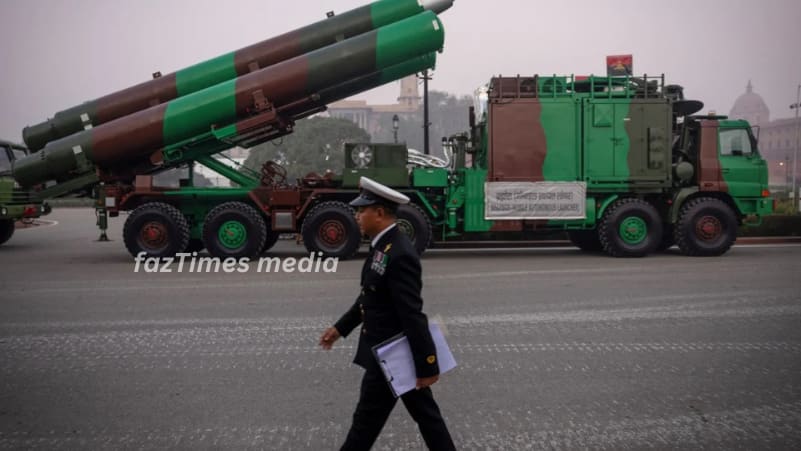
fazTimes media: India is becoming a bigger player in the global defense industry, as seen by the growing interest in the BrahMos missile system. This missile, one of the fastest supersonic cruise missiles in the world, is attracting attention from countries in Southeast Asia, the Gulf, and even Latin America. India used to depend a lot on buying weapons from other countries, but now it is becoming a reliable and trusted seller of military equipment.
What Makes BrahMos Special?
The BrahMos missile was created together by India’s Defence Research and Development Organisation (DRDO) and Russia’s NPO Mashinostroyenia. The BrahMos missile is renowned for its exceptional speed, accuracy, and versatility. It can be launched from land, from the sea, or from the air. It can fly at a speed of Mach 2.8, which is almost three times the speed of sound.
BrahMos perfectly fits the preferences of countries today, which favor reliable and ready-to-use systems over new or untested ones. Walter Ladwig, a senior lecturer in international relations at King’s College London, said, “BrahMos is a standout success. It’s a strong, high-speed missile with clear political advantages. If even a few of the reported deals move forward, it would be a big step for India’s ability to export military technology.”
India's position in the global arms trade is changing quickly. For many years, the country was one of the biggest buyers of weapons, relying on systems from Western and Russian countries to meet its military needs.
Real-Time Validation in Operation Sindoor
The moment that changed BrahMos' international standing was during Operation Sindoor, when the missile was used in actual combat situations. Growing international interest in India's defense capabilities isn't just talk. Recently, India opened a new BrahMos missile factory in Uttar Pradesh, built to fulfill rising foreign orders.
Several countries, including the Philippines, Vietnam, Indonesia, and some Gulf states, are either discussing deals or planning to buy the missiles.
Challenges: Policy, Marketing, and Public-Sector Control
Even though there has been some progress, experts say India's strategy for exporting arms still needs a lot of work. Kumar said, "A big part of India's export growth is coming from selling parts, not complete weapons systems.
Although BrahMos is a major success, India's defense exports need a wider range of products. While DRDO has done well in creating technology, there is not enough effort being made to sell these products on the international market.
Kumar also mentioned, "Indian defense representatives and trade officers should be more active in countries that are interested in buying. Private companies also need more support and encouragement to come up with new ideas and grow bigger."
India's defense exports hit a record high of ₹23,622 crore (about $2.76 billion) in the 2024–25 financial year, which is a 12% increase compared to the previous year. The exports include items like ammunition, weapon parts, and even advanced systems like the BrahMos missile.
Defense Minister Rajnath Singh shared the good news on social media, saying that India is making good progress toward its goal of reaching ₹50,000 crore (about $6 billion) in annual defense exports by 2029.
However, experts like Ladwig suggest that there is still a lot to do.
He said, “Although the BrahMos project has helped India become more recognized in the global arms market, the country still relies a lot on foreign technology for things like engines, electronics, and sensors.” India is also facing competition from more experienced countries like China and South Korea. China leads in producing a lot of low-cost weapons systems, while South Korea is known for making weapons that fit with NATO standards and has many big production deals with other countries. India's main advantage is its non-aligned position and focus on high-precision systems like the BrahMos missile.
What’s Next: Going Beyond BrahMos
The next step isn’t just about selling one successful weapon system but about becoming a center for joint defense development, training, and support after the sale.
“BrahMos shows what can be done,” said Ladwig. “But to keep progressing, India needs to provide more, both in terms of the types of products it offers and how reliable they are.”
Conclusion: India's Chance to Take the Lead
The BrahMos missile is more than just a weapon; it represents India's growing strategic wisdom and desire to innovate. And as the world watches, India appears ready not just to participate but to step forward as a leader.
At FazTimes, we prioritize accuracy, confidence, and strong journalistic standards. To ensure every news story we share is real, we verify it with multiple trustworthy and independent sources.
We’ve compared this report with coverage from major news outlets around the world, including BBC News, Reuters, Bloomberg, South China Morning Post, Al Jazeera, NDTV, The Economic Times, and The Indian Express.
Our dedication lies in upholding the highest standards in global journalism, ensuring our readers can trust the information they receive.





Discussion0
Join the conversation on this story
Loading comments...