
CEC Gyanesh Kumar's Defense on '0' House Numbers Questioned

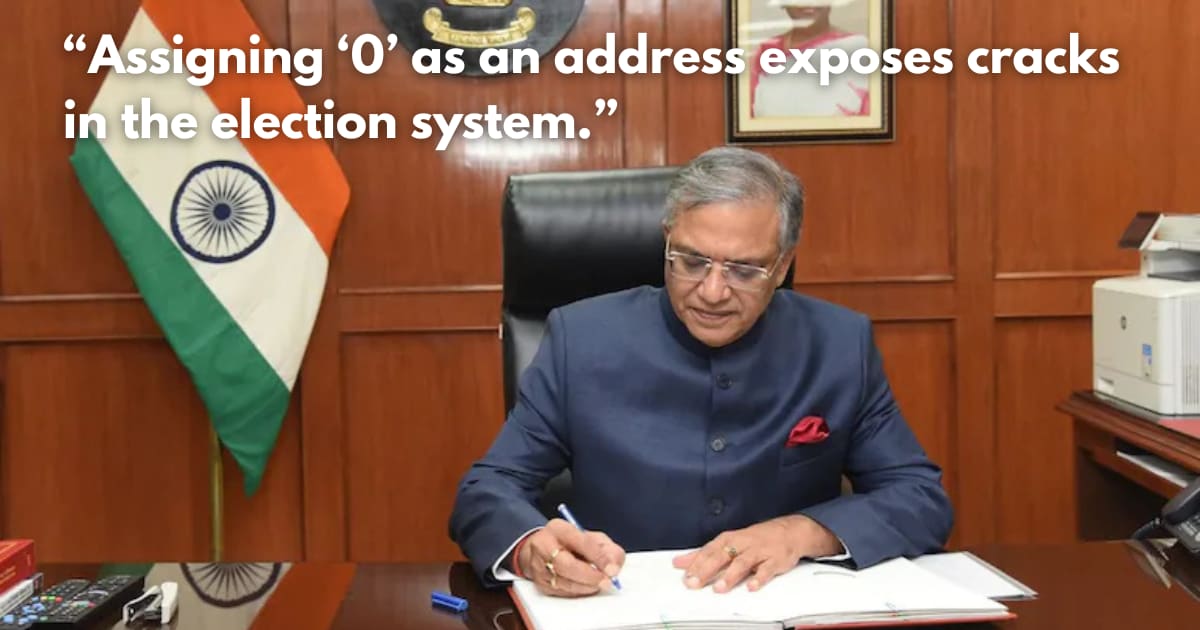


FazTimes Media, New Delhi – The issue of "zero" house numbers in Bihar’s voter lists is becoming more troubling, and even the explanation provided by the Election Commission of India (ECI) head, Gyanesh Kumar, hasn’t convinced the critics. Opposition leaders, civil society groups, and election experts think the problem is much worse than what is being said, and the finding raises concerns about the reliability of election records in a state that is crucial politically in India.
In a recent press meeting, Chief Election Commissioner (CEC) Gyanesh Kumar explained that the presence of many voters with house numbers marked as '0', '00', or '000' is not an error but a result of how local authorities handle addresses. He told reporters, as reported by The News Minute, that in the country, millions of people have a zero before their address because the local panchayat or municipality hasn’t given them a number yet.
He also said that in places like illegal colonies and informal settlements, people often don't have official house numbers. In such cases, temporary numbers are used. “The computer system accepts zero, so it is used temporarily,” he added.
However, independent reports, especially from Newslaundry, show a different situation. The publication found that at least 229,000 voters in Bihar had their house numbers listed as '0', '00', or '000' during the Special Intensive Revision (SIR). Opposition parties, led by Tejashwi Yadav of the RJD, have accused the ECI of mishandling voter data and possibly allowing for tampering.
Adding to the confusion, Bihar’s Deputy Chief Electoral Officer, Ashok Priyadarshi, provided a different explanation. When asked by Newslaundry, he said that many voters often leave the house number blank when applying to register. But the system automatically fills in 0 as a default. “This is later fixed by Booth Level Officers (BLOs) during on-the-ground checks, who update the correct addresses,” he explained.
This explanation conflicts with what Gyanesh Kumar had said earlier, causing more uncertainty about whether the error is a widespread mistake or an overlooked flaw in the process.
Former Chief Election Commissioner S.Y. Quraishi has also spoken about the problem. He told the media, “I’ve never seen any voter with a house number zero. Even for homeless people, the address should be specific—for example, if someone sleeps outside a shop, the shop’s address is used.” He believes that having so many ‘0’ entries suggests more than just one mistake, but possibly several errors in the voter list.
Why This Matters for Bihar
Bihar has very competitive elections, where even small issues in voter records can affect the outcome in closely contested areas. As BBC News reported, trust in elections is essential for democracy. Any doubt about the accuracy of voter lists can shake public confidence.
Political analysts are worried that the “zero house number” issue could become a big problem before the next elections. The Rashtriya Janata Dal (RJD) has already used this as a point against the Election Commission of India (ECI). Tejashwi Yadav accused the ECI of not stopping these irregularities. “How can hundreds of thousands of voters live in houses with number zero? Such behaviour shows negligence and raises questions about whether the elections are fair,” he said in a recent press conference.
On the other hand, the ruling JD(U)-BJP alliance has not responded directly to the issue. Some people suggest they would rather not give the opposition more fuel for their claims of poor administration.
A large problem with data accuracy
Al Jazeera reports that India's voter lists have always had problems. These issues include the presence of repeated names, the inclusion of deceased individuals as active voters, and the absence of certain names. The situation in Bihar is now considered a new example of how these profound system issues are not being fixed, even after many promises of improvements.
Sanjay Kumar, an election expert from the Centre for the Study of Developing Societies (CSDS), said, "The problem with house numbers isn't just about the numbers. It shows how seriously the election commission takes its job of being transparent. If the explanation from the Chief Election Commissioner doesn't match what the state officials are saying, it shows there's a lack of teamwork and responsibility."
People on the ground in Bihar are also upset. Many found out about the problem only when they checked their voter ID online. Rani Devi, who lives in Patna, says, "My husband and I live in the same house, but his voter ID says '0' for the house number, while mine has the right address. How can such an incident happen? Will such an error confuse us when we go to vote?"
Similar stories are coming from several districts like Gaya, Muzaffarpur, and Darbhanga. Local activists say the issue is not just tech; it complicates voter verification and can be misused.
Demands for More Transparency
Civil society groups are now asking the Election Commission to provide a breakdown of 'zero house number' entries by district and explain how many of these have been fixed through BLO verification. Without this information, critics say, it will be difficult to understand the extent of the problem.
Some activists have even called for an independent audit of voter lists in Bihar, especially in areas where there are many mistakes. “The honesty of elections is crucial. If people lose trust, then the base of democracy is in danger,” said Jagdeep Chhokar from the Association for Democratic Reforms (ADR).
What's Next?
Although Gyanesh Kumar is trying to make the situation seem normal, it's not going away soon. As reported by BBC News, India’s Election Commission has usually been praised for handling large elections, but cases like the one at hand show the need for more accurate digital records, better training for BLOs, and stricter checks.
For millions of Bihar voters, the question is clear: if their house number can be wrong, how can they trust the system to protect their vote?
Our primary goals at FazTimes Media are to be accurate and confident and adhere to the highest journalistic standards. We check every news story we share against several trustworthy and separate sources to ensure its accuracy.
We have reviewed this report, along with articles from major news outlets worldwide, including BBC News, Reuters, Bloomberg, Al Jazeera, NDTV, The Economic Times, and The Indian Express.
We want to keep the highest standards in global journalism so that our readers can trust the information they acquire.


Discussion0
Join the conversation on this story
Loading comments...