
General
China Commissions Fujian: 3rd Aircraft Carrier with Electromagnetic Catapults
By Mohamed Areif Mubarack
Published: Nov 07, 2025, 09:05 AM
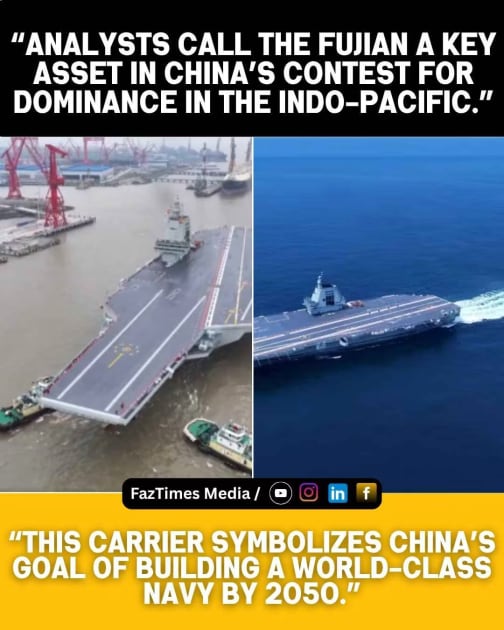
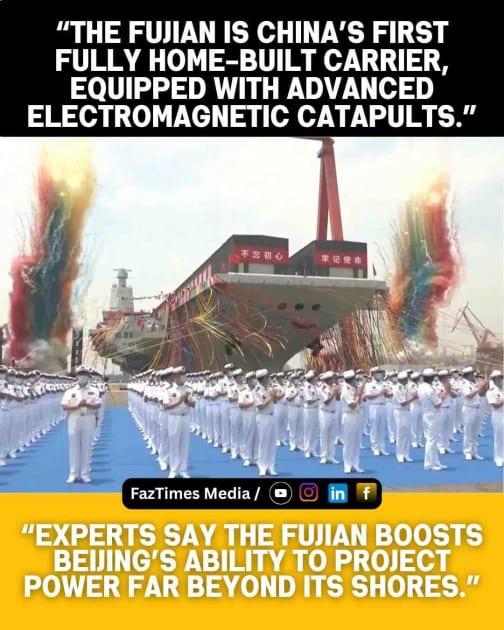

FazTimes Media, China, Nov 07: After many years of testing, making changes, and conducting trials, Beijing has officially launched its newest and most advanced aircraft carrier, the Fujian. This marks a major shift for the world's largest navy. The ceremony for the launch took place this week in Sanya, a city on the southern coast of Hainan province, and was attended by President Xi Jinping himself—showing how important this ship is to China's military plans for the future.
According to Chinese state media, the event had over 2,000 people attending, including navy officers, ship designers, and high-ranking officials who were involved in building this huge ship. Fujian's service not only makes China's military presence stronger around the world but also shows the country's growing confidence in its own technology and shipbuilding skills.
Read more news on our Faztimes media platform: Click on this Trending news
Unlike the Liaoning and the Shandong, which were based on designs from the Soviet era, the Fujian is completely made in China. Experts say it represents a big technological breakthrough that places China's military engineers on par with those of the top naval powers.
The Fujian weighs 80,000 tons and is special because it uses electromagnetic catapults, a technology that was only on the U.S. Navy's Ford-class carriers. This allows the Fujian to launch heavier and more modern fighter jets with more speed and accuracy than older carriers that use ramps.
By replacing the older "ski-jump" launch systems used on its previous carriers, the Fujian greatly improves China's ability to operate aircraft.
This change allows more planes to take off in less time and with heavier loads, which means the ship is more ready for battle and can be used in more different ways.
During multiple tests at sea, the Chinese navy showed off some of its newest and most advanced airplanes that can operate from the deck of the Fujian. One of these planes is the stealthy J-35 fighter, which is designed to perform similarly to the American F-35. It was seen taking off from the ship using a new type of catapult system. China also tested the KJ-600 early-warning aircraft, which acts as the fleet’s “eye in the sky,” and improved versions of the J-15 fighter jets.
Together, these advanced planes let the Fujian work more on its own and be more effective than earlier carriers. In the past, Chinese carriers like the Liaoning had a big problem—they relied on radar and other support from land, which made it hard for them to stay active far from home.
Greg Poling, a well-known expert on maritime security at the Center for Strategic and International Studies, put it this way: “A carrier like the Fujian isn’t made to control areas close to shore; it’s built to project power. It’s about competing with the United States in deeper waters.”
This increase in Chinese naval power is challenging long-standing rules in the Pacific. As Beijing keeps improving its military, it shows a clear plan—to move from a regional power focused on protecting its coast to a global force able to operate far out at sea.
When President Xi Jinping visited the Fujian aircraft carrier recently, it wasn’t just a symbolic event. It showed a bigger plan: to build a top-tier military by 2050. Under his leadership, China’s armed forces have gone through major changes—reducing the number of ground troops while focusing a lot on naval technology, space defense, cyber abilities, and artificial intelligence.
The Fujian fits into this plan. It shows China is moving closer to having a “blue-water navy”—a navy that can operate far from its home bases around the world.
While many recognize China’s progress, they also say it will take a long time to catch up to the U.S. Navy. The U.S. currently has eleven active aircraft carriers, all experienced and part of a worldwide command system. The Fujian, even with its promise, still needs years of training, logistics setup, and practice before it can match the U.S. in real combat readiness.
As retired U.S. Navy officer Mark Montgomery said in a recent interview, “Designing and launching a ship is one thing. Building a fully prepared carrier group that can fight, refuel, and work with other forces across the world—that’s a completely different challenge.”
Beyond politics, Fujian’s launch also shows how much China’s shipbuilding industry has grown. It’s now the biggest in the world, making not just warships but also large commercial ships in huge amounts. This steady growth shows how closely China’s civilian and military sectors work together under its “military-civil fusion” policy.
News reports and state media have praised it as a victory for Chinese science and effort—a moment that brings people together at a time when the country is facing economic and diplomatic challenges.
One editorial in People’s Daily said, “This ship carries the spirit of China’s revival. It shows the country’s resolve to protect peace through strength.”
Even though there's a lot of pride about Fujian's first appearance, people around the world also point out some risks.
FazTimes Media has been providing you with unique and standard breaking news related to general, business, sports, entertainment, politics, and more.
Reference: Read more details on this portal, Al Jazeera.
Link:
https://www.faztimesmedia.com/viewpost/china-commissions-fujian-3rd-aircraft-carrier-with-electromagnetic-catapults


Discussion0
Join the conversation on this story
Loading comments...