
China Develops Mosquito-Sized Microdrone for Covert Military Ops
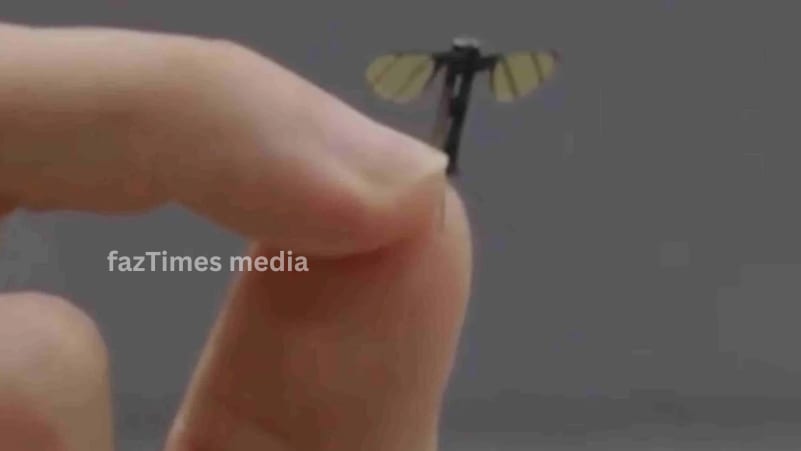
fazTimes media: In a calm lab in China’s Hunan area, a little gadget that might alter the long-term future of fighting is taking flight, very literally. Analysts at the National College of Defense Innovation (NUDT) have presented a mosquito-sized microdrone, an exceptional accomplishment in smaller-than-expected mechanical technology planned for mystery military missions.
Even though its wings vacillate like an insect’s and its body is smaller than a fingernail, the suggestions of this headway are critical. With innovation this unobtrusive and capable, the hole between science fiction and reality proceeds to limit, capturing worldwide attention.
A look into the long-term
In a later broadcast by CCTV-7, China’s military TV channel, youthful analyst Liang Hexiang from NUDT is shown with a little rattle between his fingers. “Miniature bionic robots like this one are particularly suited for data gathering and uncommon missions on the battlefield,” he said.
The ramble, taking after a mosquito with leaf-like wings and fragile legs, was one of a few microbots that appeared within the portion. Other cases included insect-like models and smartphone-operated flying robots, each pushing the limits of small-scale flight. To somebody untrained, it could appear like an oddity. But for defense examiners and tech analysts, it signals that the worldwide arms race in manufactured insights and micro-robotics is entering an unused and more tactful phase.
How Do They Work?
Making something so small and useful is challenging. These microdrones result from collaboration over areas like bionics, materials science, and micro-electromechanical systems (MEMS) building. Each portion, from the wings and battery to the sensors and transmitters, must fit into an inconceivably tight space.
According to CCTV’s report, the drone’s estimate empowers it to conduct “covert data reconnaissance,” basically spying without being seen. Its plan imitates a standard creepy crawly, making it troublesome to identify outwardly or on radar.
In spite of the fact that it is not outfitted like bigger UAVs, its part remains significant: collecting information, recording enemy positions, and mapping situations precisely. It can enter rooms, float close to windows, and tune in or observe without drawing attention.
Not the Primary, But Possibly the most progressed.
Microdrones are currently on display in the military field. The U.S.-made Dark Hornet, created in Norway, is utilized by NATO powers for reconnaissance. Almost the size of a human thumb, the Dark Hornet gives real-time video bolsters and information to troopers in the field. The most recent form, the Dark Hornet 4, offers longer battery life and has made strides in climate resistance, tending to a few common challenges in micro-UAV plans.
Indeed, in the scholarly community, such innovation isn't modern. Harvard University’s RoboBee venture, for instance, picked up attention a long time ago for its bee-inspired robots that can roost on surfaces utilizing passive power and indeed swim submerged. Be that as it may, China’s most up-to-date creation takes a step forward. At, as it were, the estimate of a mosquito, it may be the littlest operational military-grade ramble ever created.
Why Ought We to Care in South Asia?
For perusers in South Asia, this progression might appear like a high-tech detail within the broader story of military modernization. However, it has genuine and nearby suggestions. South Asia is domestic to a few nuclear-armed countries, border pressures, and thickly populated urban zones. The presentation of insect-sized reconnaissance rambles raises issues of almost protection, secret activities, and topsy-turvy fighting.
“What happens when such rambles are sent along the LoC (Line of Control) or interior swarmed cities?” inquired Dr. Rakesh Mehta, a defense examiner from Modern Delhi. “They seem to screen troop developments, invade government buildings, or indeed spy on key decision-makers unnoticed.” Pakistan, India, and other territorial powers are likely checking this improvement closely and may investigate their forms of such innovation.
Civilian and Commercial Conceivable Outcomes
Whereas military employments are concerning, there’s a confident side. Micro-robotics isn’t a fair defense in space. Therapeutic analysts are creating small-scale and nanorobots for diagnostics, focused on medication delivery and, indeed, negligibly invasive surgery. In farming, microdrones may help in pollinating crops, assessing plants, or observing soil well-being. Natural researchers might utilize them to track natural life or consider discussing quality in inaccessible, perilous regions.
As Dr. Priya Nandan, a mechanical technology analyst in Bengaluru, clarifies, “What starts in defense labs frequently finds its way into civilian life. As far as GPS and the web did, these little robots may soon help us in well-being care, farming, and crisis response.”
The Moral Talk About: How Little Is As Well Little?
Like every modern innovation, moral concerns emerge. The most stressful part is observation. These microdrones can enter ranges where bigger rambles or cameras might not fit. They might abuse security, collect insights, or meddle in political exercises.
“Imagine not knowing in case the fly on your divider could be a genuine creepy crawly or a spy drone,” said Amina Qureshi, a protection advocate from Karachi. “It sounds like a motion picture, but we’re closer to that reality than we think.” Without strict directions and oversight, such advances seem to be effectively abused by governments, enterprises, or indeed criminal groups.
The Worldwide Arms Race Gets Littler
With nations like China, the U.S., and Norway driving the microdrone advancement, other countries are likely to join in. The U.S. Discuss Constrain has indicated comparable progressions, in spite of the fact that few subtle elements are available.
India’s Defense Research and Development Organization (DRDO) is additionally supposedly working on swarm drones and lightweight UAVs. As microbotics advances, strong competition in this field is anticipated. It’s not who has the greatest bombs or the quickest planes; it’s almost who can make the littlest, most astute machines.
Last Considerations: A Monster Jump for Minor Tech
The disclosure of a mosquito-sized ramble by Chinese military analysts isn’t just a mechanical oddity; it marks a turning point for the end of fighting and observation. For a locale as tense and deliberately critical as South Asia, this advancement merits consideration.
Whether this innovation leads to superior cultivation, improved well-being care, or more intrusive spying depends totally on worldwide choices with respect to its utilization. One thing is obvious: the age of scaled-down mechanical technology has started, and its effect expands past the mechanical; it’s moreover geopolitical.
Remain tuned to fazTimes media for more nitty-gritty scope of developing innovation and worldwide defense patterns.



Discussion0
Join the conversation on this story
Loading comments...