
General
China Slams Australia's "Cover-up" of South China Sea Airspace Incursion
By Mohamed Areif Mubarack
Published: Oct 22, 2025, 07:03 AM

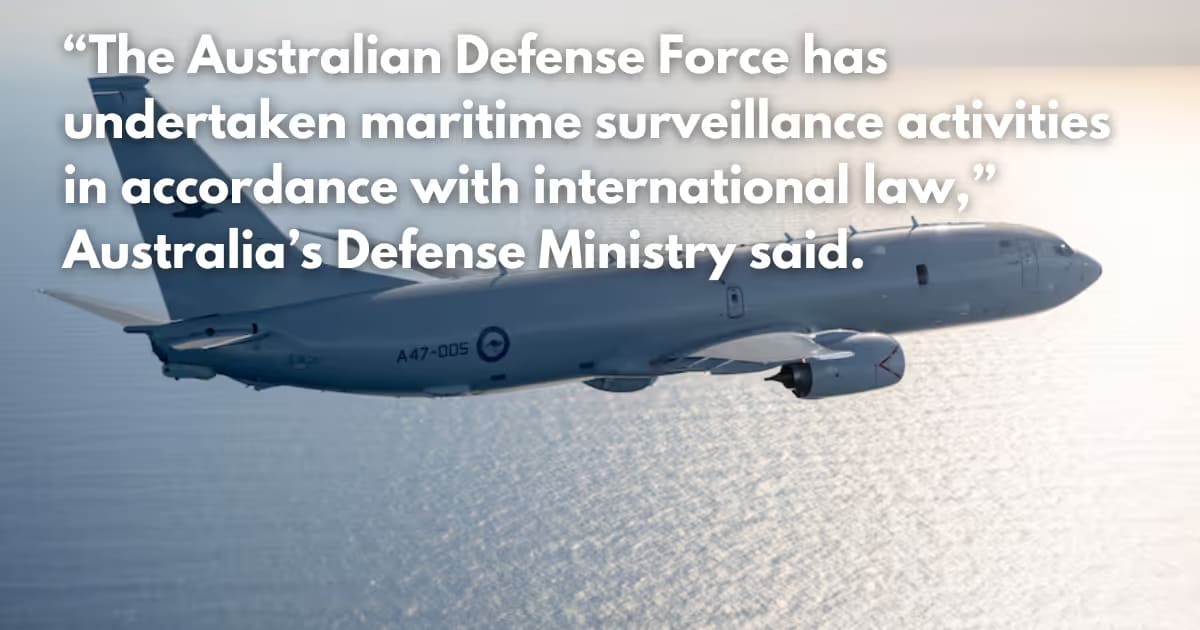


FazTimes Media, Beijing, 22 Oct: A new diplomatic flashpoint has emerged between China and Australia after Beijing accused Canberra of covering up what it called an “illegal airspace intrusion” over the disputed South China Sea, intensifying already fraught regional relations.
On Tuesday, China’s Ministry of National Defense said it had lodged a “solemn complaint” with the Australian government, accusing the Royal Australian Air Force (RAAF) of violating Chinese airspace.
Ministry spokesperson Jiang Bin told reporters in Beijing that the Australian aircraft “illegally entered airspace over China’s Xisha Islands”—Beijing’s name for the Paracel Islands—during a maritime operation earlier this week. “Australia’s actions were dangerous, provocative, and a serious violation of China’s sovereignty,” Jiang said. “We urge Australia to restrain its frontline forces and stop such reckless behavior that damages mutual trust.”
The accusation came just a day after Australia’s Department of Defense issued a statement describing a tense mid-air encounter on Sunday.
Canberra said its P-8A Poseidon aircraft was conducting “routine maritime surveillance operations” in accordance with international law when the incident occurred. “For decades, the Australian Defense Force has operated safely and professionally in the region,” the statement read, adding that the crew’s safety was briefly jeopardized by China’s “unsafe” maneuvers.
While Australia did not reveal the exact location of the encounter, Beijing maintains it occurred over the Paracel Islands, a strategically vital chain claimed by China, Vietnam, and Taiwan.
The Paracel Islands, which are about 320 kilometers southeast of China's Hainan Island, have long been a source of conflict in maritime disputes in the region. China has turned some of the reefs and atolls into military bases in the last few years, putting in radar systems, runways, and missile batteries, even though other countries in the area have protested.
Jiang Bin dismissed Canberra’s claims as “deliberate distortion” intended to mislead the public and mask Australia’s military trespass. “The Australian aircraft not only entered Chinese airspace without authorization but also took provocative actions,” Jiang said. “Its attempt to portray China as the aggressor is a cover-up of its own misconduct.”
He added that Beijing had “issued strong representations” through diplomatic channels and demanded that Australia halt “provocative military reconnaissance” near Chinese territory.
The Chinese spokesperson also warned that such incidents could “undermine the foundation of bilateral cooperation” between Beijing and Canberra, which have only recently sought to stabilize relations following years of political and trade tensions.
The two countries have accused each other of military actions in the South China Sea before. In February 2025, there was a similar standoff when Australia said that a Chinese warplane used radar targeting against one of its surveillance planes. Beijing denied this.
As Australia strengthens its security ties with the United States through the AUKUS pact, which also includes the United Kingdom, analysts say the most recent incident is part of a larger pattern of strategic rivalry. The goal of the alliance is to balance out China's growing military presence in the Indo-Pacific.
China says it owns almost 90% of the South China Sea and uses old maps to back up its claim to what it calls the "nine-dash line." But in 2016, an international court in The Hague said that Beijing's broad claims had no legal basis. China still disagrees with this decision.
The waterway is one of the busiest shipping lanes in the world, moving more than $3 trillion worth of trade each year. It is also thought to have large amounts of oil, gas, and marine resources, which makes it a target for competing geopolitical goals.
Vietnam, the Philippines, Malaysia, and Brunei are just a few of the Southeast Asian countries that have overlapping claims to land. In the last few months, both the U.S. and Australia have sent more patrols and freedom-of-navigation missions to the area, saying they are protecting the idea of open seas.
Beijing, however, views these patrols as foreign interference. “Australia’s so-called ‘surveillance missions’ are nothing more than coordinated provocations with the United States,” said Chinese military commentator Zhao Long, speaking to state broadcaster CCTV. “They are testing China’s patience and sovereignty.”
The latest tensions coincided with Australian Prime Minister Anthony Albanese’s visit to Washington, where he met U.S. President Donald Trump on Monday. The two leaders signed a new agreement for Australia to supply rare earth minerals to the United States—a move analysts say is aimed at reducing dependence on China, which dominates the global supply chain for critical minerals.
Trump praised the partnership as a “strategic win” for both nations, telling reporters, “The submarines that we’re building with Australia are moving along faster than ever.”
The remark referred to the AUKUS nuclear submarine deal, under which Australia will acquire at least three Virginia-class nuclear-powered submarines from the U.S. The plan, initially brokered under former President Joe Biden, has faced scrutiny over cost and regional stability concerns.
In Beijing, the Chinese Foreign Ministry condemned the deal once again, calling it a step toward “bloc confrontation and nuclear proliferation.” Foreign Ministry spokesperson Guo Jiakun said on Tuesday that China “firmly opposes actions that intensify the arms race in Asia and create instability under the guise of security cooperation.”
The latest accusations have cast a shadow over the fragile diplomatic thaw between Beijing and Canberra. Relations had only begun to improve after years of economic boycotts, trade restrictions, and diplomatic silence following Australia’s 2020 call for an independent investigation into the origins of COVID-19.
Experts fear that renewed military friction could derail progress. “This incident will test the limits of China-Australia rapprochement,” said Dr. Mei Ling, an Asia-Pacific security researcher at the University of Sydney.
Source: Al Jazeera – China accuses Australia of covering up South China Sea airspace incursion
By FazTimes Media
This article is an original rewrite created for journalistic and educational purposes based on publicly available reports. It adheres to Google AdSense and News content quality standards for originality, accuracy, and neutrality.
Link:
https://www.faztimesmedia.com/viewpost/china-slams-australias-cover-up-of-south-china-sea-airspace-incursion


Discussion0
Join the conversation on this story
Loading comments...