



Egg Prices Rise 40%: Is Ethanol Making India’s Breakfast Costlier?
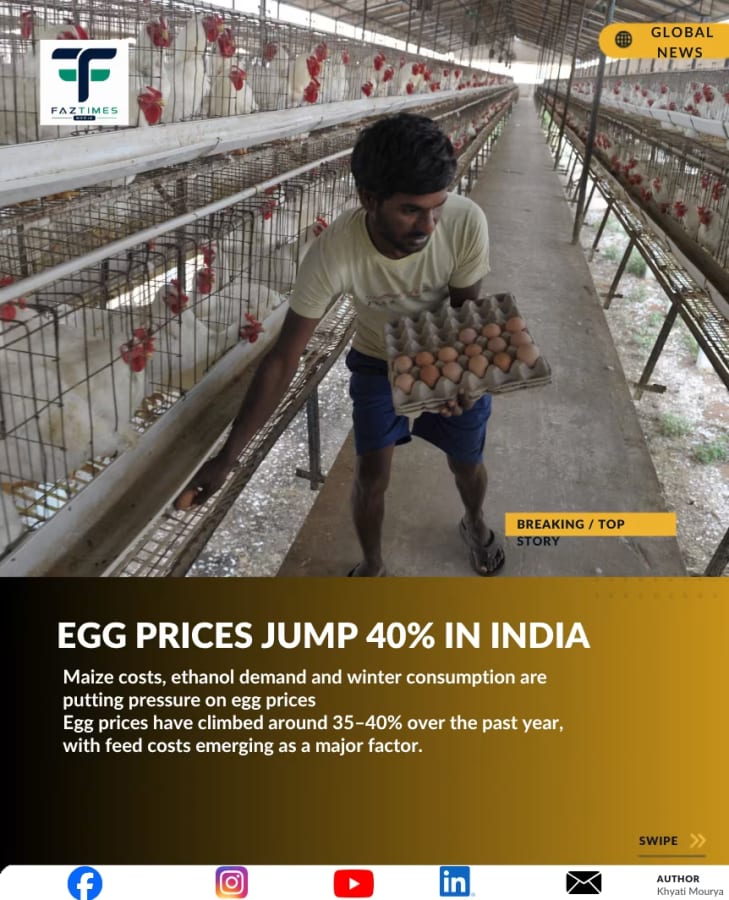
Egg prices in India have climbed around 35–40% over the past year, with farm-gate prices around ₹7 and retail prices reaching ₹8.50–₹9 per egg. With winter demand expected to increase, poultry farmers are facing fresh pressure from rising feed costs, particularly the cost of maize.
The price rise is not simply about eggs. It reflects a growing competition for maize between food production and ethanol.
FazTimes Insights
Why Are Eggs Getting Costlier?
The latest increase is closely linked to the cost of poultry feed. Maize is one of the main energy sources in chicken feed, and higher maize prices raise the cost of producing eggs.
Industry estimates suggest feed accounts for roughly 65–70% of egg production costs, making poultry prices highly sensitive to changes in maize and other feed ingredients.
The Ethanol Connection
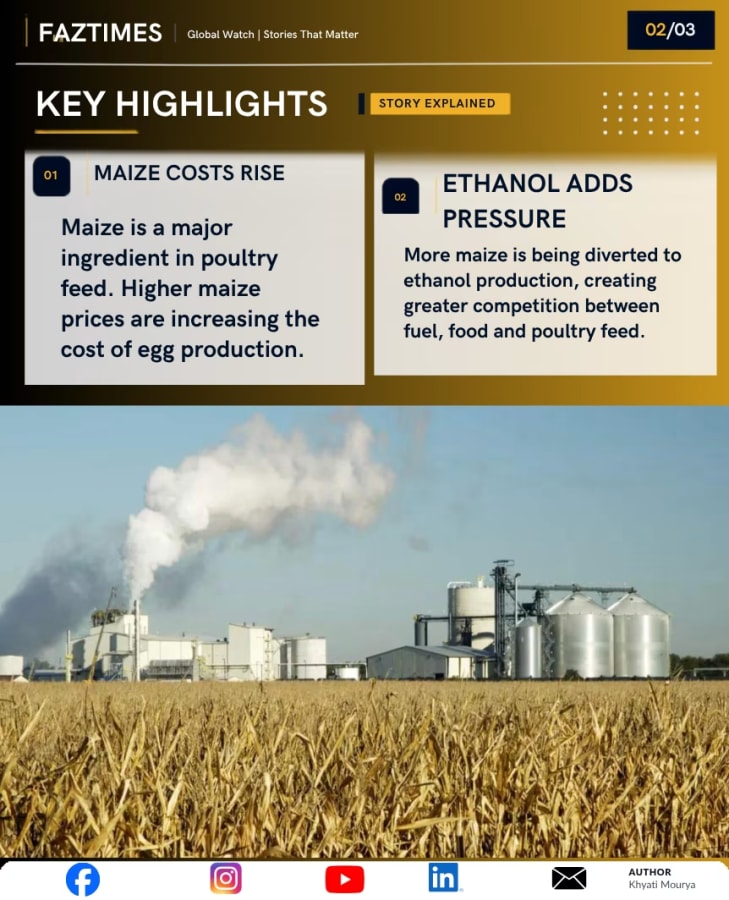
India has increasingly been using maize for ethanol production as the country expands its ethanol-blending programme.Government data cited by India Today shows that maize utilisation for ethanol rose from 8.3 lakh tonnes to 125.75 lakh tonnes between ESY 2022–23 and ESY 2024–25, a more than 15-fold increase. An allocation of about 125.78 lakh tonnes was also cited for ESY 2025–26, although actual utilisation can differ from allocations.
This creates a new source of demand for maize.More maize going to ethanol means poultry feed producers are competing for the same crop. If production does not increase quickly enough to meet both demands, feed costs can rise.
What Is Happening to Maize Prices?
Recent market prices have been reported at around ₹2,300–₹2,645 per quintal, although prices vary considerably between markets. Business Today also reported maize prices around ₹26,500 per tonne, compared with roughly ₹14,000 three years ago.
For poultry farmers, this increase directly affects operating costs.
Winter Could Add More Pressure
The timing is important.Egg consumption normally increases during the colder months as household, hotel and restaurant demand strengthens. If feed prices remain elevated while demand rises, egg prices could face additional upward pressure.
That does not necessarily mean prices will continue rising at the same pace, but the poultry industry is entering a period where both cost and demand pressures could work in the same direction.
Is Ethanol the Only Reason?
No.
It would be too simplistic to blame the entire increase in egg prices on ethanol.Maize prices are also influenced by crop production, weather, market arrivals, storage, imports and exports. Soybean meal, another important poultry-feed component, can also affect production costs. Egg prices are influenced by flock sizes, disease conditions, regional supply and seasonal demand.
So the ethanol programme is better understood as an additional source of maize demand, rather than the sole explanation for the price increase.
India Is Producing More Eggs Too
India's egg production has continued to grow. Production reached a record 149.11 billion eggs in 2024–25, although the rate of growth has slowed compared with earlier years.The challenge is therefore not simply producing more eggs. Farmers also need affordable and reliable access to feed.
The Bigger Picture
The egg-price story highlights a larger policy challenge for India.Maize has to serve several competing needs: food, animal feed and biofuel production. India's ethanol programme can support energy security and reduce dependence on fossil fuels, but greater demand for maize can also affect industries that depend heavily on the crop.
The key question is whether India's maize production can expand fast enough to satisfy all these markets without putting excessive pressure on food and feed prices.
The Bottom Line
Egg prices have risen around 35–40% over the past year, with rising maize costs emerging as an important factor. The growing use of maize for ethanol is adding competition for poultry feed, while winter demand could create further pressure. But ethanol is not the only factor: production, weather, feed costs and seasonal demand will also determine where egg prices go next.
FAQs
Q. Why have egg prices increased in India?
Higher poultry-feed costs, particularly maize prices, are an important factor. Seasonal demand and other supply conditions are also influencing prices.
Q. How much have egg prices increased?
Prices have risen by around 35–40% over the past year. Farm-gate prices are around ₹7 per egg, while retail prices have reached roughly ₹8.50–₹9.
Q. How does ethanol production affect egg prices?
Maize is an important poultry-feed ingredient. As more maize is used for ethanol, poultry producers face greater competition for the crop, which can increase feed costs.
Q. Will egg prices rise further in winter?
There is a possibility. Egg demand generally strengthens during winter, and industry experts expect additional pressure if feed costs remain high.
Q. Is ethanol responsible for the entire egg-price increase?
No. Maize production, weather, market supply, soybean prices, poultry flock sizes and seasonal demand can all influence egg prices.
Q. Why is maize important for poultry?
Maize provides a major source of energy in poultry feed. Because feed represents a large portion of egg-production costs, changes in maize prices can quickly affect poultry economics.


Discussion0 comments
Join the conversation on this story
Loading comments…