
General
Historic Expat Vote: Can Bangladesh's Diaspora Sway the 2026 General Election?
By Mohamed Areif Mubarack
Published: Oct 28, 2025, 09:36 AM
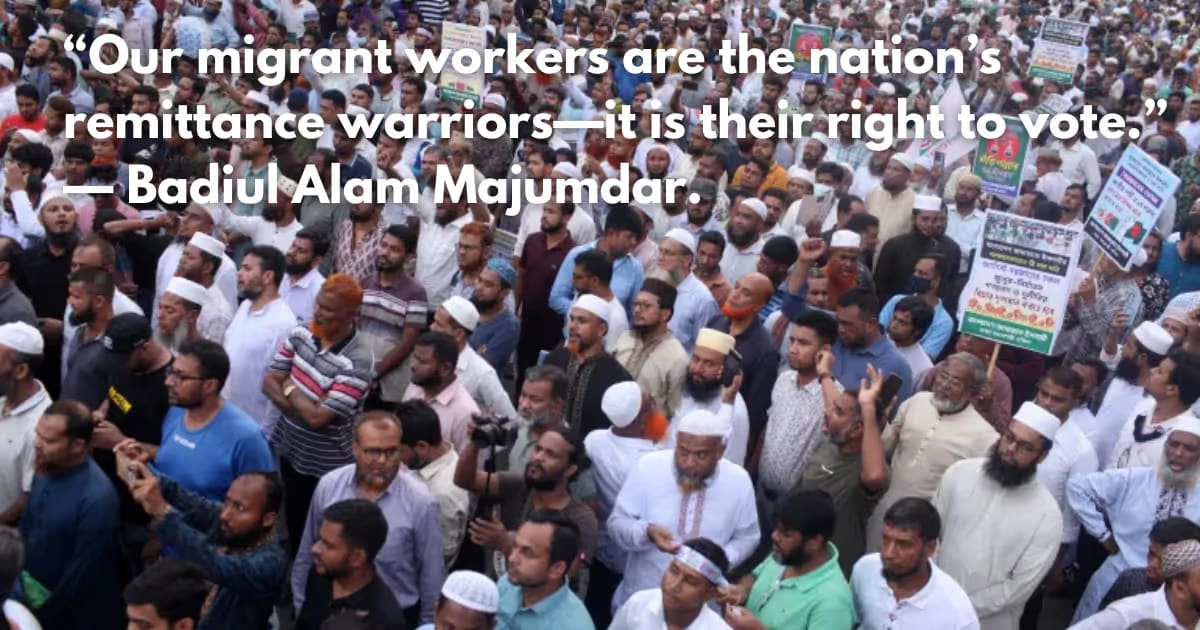


FazTimes Media, Dhaka, Bangladesh — For the first time in the country’s history, the vast community of Bangladeshi expatriates—including migrant workers in the Gulf, Europe, Southeast Asia, and beyond—is poised to participate in the national election. With estimates of around 15 million citizens living overseas, this group now represents more than 10 percent of the total electorate, presenting a potentially game-changing influence on what’s set to be one of Bangladesh’s most important polls.
The Election Commission of Bangladesh (EC) has introduced a suite of reforms to allow this group to vote via postal ballots, with the backing of a new mobile application for overseas voters. This action coincides with significant changes in the government that began when students took control in 2024, leading to the end of the previous leadership.
But even though things are slowly improving, there are still big challenges to deal with. The question many voters and analysts ask is, will overseas Bangladeshis really have the power to sway next year’s election—and will the system be credible enough to let them do so?
The interim government has already announced parliamentary elections for February 2026, promising to restore electoral integrity after years of what many observers describe as flawed processes. The framework portrays allowing overseas residents to vote as a cornerstone of democracy.
With this electoral group now formally recognized, political parties are having to prepare for a new front of campaigning and voter outreach—one that spans continents rather than districts.
Under the reforms, expatriate Bangladeshis will register via an online or mobile-app platform, linking their National ID to the system, after which they will receive postal ballots at their overseas address. The ballots will be returned in sealed envelopes, tracked via QR codes to ensure delivery and authenticity.
The EC documents show that postal ballots are targeted to be dispatched to overseas voters by early January, with registration to begin in November. The commission is also evaluating hybrid methods—including proxy voting and online ballots—but for this cycle, postal voting is the primary instrument.
Officials say embassies will not manage the ballots themselves; instead, they will be sent directly to a local returning officer in Bangladesh. The EC aims to monitor each step to guard against tampering and fraud.
While the constitution does not explicitly forbid expatriate voting, past legislation linked to residency requirements effectively prevented overseas citizens from voting in national elections. The 2009 Electoral Rolls Act recognized citizens abroad as residents of their last home constituency, but in practice, the voting infrastructure for them never existed.
Civil-society advocates say this moment has been decades in the making. “Over 15 million Bangladeshis living abroad remain largely disenfranchised despite being integral to the country’s economy and development narrative,” one policy brief observed.
Analysts agree with this view. In tight races, especially in areas where many people have moved away, adding votes from overseas could change the outcome. A political expert said that people living abroad are usually well-informed, have excellent finances, and stay connected to their home areas—so their vote is more than just a formality.
Since Bangladesh uses a first-past-the-post voting system, even a small number of votes in a closely contested area can decide the winner.
There are problems ahead, even though things look good. It is very difficult to send and collect postal ballots in different places. In a politically charged election like this one, making sure everything is legal and open will take a lot of planning. The European Commission has acknowledged the difficulty of the task and the possibility of not fully implementing it in all countries in a single cycle.
Another concern is whether overseas voters will actually turn out. Even when mechanisms are available, diaspora turnout globally tends to be lower than domestic turnout. It will be very important to ensure that people know about it, trust it, and can use it without any problems.
Another danger is false information. People from Bangladesh who live abroad use social media and other global media, so they might hear different stories. Parties and reformers will need to address such risks proactively to keep the process credible.
Voting is more than just politics for many migrant workers—it's about recognition. A worker in the Gulf told local media that he sends money home to support his family, but he still doesn't have fair voting rights.
Overseas voters want better help from embassies, easier ways to handle paperwork, safety while living abroad, and stronger ties to the progress of their home country. Many people hope that political parties will stop just talking and start offering real solutions.
Political parties are realizing how important this group of voters is, so they are changing their plans and approaches.
One party has pledged to recognize overseas Bangladeshis not just as remitters but as “partners in national rebuilding.” They promise digital access to public services, investment schemes for returnees, and stronger protections abroad.
Another party emphasizes its established diaspora networks—committees in multiple countries—and links them with overseas voter outreach, seeing the diaspora not only as voters but also as influencers of local communities back home.
This moment is more than procedural. Allowing people from other countries to vote is a big step toward making the process more open in a country that has had trouble with election credibility.
As one think-tank summary put it, “Enfranchising Bangladesh’s absent voters is crucial for strengthening democratic inclusivity and national identity.”
Registration take-up: Will the majority of the estimated 15 million overseas citizens register in time?
Ballot delivery and return: Timeliness and security of postal ballots will be a test of the system.
Link:
https://www.faztimesmedia.com/viewpost/historic-expat-vote-can-bangladeshs-diaspora-sway-the-2026-general-election


Discussion0
Join the conversation on this story
Loading comments...