
India-China Bonhomie: A New Trade Axis to Reshape Asia?


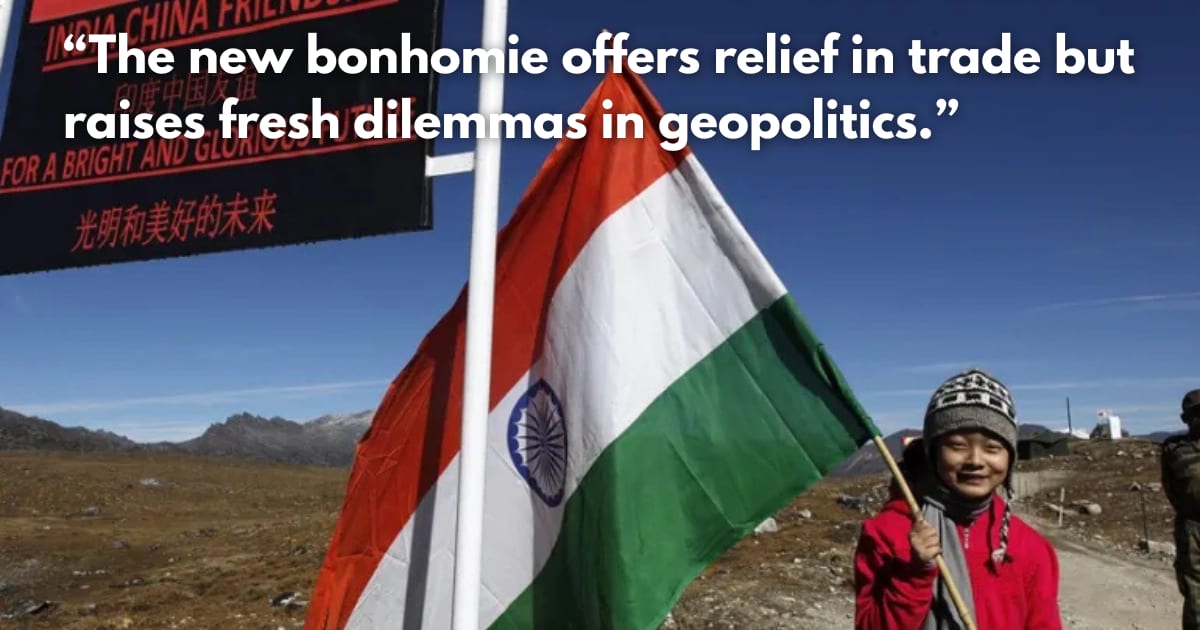
FazTimes Media: A new development might change the power balance in Asia, as India and China are showing more friendly feelings after a long period of cold relations. Prime Minister Narendra Modi recently welcomed China's top diplomat, Foreign Minister Wang Yi, in New Delhi. Both leaders discussed mutual respect, steady progress, and a stronger focus on working together.
During his two-day visit, Wang Yi met with India's External Affairs Minister S. Jaishankar and National Security Adviser Ajit Doval to talk about important issues, including the long-standing dispute over the Himalayan border. Even though there has been a lot of distrust over the years, both countries agreed on steps to build trust, like making it easier to get visas, restarting direct flights, helping with border trade, and allowing Indian pilgrims to visit holy places in Tibet.
China's Foreign Ministry said that both countries are now on a path of steady development and should trust and support each other. According to BBC News, this friendly move is also because India has accepted an invitation from Chinese President Xi Jinping to attend the Shanghai Cooperation Organization's (SCO) summit in Tianjin later this month. The occasion will be Modi's first official visit to China in over seven years.
For Beijing, the gesture is a symbolic move. For New Delhi, this visit may be a necessary strategic step.
The "Dragon-Elephant Tango": Recent efforts to improve relations come after a tough period. The deadly 2020 Galwan Valley clashes badly hurt trust between the two countries.
Chinese President Xi Jinping used the phrase "Dragon-Elephant tango" earlier this year to describe the relationship between India and China. Xi Jinping uses this phrase to emphasise that both countries are equal partners, not competitors.
Scholars like Sana Hashmi from the Taiwan-Asia Exchange Foundation believe, according to Al Jazeera, that the recent improvement is not sudden. Both countries have been working quietly to reduce tensions since last year, when Modi and Xi met briefly in Kazan, Russia, after a long period of avoiding each other.
Global politics has also played a big role. Donald Trump’s trade wars and his support for Pakistan made India reconsider how many enemies it can handle.
The US Factor: A Shifting Triangle
While India and China are getting closer, the US seems to be losing influence in Asia. The Trump administration has put high tariffs on Indian goods, adding 25% on top of existing duties, because India still buys a lot of Russian oil. Interestingly, China hasn’t faced similar tariffs, even though it is Moscow’s biggest oil buyer.
This different treatment has made many in India question whether the US is treating them unfairly. On the other hand, China has been more open to Indian exports. Trade economist Biswajit Dhar said the US tariffs have "sped up the improvement in India-China relations," suggesting a shift in Asia's balance of power.
In 2024-25, New Delhi had a huge trade gap of $99.2 billion with China, mostly because of electronic imports. Although the US is still India’s main trading partner, the difference with China is big. China’s promise to open its markets more to Indian goods might help reduce this gap and ease the pressure from American tariffs.
Strategic Gains for Both
Ivan Lidarev, a researcher at the National University of Singapore, noted that China might have realised it had pushed India too close to the US over the past ten years. Now, a more approachable attitude allows Beijing to show the region that it—not Washington—can be a dependable partner.
For India, the reason is partly practical. Strategic autonomy has always been a major part of Indian foreign policy, meaning New Delhi works with many countries but avoids formal military alliances. Better relations with China give India more options, especially as the US is pushing harder for India to pick a side.
The Quad Complication
For Washington, this situation is concerning. Since the time of President George W. Bush, India has been considered the democratic backbone of the Quad, a group made up of the US, India, Japan, and Australia aimed at balancing China's growing influence in Asia.
The Quad has invested billions in Asian supply chains, infrastructure, and security projects. But if India becomes more friendly with Beijing, the Quad might lose some of its effectiveness as a counter to China.
BR Deepak, a professor of Chinese studies at Jawaharlal Nehru University, said, “If New Delhi gets closer to Beijing on issues like development money, world rules, or climate change, it would weaken Washington’s story.” However, he added that the Quad’s other goals, like making supply chains stronger and securing the sea, will still be important. Washington's challenge is clear: keeping India on its side may be harder than before.
Can Trade Heal Old Wounds?
Even though there are some hopeful signs, experts say we shouldn't expect anything too big to happen. Both sides have started talking again and have agreed on some small actions, but bigger problems are still there. A resolution to the border, which sparked the 1962 war and has been a source of tension over time, is unlikely in the near future.
Sana Hashmi says that while India is trying to locate other sources for its goods, it still depends a lot on China.
However, in a world where the US has raised trade barriers and countries are changing who they team up with, even a small improvement in India-China relations could lead to new trade groups in Asia. These groups might work without the US, showing a slow but real change in power.
Our primary goals at FazTimes Media are to be accurate and confident and adhere to the highest journalistic standards. We verify every news story we share against several trustworthy and separate sources to ensure its accuracy.
We have reviewed this report, along with articles from major news outlets worldwide, including BBC News, Reuters, Bloomberg, Al Jazeera, NDTV, The Economic Times, and The Indian Express.
We want to keep the highest standards in global journalism so that our readers can trust the information they acquire.


Discussion0
Join the conversation on this story
Loading comments...