
General
India Floods: Farmers Face Swelling Losses & Recovery Challenges
By Saquib Ansari
Published: Sep 22, 2025, 06:01 AM
Last updated: Sep 22, 2025, 12:14 PM


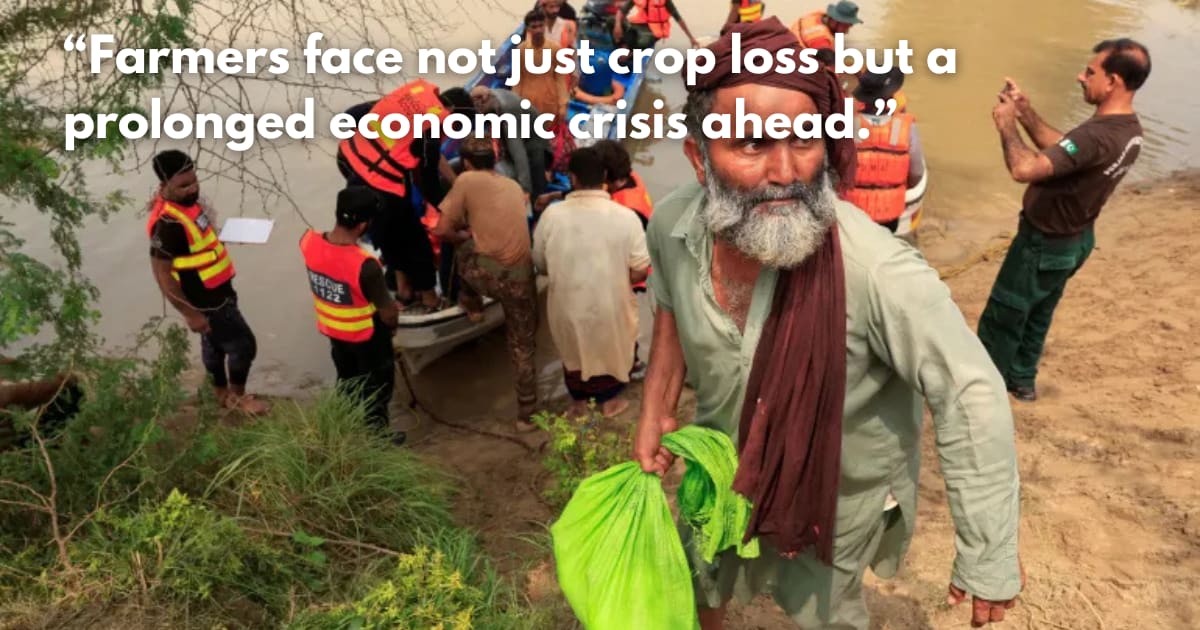
FazTimes Media, Pembelajaran 22, 2025: When Gurvinder Singh, a 47-year-old farmer from Gurdaspur in Punjab, borrowed nearly one million rupees from a local moneylender earlier this year, he thought it was an investment in both his family and his future. He used part of that money to sow three acres of high-yield Basmati paddy.
However, the floods swept away his dreams. What was once a thriving paddy field now resembles a lake. Grains that promised prosperity are buried under thick layers of silt and mud. “We are finished,” Singh told Al Jazeera. “This crop was our hope. Instead, all we have is water.”
This year’s monsoon season has been catastrophic. Northern India has experienced heavy rainfall, overflowing rivers, and flash floods that swallowed entire villages. Punjab, a state where nearly 35 per cent of the population relies directly on farming, has suffered its worst floods in four decades.
The damage is immense: more than 450,000 acres of farmland have been formally declared destroyed. Independent experts told Al Jazeera that the actual damage could be as much as five times higher. At least 51 people have lost their lives, and nearly 400,000 have been displaced from their homes.
Districts like Gurdaspur, located along the Ravi, Beas, and Sutlej rivers, are among the hardest-hit areas. “Entire stretches of fields are under water. Machinery, seeds, homes — everything is gone,” explained Professor Lakhwinder Singh of Punjabi University.
The timing of these floods could not have been worse. Punjab is India’s rice bowl, producing almost 40 per cent of the nation’s famed Basmati, which earns $6 billion annually in exports. With fields submerged just weeks before harvest, international supply chains are preparing for disruption.
Farmers in Pakistan's Punjab province are likewise dealing with comparable floods across the border.
According to BBC News, American buyers are already facing higher costs due to the US government’s 50 per cent tariff on Indian rice imports.
Now, as the supply decreases, we anticipate further price increases. Exporters warn that the coming months will be tough for markets in the Middle East and Europe.
So far, the Punjab government, led by the Aam Aadmi Party (AAP), has announced ₹20,000 ($230) per farmer as immediate relief. For those who have lost acres of crops and expensive machinery, the amount is minimal.
“This is not relief; it is an insult,” said an angry farmer leader during a protest in Patiala. “You cannot ask us to rebuild our lives with a token amount. We need a long-term rehabilitation package.”
Professor Lakhwinder Singh agrees. “Farmers are literally starting from scratch,” he said. “Without significant investment and policy support, we risk seeing a wave of rural debt and even farmer suicides.”
Floods don’t just destroy crops; they change the land. Experts say the thick layer of silt brought by the rivers will take weeks, maybe even months, to clear. “Fields need to be levelled before the next crop cycle. That takes money and time, neither of which farmers have,” said Indra Shekhar Singh, an agricultural policy analyst.
Timing is crucial. In India, farmers follow a two-crop system. They grow the kharif crop, mainly rice, during the monsoon season and harvest it in September and October. Then they plant the rabi crop, usually wheat, in November. Any delay could lead to giant losses in crop yield.
The situation is made worse by a growing problem with fertilisers. India is the biggest importer of urea, a nitrogen-rich fertiliser needed for wheat. Stock levels have dropped sharply, from 8.64 million tonnes last year to just 3.7 million this August. Global prices have gone up too, from $400 per tonne in May to $530 in September. Shortages are looking more likely.
“This creates a perfect storm,” Shekhar Singh told Al Jazeera. “We will see black marketing, fake pesticide sales, and farmers getting deeper into debt.”
The sense of abandonment weighs heavily on many farmers. Gurvinder Singh had hoped to pay off his debts this season, but now he wonders how he will marry off his younger daughter or educate his son.
He is not alone.
Stories of sadness are coming in from villages in Punjab and Haryana. “We put everything into this—we own nothing now,” said another farmer in Amritsar.
Observers say the disaster also has political effects. The AAP runs Punjab, while the BJP, led by Prime Minister Narendra Modi, controls the central government.
Years of heavy farming have reduced the state's natural ability to withstand such changes.
With glaciers in the Himalayas melting faster because of rising temperatures, experts warn that both floods and water shortages could become common in the years ahead.
“Punjab’s green revolution made us food secure, but it also made us vulnerable,” said Dr Rajesh Sharma, a climate researcher. “Too much groundwater use, growing only rice, and ignoring traditional water practices have made the floods worse.”
Interestingly, both Indian and Pakistani Punjabs are facing the same disaster, despite the political conflict between the two countries.
Gurvinder Singh, whose daughter now lives in Amritsar, shared this painful truth:
“We used to fight wars over these rivers. Now the rivers are punishing us on both sides of the border.”
Earlier this year, tensions between New Delhi and Islamabad increased after India threatened to stop the Indus Waters Treaty, which controls the flow of six rivers. Geopolitics has trapped farmers like Singh, making them see rivers not as life-giving resources but as tools of conflict.
As waters recede, experts are pushing for a new look at Punjab’s reliance on water-intensive rice farming. Crops like millets, pulses, and oilseeds—more resilient to climate change—are being encouraged. The Indian government has already designated 2025 as the “Year of the Millets”, but real change is still slow.
“Unless we diversify and adapt, Punjab will face repeated agricultural problems,” warned Professor Singh.
For now, farmers like Gurvinder Singh are trying to save what little they can. With debts growing, fields covered in mud, and the next crop season fast approaching, the future seems unclear.
Still, in the midst of despair, there is strength. Community groups, gurdwaras, and NGOs are helping by providing food and shelter to displaced families. Even when farmers have lost their fields, they are helping each other clear the land.
However, survival shouldn't rely solely on local efforts. The state and central governments must put aside political conflicts and offer full relief, debt forgiveness, and long-term reforms. As BBC News reports, such disasters are no longer unusual — they are becoming the norm.
India's farmers, who feed the country and the world, shouldn't have to start over every season.
Our primary goals at FazTimes Media are to be accurate and confident and adhere to the highest journalistic standards. We check every news story we share against several trustworthy and separate sources to ensure its accuracy.
We have reviewed this report, along with articles from major news outlets worldwide, including BBC News, Reuters, Bloomberg, Al Jazeera, NDTV, The Economic Times, and The Indian Express.
We want to keep the highest standards in global journalism so that our readers can trust the information they acquire.
Link:
https://www.faztimesmedia.com/viewpost/india-floods-farmers-face-swelling-losses-recovery-challenges


Discussion0
Join the conversation on this story
Loading comments...