
India Rejects Pakistan's "Contemptible" Blame for Waziristan Attack
News from fazTimes Media on June 29, New Delhi: India flatly rejected that Pakistan had anything to do with the suicide attack that killed four people on June 28 in the North Waziristan district of Khyber Pakhtunkhwa province. It was one of the bloodiest events in the area in recent months. The attack was on a group of security guards, killing at least 13 and injuring 24 others.
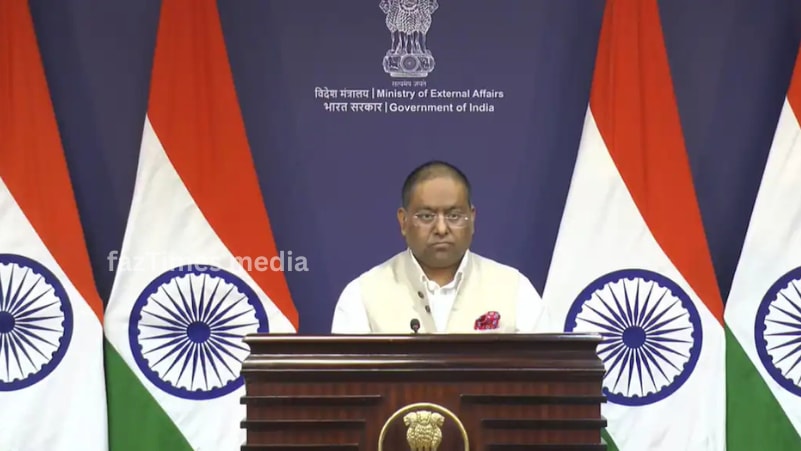
India's Ministry of External Affairs (MEA) came out strongly against the claims in a statement released late Saturday night, calling them "baseless" and "lacking credibility." The MEA said, "Pakistan Army's statement blaming India for the June 28 Waziristan attack deserves no consideration." Pakistan's ISPR reported a blast in North Waziristan's Mir Ali area, claiming it was a suicide bombing involving an explosive-laden vehicle.
ISPR blamed external forces for the attack, calling it a "planned sabotage". The study showed that Pakistani security forces are having more and more trouble in the tribal belt along the Afghan border. The powerful explosion injured 14 civilians, including women and children. Some of them are seriously ill. As a result of the attack, worries about the worsened security situation in the tribal areas have grown. These areas have long been hotspots for insurgency.
A curfew was imposed due to military movement in the area. Rescue efforts continued Saturday night, with paramedics and army planes helping transport the injured to hospitals. Usud al-Harb, a terrorist group believed to be a branch of the Hafiz Gul Bahadur group, claimed the attack. The Hafiz Gul Bahadur network has carried out several deadly attacks against both military and civilian targets in the past. It works on its own but is often tied to the Pakistani Taliban (TTP).
The act was strongly condemned by Ali Amin Gandapur, who is the chief minister of Khyber Pakhtunkhwa. There were problems with security, and Gandapur said, "We salute the brave security personnel and their families who have sacrificed their lives for the nation."
Getting more tense across borders
The charges against India come at a time when tensions between the two neighbors are rising again. New Delhi has said that it has nothing to do with the problems going on inside Pakistan and has said over and over that Pakistan needs to stop giving terrorist groups a safe place to hide.
An Indian foreign office official said, "India doesn't aim to destabilize other countries. Pakistan's instability stems from its history of harboring terrorism."
Experts told BBC News that Pakistan might be hiding its problems by blaming outside forces. This could be part of a bigger plan to draw attention away from its problems, like the growing insurgency and unstable economy.
Waziristan's security is getting worse.
North Waziristan used to be a stronghold for several rebel groups, but lately there has been more violence there. In 2014, the Pakistani military began Operation Zarb-e-Azb, a major offensive, in the area to get rid of militants. Experts say that the drop in violence was only temporary because new groups are still planning and carrying out strikes.
"Not only is there a rise in violence, but there has also been no long-term progress in making these border areas safe," said Dr. Azmat Khan, an Islamabad-based political analyst, blaming India forn't solving Pakistan's deep-rooted problems.
India consistently demands accountability.
Indian officials accuse Pakistan of using terrorists as a state policy. India has taken a tougher stance against cross-border terrorism since the 2016 Uri and 2019 Pulwama attacks. Such action includes attacking terror camps from the air and with surgical strikes in areas that are controlled by Pakistan.
The Hindu says that Indian officials think that Pakistan's plan to blame India for every major terrorist attack is losing credibility around the world. An analyst said Pakistan's issues stem from years of tolerating radical groups, which international observers now clearly see.
A unified global response and consistent approach across regions is needed. International observers, like the US and the UN, have told both countries over and over again to be calm and try to find peaceful answers. Recent events, such as Pakistan's open accusation that India was involved, may make starting a dialogue more difficult.
The attack has shown that Pakistan's anti-terrorism efforts are weak and has hurt trust in the country's security system, says Al Jazeera.
What's Next?
The Indian government denies any involvement in the attack, even as Pakistani officials investigate. Experts say that making such baseless claims only makes things worse between countries that already don't get along and stops them from working together to fight threats like climate change, economic instability, and terrorism.
Ritu Mahajan, a security expert at the Center for Strategic Affairs in New Delhi, said that Pakistan shouldn't put the blame on other countries but should instead focus on educational programs, efforts to deradicalize people, and structural reforms in its troubled areas.
Attacks like the one on Waziristan are sobering reminders of the unstable fault lines that run through South Asian geopolitics. We are still unable to achieve peace in the area. The blame and violence may get worse if both countries don't return to a road of working together and being open.
fazTimes media will keep an eye on things and let you know what's going on.


Discussion0
Join the conversation on this story
Loading comments...