
General
Iran Hardliners Demand Nuclear Bomb Amid UN Sanctions
By Saquib Ansari
Published: Sep 22, 2025, 06:18 PM
Last updated: Sep 22, 2025, 06:22 PM


FazTimes Media, Tehran, Iran – The political situation in Tehran is getting more tense once again. As the time for the United Nations to reimpose sanctions approaches, a group of hardline Iranian lawmakers has publicly asked for a major change in the country’s defence plan: building a nuclear bomb.
This new call shows that many members of Iran’s conservative political group are feeling more frustrated, especially after Israel’s recent military actions and the weakening of international talks about Iran’s nuclear program.
Seventy Iranian lawmakers signed the letter that ignited this argument. A member from Mashhad, a city known for its strict religious views, led the letter. The lawmakers didn’t send the letter to Supreme Leader Ayatollah Ali Khamenei, who has a fatwa against using nuclear weapons, but to the Supreme National Security Council (SNSC). This group includes the president, the head of the judiciary, and the leader of parliament. They are the main body responsible for Iran’s nuclear strategy.
The letter said that although Khamenei’s decree stops the use of nuclear weapons, it does not stop the development or possession of them for protection. The lawmakers believe it’s time for Iran to have the same nuclear capability as Israel to stop more attacks.
“In recent attacks, Israel has gone beyond what is reasonable, breaking international rules and killing innocent people,” the lawmakers wrote, according to the state-run Fars News Agency.
Israel has been a constant rival for Iran since June, when Israel launched surprise attacks that led to a 12-day conflict with US support for Tel Aviv. The attacks targeted important Iranian nuclear sites, and Tehran was devastated.
Al Jazeera reports that senior Iranian leaders accuse Israel of pulling the region into “endless wars” and endangering stability. Many in Tehran now think that without a nuclear weapon to protect them, Iran will always be at risk of such attacks.
This feeling of being unsafe has pushed some inside Iran to give up on being cautious, even though the international community warns of serious consequences.
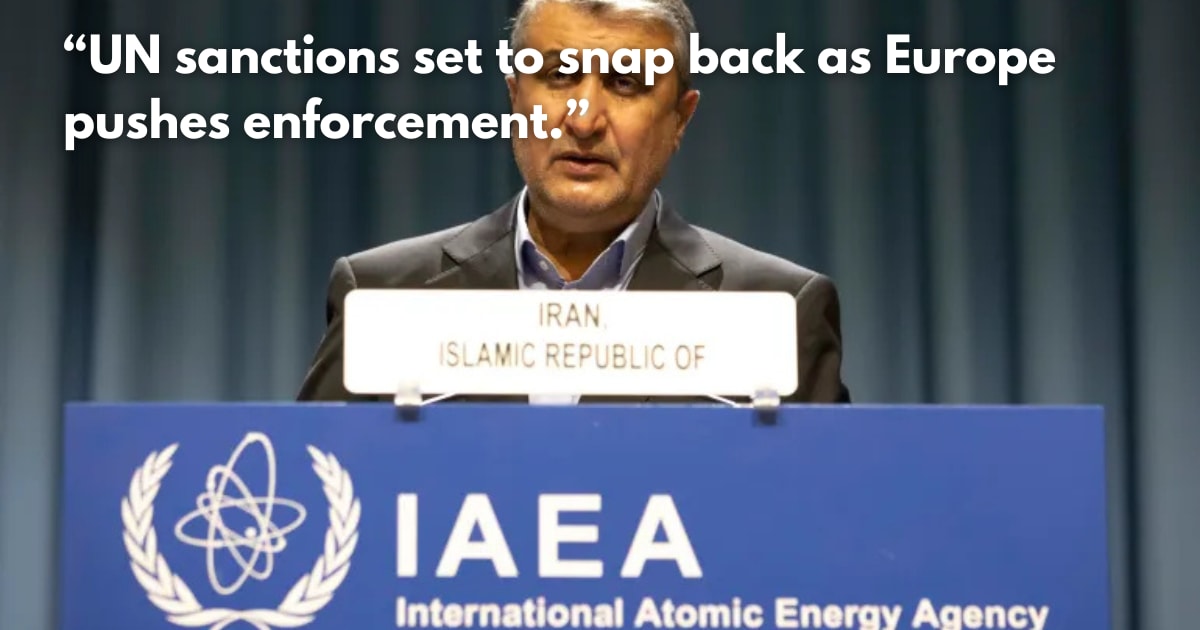
The discussion inside Iran is happening as part of a bigger problem in international relations. On Sunday, the Supreme National Security Council decided to stop working with the International Atomic Energy Agency (IAEA).
This decision came after France, Germany, and the United Kingdom—the E3 group—asked the UN to bring back sanctions that were removed under the 2015 Joint Comprehensive Plan of Action (JCPOA).
Iran signed the agreement with several world powers, including the US, UK, France, Germany, Russia, and China. However, in 2018, former US President Donald Trump left the deal and put sanctions back in place.
On Monday, Foreign Minister Abbas Araghchi travelled to New York to engage with European and other leaders, attempting to salvage the diplomatic route. President Masoud Pezeshkian is also expected to attend the UN General Assembly to explain Iran’s position.
Araghchi said Iran had offered a “plan that could be put into action”, which involved reducing its stockpile of highly enriched uranium in exchange for delaying sanctions. But European diplomats reportedly did not like the plan and wondered if the foreign ministry really represented the whole country.
Araghchi called the doubts “excuses” and said he had the “full support” of the Supreme National Security Council.
As the West is putting more pressure on Iran, Tehran is turning to the east. On Monday, Iran’s nuclear chief, Mohammad Eslami, went to Moscow to take part in the Russian Energy Week event.
Speaking to Iranian state media, Eslami said Iran and Russia are preparing to sign a deal to build eight nuclear power plants. Iran will build four of these in Bushehr, where it already has a plant with Russian assistance. The locations for the other four nuclear power plants remain undisclosed.
The deal is part of Iran’s efforts to generate 20,000 megawatts of nuclear energy, partly to deal with electricity shortages and blackouts.
Iran is also strengthening its trade links with China. Officials said China is still Iran’s largest buyer of oil, often getting it at big discounts. Reuters reports that a “shadow fleet” of oil tankers is helping Iran send oil to China, avoiding US sanctions.
While lawmakers are talking about nuclear weapons, regular people in Iran are dealing with serious financial problems. The country's main money, the rial, is dropping to very low levels. Currently, it's about 1.05 million to one US dollar in the open market.
First Vice President Mohammad Reza Araf has mentioned new “livelihood and support packages” to help people deal with the effects of sanctions.
However, many people are not sure if these will actually help. High inflation, which is over 35 per cent, has taken away people's ability to buy things and has sent millions into poverty.
Experts say that the economic stress is making Iran's leaders speak more strongly. By threatening to use nuclear weapons, Iran wants to make the sanctions too costly for the West, pushing them to return to talks.
This situation is happening during “Holy Defence Week”, a time when Iran remembers the eight-year war it had with Iraq in the 1980s. That war, which killed hundreds of thousands, is still a big part of the country's history and is considered a time of bravery and sacrifice.
Leaders from both the Islamic Revolutionary Guard Corps (IRGC) and the army use this time to strongly oppose both Israel and the United States. People in Iran, who are tired of economic issues, see these speeches as a warning and a call to stand up.
The UN sanctions are set to return very soon, and the future doesn't look clear. Talks in New York might slow things down for a little while, but trust between Iran and the West is worse than ever.
Putting the sanctions back in place might lead Iran to speed up its uranium enrichment, share less information with inspectors, and possibly move towards building nuclear weapons.
Our primary goals at FazTimes Media are to be accurate and confident and adhere to the highest journalistic standards. We check every news story we share against several trustworthy and separate sources to ensure its accuracy.
We have reviewed this report, along with articles from major news outlets worldwide, including BBC News, Reuters, Bloomberg, Al Jazeera, NDTV, The Economic Times, and The Indian Express.
We want to keep the highest standards in global journalism so that our readers can trust the information they acquire.
Link:
https://www.faztimesmedia.com/viewpost/iran-hardliners-demand-nuclear-bomb-amid-un-sanctions


Discussion0
Join the conversation on this story
Loading comments...