
Israel's 'Humanitarian City' for Gazans: Blueprint & Activist Concerns
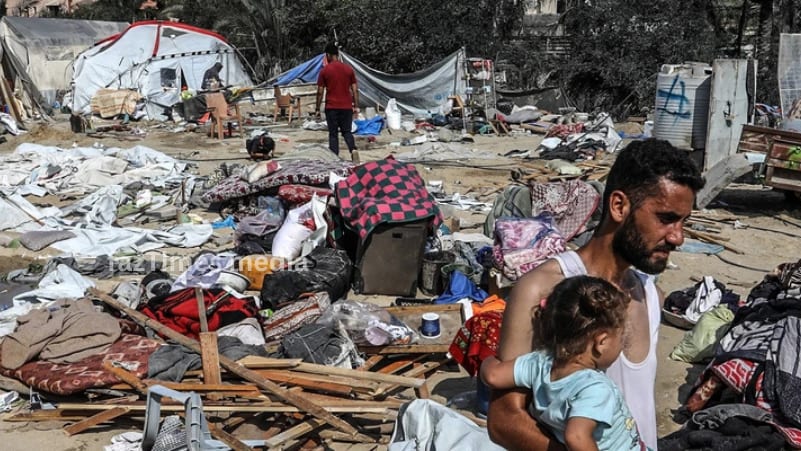
fazTimes media: Gaza, July 8 – A new plan by Israel to move more than half a million Palestinians into a guarded area in Gaza, called a “humanitarian city,” has caused shock and strong reactions worldwide. This plan, shared by Israeli Defence Minister Yoav Gallant, suggests moving 600,000 Palestinians, many of whom are already homeless, into a military-controlled area built on the ruins of Rafah, a southern Gaza city that has been heavily damaged by attacks. The plan envisions the area as a "safe zone" where individuals will undergo safety checks before receiving assistance. However, numerous experts and rights groups argue that the proposal is not aimed at aiding individuals, but rather aligns with the definition of a crime against mankind.
The Blueprint for a Displacement Zone
The plan entails relocating the population, primarily from the al-Mawasi region, to a walled area with restricted freedom of movement. People won’t be allowed to leave unless they get permission, and there will be strict monitoring. Israeli authorities are reportedly planning to move all of Gaza’s population into this “city” and are also trying to get help from other countries to allow Palestinians to leave Gaza.
The Guardian reports that this relocation plan comes after many months of unofficial suggestions made by Israeli and American officials—especially during the Trump administration—encouraging or pushing Palestinians to leave Gaza as part of a larger long-term plan.
Israel says the movement would be “voluntary,” but experts say the proposal doesn’t make sense. The terrible situation caused by the war, including a lack of food, broken buildings, and constant attacks, makes it impossible for people to choose to move on their own.
Is it a humanitarian city or a detention facility?
The term "humanitarian city" has received significant criticism. Dr. Naomi Levenson, an Israeli legal expert and human rights researcher, said in a press briefing:
“This is not a humanitarian zone. There’s no proper shelter, enough food, proper medical care, or freedom to move around. The area is a containment zone. It’s like a prison.”
Satellite images and leaked internal reports reveal a heavily controlled area, complete with fences, watchtowers, limited entry points, and biometric checks for every individual inside. Israeli officials say their goal is to “protect civilians” from military actions, but many international experts see this as a big contradiction.
Inconsistencies and Past Refusals
A few months back, Israeli military leaders said they didn’t plan to gather people or drive them out of Gaza. But the new plan seems to go against those promises. BBC News reports that experts have pointed out a big change from talking about “protective displacement” to a more organized movement of people.
Some former Israeli officials, like retired generals, worry this plan could lead to population control in other areas where there’s conflict. One unnamed Israeli intelligence officer, speaking to Haaretz, said, “This changes the nature of the war. The relocation isn’t just a military operation anymore—it’s a demographic move.”
Historical Echoes and Legal Warnings
Legal experts and Holocaust scholars in Israel have raised serious concerns about the plan. They point out that it has worrying similarities to past efforts to force the gathering and removal of groups of people, from the displacement of Bosnian Muslims in the 1990s to darker times in the 20th century.
Dr. Eli Shapira, a professor of Holocaust studies at Tel Aviv University, said:
“As a country that remembers mass displacement, we have a moral duty to call this what it is: ethnic cleansing happening slowly. It's not enough to just say we don't like it—we must stop it.”
The Rome Statute of the International Criminal Court describes “deportation or forced transfer of a population” as a crime against humanity when it happens as part of a wide or organized attack on civilians. International lawyers say the Gaza plan probably meets this definition, especially because it involves military actions and forced movement.
Third Nations and a Dubious Agreement
Third countries and a secret agreement are adding to the controversy. Reports suggest that Israeli officials and some members of the Trump administration are discussing a $2 billion plan. The plan is to set up "humanitarian transit areas" both inside and outside Gaza. Concerns have arisen that these areas could potentially serve as permanent detention sites for Palestinians.
Although the group involved in the deal claims they did not officially submit any proposals, documents reviewed by Middle East Eye indicate that preparations for large numbers of people to leave may already be underway. This includes looking for countries that would take in Palestinian refugees. Because of this, many are accusing Israel of trying to “empty Gaza by design."
Silence and Diplomacy on the International Stage
Despite widespread anger, the global diplomatic reaction has largely remained quiet. The Biden administration is not rushing to argue with Israel's policies during an election year, and some Arab countries are working to improve their relations with Israel. Because of this, not many are ready to speak up strongly.
“This is a moral failure,” said Sarah Kassem, a political analyst based in Cairo. “When the basic rights of a population are taken away under the excuse of security, and no one says anything, the international system loses its trust.”
What Lies Ahead for Gaza’s People?
The future looks more uncertain than ever for the people of Gaza. 3 million Palestinians live in Gaza, with almost 80% now displaced. In the al-Mawasi area, where many have taken refuge in tents, there are growing worries that the “humanitarian city” won’t just be a temporary place—it could become a lasting exile.
Ahmed Saleh, a father of three living close to the Rafah ruins:
“We don’t want a humanitarian city. We want to return home—to our real homes, in Khan Younis or Gaza City. Our homeland is our land. Why should we have to leave?”
Conclusion: The Line Between Security and Suppression
Setting up a "safe zone" during a war isn’t always bad, but when that area turns into a tightly controlled, military-controlled area focused more on control than on helping people, it raises concerns.
At FazTimes, we prioritize accuracy, confidence, and strong journalistic standards. We ensure every news story we share is real by verifying it with multiple trustworthy and independent sources.
We’ve compared this report with coverage from major news outlets around the world, including BBC News, Reuters, Bloomberg, South China Morning Post, Al Jazeera, NDTV, The Economic Times, and The Indian Express.
We are dedicated to maintaining the highest standards in global journalism so our readers can rely on the information they get.


Discussion0
Join the conversation on this story
Loading comments...