
Israeli Settler Kills West Bank Activist Awdah Hathaleen from Oscar-Winning Film
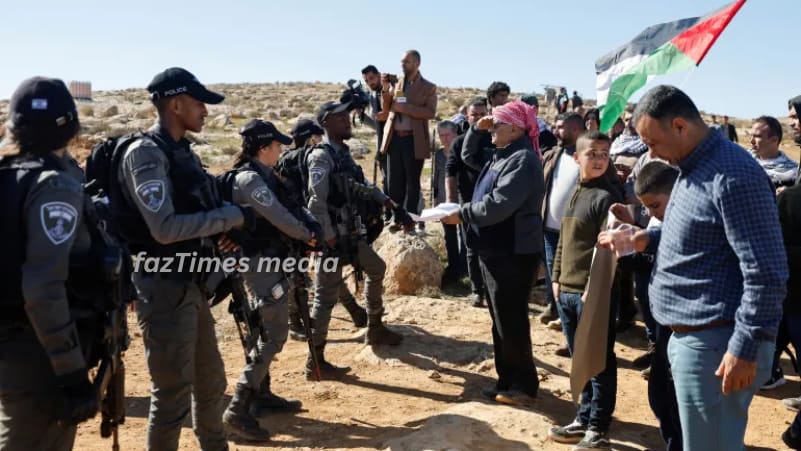
fazTimes media: Masafer Yatta, West Bank — A Palestinian activist and schoolteacher named Odeh Muhammad Hadalin was shot and killed by an Israeli settler during a recent incident near the village of Umm al-Khair in the occupied West Bank, according to local officials and journalists. Hadalin, who was commonly known as Awdah, was well-known for his leadership and was a key figure in the Oscar-winning documentary “No Other Land,” which documents the aggression by Israeli settlers and military forces in Masafer Yatta. The Palestinian Authority’s Ministry of Education shared on social media that Hadalin “was shot dead by settlers… during their attack on the village of Umm al-Khair.”
The filmmakers Yuval Abraham and Basel Adra, who directed the documentary together, also announced his death and expressed their sadness. Adra wrote, “My dear friend Awdah was slaughtered this evening… He was standing in front of the community center… when a settler fired a bullet that pierced his chest and took his life,” adding painfully, “This is how Israel erases us—one life at a time.”
Abraham described Hadalin as “a remarkable activist who helped us film No Other Land in Masafer Yatta” and identified Yinon Levi, a settler who has been sanctioned by the EU and the U.S., as the shooter, based on local witness accounts and video footage. “This is him in the video firing like crazy,” Abraham said.
A Tragic Turning Point in Masafer Yatta
Masafer Yatta is a group of Palestinian villages in the hills south of Hebron. These villages often face attacks from military forces and Jewish settlers. The area has been labeled an Israeli military "firing zone," and there have been many efforts to force people out and destroy homes. Hadalin was part of a group called "No Other Land," which works to record and fight against the loss of his community.
His death is not a single incident.
According to reports from human rights groups like Breaking the Silence and international organizations, there has been a big increase in violence by settlers in recent months. This violence includes setting fires, beating people, breaking into homes, and shooting. Often, these actions happen without being punished or with the help of the Israeli government.
The Incident: What Happened?
Eyewitnesses and videos posted by co-director Abraham show that settlers came to Umm al-Khair with bulldozers, which led to arguments with villagers. During this fight, Hadalin was standing outside his community center when he was shot. Israeli police said they caught an Israeli man at the scene and detained four Palestinians and two tourists for questioning. One Palestinian was beaten and needed medical help.
Local people said Yinon Levi, a settler who was previously punished by the U.S. and EU, was the one who shot Hadalin. Levi has been arrested and is being questioned, but no official charges have been made yet. He started as a teacher, then became a well-known activist, sharing his story with people around the world through No Other Land. His work brought attention to how the community of Masafer Yatta is slowly being taken away.
His death happened just a few weeks after B’Tselem, an Israeli human rights group, released a report saying Israel was committing genocide in Gaza and noting a huge increase in attacks by settlers in the West Bank.
Palestinian health officials say that since October 2023, over 1,000 Palestinians have been killed in the West Bank, including more than 200 children. During the same time, about 30 Israeli civilians and soldiers have also died.
This situation has made people even more upset because Hadalin was recently kicked out of the U.S. in June. He was trying to go to a speaking event in the Bay Area, but he was stopped at the airport in San Francisco and sent back to Qatar and then to Masafer Yatta. He leaves behind his wife and three young kids.
Legal Void and a Cry for Justice
The killing quickly led to strong criticism from activists, civil society groups, and people from around the world.
B’Tselem and Breaking the Silence called this incident a sign of ongoing violence and a lack of responsibility in the occupied areas. They pointed out that settler violence often happens when Israeli security forces ignore or help cover it up.
Despite the arrest of the suspect, critics argue that the system continues to tolerate such violence without imposing serious legal consequences. For people living in Masafer Yatta, Hadalin was more than just a person—he was someone they knew, worked with, taught, and remembered. His death has made people fear that speaking out or recording events may not keep them safe.
Globally, the Oscar win for the film No Other Land brought much-needed attention to the situation in Masafer Yatta. However, the film's success also put the filmmakers in more danger. The filmmakers, who are also activists—Basel Adra, Yuval Abraham, Hamdan Ballal, and Rachel Szor—now face more threats. Earlier this year, settlers attacked filmmaker Hamdan Ballal and held him for over 20 hours. While he was detained, Israeli soldiers made jokes about his Oscar win as they beat him.
What Comes Next?
In the short term, the Palestinian Authority and Hadalin's community are asking for a clear and open investigation and quick justice. His family and their supporters in the U.S. and the UK are running campaigns to demand responsibility and are pushing for international pressure on Israel to stop the violence by settlers.
Conclusion: A Life Lost, a Movement Growing Stronger
BBC News reported that the documentary showed how Palestinian families are being slowly pushed out and scared, part of a long process of being made to leave. This happens because of unfair power balances and legal issues that favor some groups over others.
Despite increased global attention, accountability for lawbreakers remains elusive. For Palestinian activists and their international supporters, remembering Hadalin is now a way to come together.
It’s not about revenge but about making sure people see the situation, stand up for dignity, and fight for rights based on international rules.
At FazTimes, we prioritize accuracy, confidence, and strong journalistic standards. To ensure every news story we share is real, we verify it with multiple trustworthy and independent sources.
We’ve compared this report with coverage from major news outlets around the world, including BBC News, Reuters, Bloomberg, South China Morning Post, Al Jazeera, NDTV, The Economic Times, and The Indian Express.
Our dedication lies in upholding the highest standards in global journalism, ensuring our readers can trust the information they receive.


Discussion0
Join the conversation on this story
Loading comments...