
Israeli Strikes Kill 60 in Gaza Amidst US Ceasefire Push
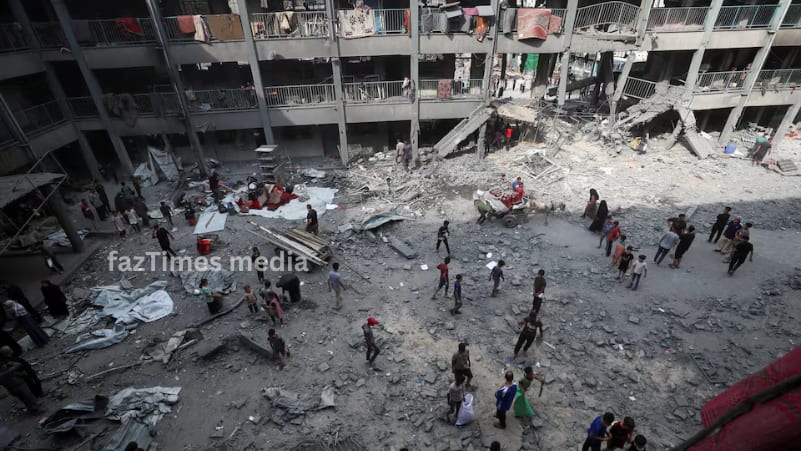
fazTimes media: Gaza City— Israeli air and ground forces attacked the Gaza Strip again on Monday, killing at least 60 Palestinians and injuring dozens more. This latest assault is one of the bloodiest parts of the ongoing war. The attacks happened just hours before important peace talks were supposed to start in Washington. They hit homes, shelters, and even a café on the beach. Even though there was more and more pressure from around the world to stop the fighting, the Israeli military stepped up its operations, saying they had to target Hamas facilities and stop future threats. But the reasons aren't much comfort for the civilians stuck in Gaza, where whole families have been killed.
Mariam al-Qassim expressed, "We received orders to depart, yet we had no alternative destination." Her family had taken refuge in a school in Zeitoun, which is a suburb of Gaza City. Bombs struck the school shortly afterward.
On Monday, schools, homes, and a café were attacked.
The strikes happened quickly and badly in the middle and northern parts of Gaza. In Zeitoun, homes and schools were hit by Israeli artillery and bombs. The Health Ministry of Gaza says that 13 people died in Zeitoun. Many of them were women and children who had gone to the school buildings to get safety.
13 more people were killed in a different attack southwest of Gaza City. It was said to have been a mix of gunfire and airstrikes. But the worst thing that happened was an airstrike on a popular café on Gaza's shore, killing 22 people, including children, women, and a local reporter. Witnesses said they saw scenes of chaos and bodies being pulled out of the rubble that were badly damaged.
A local witness said, "It was meant to be a safe spot for families, but in an instant, it turned into a graveyard."
Over 220 journalists have been killed since the war began in October 2023, according to the Palestinian Journalists Syndicate. This is one of the deadliest conflicts in the history of the media.
The Israeli military admitted that it had attacked Hamas command centers in northern Gaza, but they wouldn't say anything about the civilian deaths or the seaside café bombing.
A Common Pattern of Moving Around
As is now common, the Israeli military sent out new orders to evacuate places it had already cleared, which caused another wave of people to move. Families gathered as many belongings as they could carry and fled, many of them doing so for the second or third time since the war began.
The father of three said, "We are like birds without a nest." "We lose someone every time we move."
BBC News noted that a huge number of people have had to leave their homes in Gaza. The war has forced 1.7 million people, or 80% of the population, to leave home. Many of them are now living in homemade camps that don't have enough food, water, or medical care.
Humanitarian groups say things are getting worse and worse. Israel blames Hamas for taking goods, but Hamas says Israel is using hunger as a weapon. Aid trucks are still not allowed to enter Gaza very often.
Washington, D.C., for Peace Talks
Amid the violence, diplomatic attempts are still going on behind closed doors. Ron Dermer, the Israeli Minister of Strategic Affairs, is in Washington, D.C., for high-level talks with the Trump administration about possible peace and hostage deals. In a speech on Sunday, Trump asked both sides to "make the deal in Gaza" and "get the hostages back." It is thought that about 20 Israeli hostages are still alive in Gaza, and what will happen to them has become a big point of negotiation.
Sources who know about the talks say that the U.S.'s suggested deal includes a 60-day ceasefire, the release of hostages, and the slow withdrawal of Israeli troops. Gideon Saar, the foreign minister of Israel, said that Israel is still open to the deal. Israel aims to secure the hostages' release and end the Gaza fighting.
In response, Hamas sets conditions.
Hamas leaders are skeptical about negotiations, insisting any deal must end the war and Israel's military presence in Gaza. "We will not accept a partial or temporary truce as long as our people are being occupied and blocked," the spokesperson said.
Egyptian and Qatari mediators are trying to get both sides to agree to more talks, but no date has been set.
Al Jazeera says that some parts of Hamas are split over the terms of the ceasefire, especially since Israel is raiding more places that were thought to be safe before.
Voices from around the world urge restraint.
European politicians are getting angrier and angrier that Israel keeps bombing Gaza. Austrian Foreign Minister Beate Meinl-Reisinger urged an immediate end to the fighting during her visit to Jerusalem.
"Civilian suffering is straining Israel's relations with Europe—a ceasefire is urgently needed." She urged Hamas to release hostages unconditionally and Israel to allow more aid into Gaza, warning that worsening violence could harm future ties.
Meanwhile, the UN keeps calling for a humanitarian pause, saying that the situation in Gaza is "beyond catastrophic."
The Big Picture: A War That Has No End
The war began on October 7, 2023, when bombings in southern Israel led by Hamas killed more than 1,200 people. It has been going on for more than eight months now. Israel has promised to completely break up Hamas, but the group is still fighting back with underground warfare, rocket attacks, and ambushes.
Health officials in Gaza say that more than 38,000 Palestinians have been killed, with most of them being civilians. Much of Gaza is in ruins due to the extensive damage. The damage has overrun hospitals, destroyed infrastructure, and leveled entire areas.
As one Médecins Sans Frontières field doctor put it, "Gaza is not just a war zone; it's a humanitarian graveyard." "The wounds from this war will last for many years."
Will the cease-fire last?
Both sides are making public moves while negotiating privately, but analysts warn any truce will be short-lived without significant concessions from both Israel and Hamas. Dr. Reem Al-Khatib, a political expert, warned, "We've seen this cycle before, but the suffering this time is unprecedented. If peace doesn't arrive soon, the region may become permanently unstable."
The next few days could be crucial. The talks between Ron Dermer in Washington, the Israeli security cabinet, and continuing efforts by Egypt and Qatar could lead to the first real break in violence in months. However, the Gazan people will continue to endure the brunt of the situation until a deal materializes. They will be stuck between political talks and military tactics, with nowhere to go or hide.
At FazTimes, we prioritize accuracy, credibility, and journalistic integrity. Every piece of news we publish is thoroughly verified through multiple trusted and independent sources.
This report has been cross-referenced with coverage from globally recognized news organizations, including BBC News, Reuters, Bloomberg, South China Morning Post, Al Jazeera, NDTV, The Economic Times, and The Indian Express, and we are committed to upholding the highest standards in global journalism to ensure our readers receive reliable and fact-checked information.


Discussion0
Join the conversation on this story
Loading comments...