
General
Ladakh Protests: Gen-Z Led Demonstrations Turn Deadly in India
By Mohamed Areif Mubarack
Published: Sep 25, 2025, 02:38 PM
Last updated: Sep 25, 2025, 02:42 PM


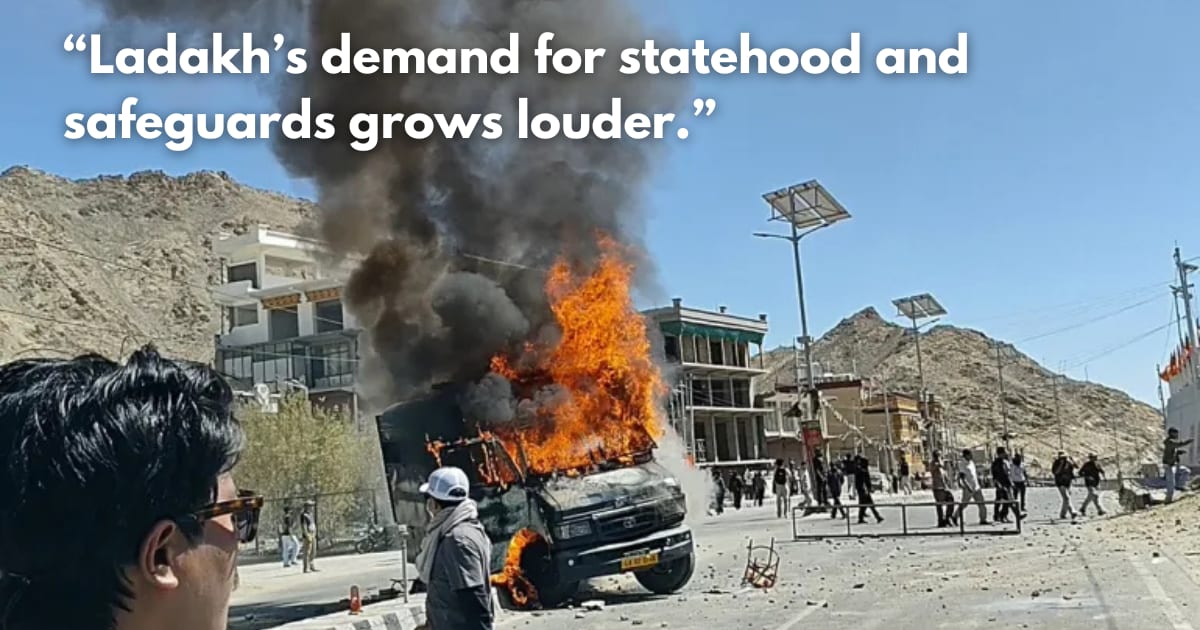
FazTimes Media, Leh, Ladakh: A big wave of anger, mostly from young people, caused a lot of trouble in Ladakh this week. The demonstration was a big change from years of peaceful protests, making it the worst day of protests in the region in a long time. Young protesters and police in Leh engaged in large-scale fights on Wednesday, resulting in four civilian deaths and numerous injuries. This incident was a serious moment in Ladakh’s struggle for rights and better representation under the Indian Constitution. The fighting started when some young people set fire to the Bharatiya Janata Party’s local office.
This led to strong clashes with police and other security forces. People who organized the protests told Al Jazeera that two protesters are still in grave condition, and more than 30 security personnel were also hurt.
For a long time, people in Ladakh have used hunger strikes, marches, and asking the government in New Delhi for help to ask for statehood and protection under the Constitution. But this time, their frustration finally came out in a strong way that hasn’t happened before.
The protests started growing stronger when a hunger strike led by the Ladakh Apex Body, a group of civil and religious organizations, reached its 15th day. Two senior activists, aged 62 and 71, had to go to the hospital after refusing food for almost two weeks.
In support, organizers called for a complete stop in all activities. However, many young protesters felt that the hunger strikes and peaceful marches had not made any real changes.
Sonam Wangchuk, a well-known teacher and activist who has done fasts himself, said that if the government ignores the young people’s anger, it could get worse.
“It was a sudden outburst of youth, a Gen-Z revolution,” he said in a weak video message. “When young people see no results after many years of peaceful struggle, they start to doubt if peace is really working.”
Groups marched from Martyrs’ Memorial Park in Leh towards government buildings, shouting slogans and asking for immediate talks.
When some protesters attacked the BJP office and set parts of it on fire, the situation got worse. Security forces used tear gas, batons, and even live bullets to control the crowd. Jigmat Paljor, a coordinator for the Apex Body, called the events “the bloodiest day in Ladakh’s history.”
He said, “Our young people were killed on the streets, only because they wanted dignity and rights. Over the years, the government's false promises have pushed people towards this extreme.”
The Home Ministry of India issued a statement blaming an "unruly mob" for the violence and affirming the police's use of force in "self-defense."
Officials asserted that Wangchuk initiated the unrest by referencing the Arab Spring and recent youth protests in Nepal. Wangchuk strongly denied encouraging violence.
He has said repeatedly that his warnings about youth anger were meant to alert the government, not to start a rebellion.
At the center of the protests are two main demands:
The protesters are demanding full statehood for Ladakh, which would allow the people to elect their own leaders.
The Sixth Schedule of the Indian Constitution, which grants Indigenous-majority areas control over land, resources, and local government, includes Ladakh. When the Modi government removed Article 370 in 2019, it ended the state of Jammu and Kashmir and created Ladakh as a separate area under federal control.
The government fully managed Ladakh, unlike Jammu and Kashmir, which retained a legislative assembly. This resulted in Ladakhis losing their opportunity for representation. Since nearly 97 percent of the population is from the Scheduled Tribes, many feel that protections from the Sixth Schedule are not only fair but necessary.
“Without statehood or constitutional protections, Ladakhis may lose control of their land, jobs, and identity,” said political analyst Siddiq Wahid, speaking to BBC News. “The younger generation sees no future if these protections are taken away.”
Besides political rights, unemployment has been a big cause of stress. Ladakh has one of the highest literacy rates in India—about 97 percent—but many people are jobless. A 2023 survey found that more than one in four graduates in the area is unemployed, which is twice the national average.
“Being unemployed for five years and losing democratic rights—this is a recipe for social unrest,” said Wangchuk. For many young people, the violence on Wednesday wasn’t about rejecting peaceful protest but about years of built-up anger.
“We have waited and waited, but nothing changes,” said a 22-year-old protester in local media. “If peaceful strikes don’t work, what choice do we have?”
This isn’t the first time Ladakhis have taken to the streets.
Protesters, demanding Scheduled Tribe status and independence from Kashmiri control, lost their lives in 1981 and 1989. Martyrs’ Memorial Park, the site of recent hunger strikes, honors these sacrifices.
Since 2019, Wangchuk and others have organized several hunger strikes, some lasting for weeks, to draw attention to Ladakh’s issues. Yet the recent violence marks the deadliest situation since Ladakh became a separate territory.
Al Jazeera reports that local leaders have now paused the hunger strikes to try and ease tensions—but anger among the youth is still growing.
Ladakh isn’t just a faraway place. Its location makes it one of India’s most important border areas. Sitting in the high Himalayas, it borders China for nearly 1,600 kilometers.
The region was the center of the 2020 clash between Indian and Chinese troops at Galwan Valley, where at least 20 Indian and four Chinese soldiers died.
That conflict was the worst between the two Asian countries in many years and caused a big military buildup.
For New Delhi, keeping Ladakh stable is important for both domestic politics and national security.
Experts warn that increasing unrest could make it harder for India to manage its complicated relationship with China. “This is no longer just about local complaints,” said Wahid. “If Ladakh becomes unstable internally, it adds a dangerous factor to India’s border defense.”
The violence has put the Modi government in a difficult situation. On one side, giving statehood or Sixth Schedule status could create a pattern that other regions might follow in asking for more independence. On the other side, not listening to Ladakh’s requests might cause more problems and make people feel left out in a crucial area for the country’s security. People who work for the community are asking for discussions before things get worse.
“The government must not leave Ladakh’s youth behind,” said Sajad Kargili, an activist who is part of a committee set up by the government to talk about the issue. “We need quick communication, not just force.” But so far, there hasn’t been any new plan for talks.
Wednesday will be remembered as Ladakh’s worst day, a time when frustration finally overtook patience. For six years, the people of Ladakh walked peacefully, fasted, and waited for their promises to be kept. But for the younger generation, time is up.
The deaths in Leh are more than a sad event—they are a warning. Unless New Delhi changes its way of dealing with the situation, problems in Ladakh could get worse, with effects that go beyond its cold mountains.
As BBC News pointed out, Ladakh’s situation is no longer just about legal rights; it is about the future of democracy and identity in one of India’s most fragile and important regions.
Our primary goals at FazTimes Media are to be accurate and confident and adhere to the highest journalistic standards. We check every news story we share against several trustworthy and separate sources to ensure its accuracy.
We have reviewed this report, along with articles from major news outlets worldwide, including BBC News, Reuters, Bloomberg, Al Jazeera, NDTV, The Economic Times, and The Indian Express.
We want to keep the highest standards in global journalism so that our readers can trust the information they acquire.
Link:
https://www.faztimesmedia.com/viewpost/ladakh-protests-gen-z-led-demonstrations-turn-deadly-in-india


Discussion0
Join the conversation on this story
Loading comments...