
General
Leh Curfew Day 4: Sonam Wangchuk NSA Detention Sparks Tensions
By Mohamed Areif Mubarack
Published: Sep 27, 2025, 06:26 AM
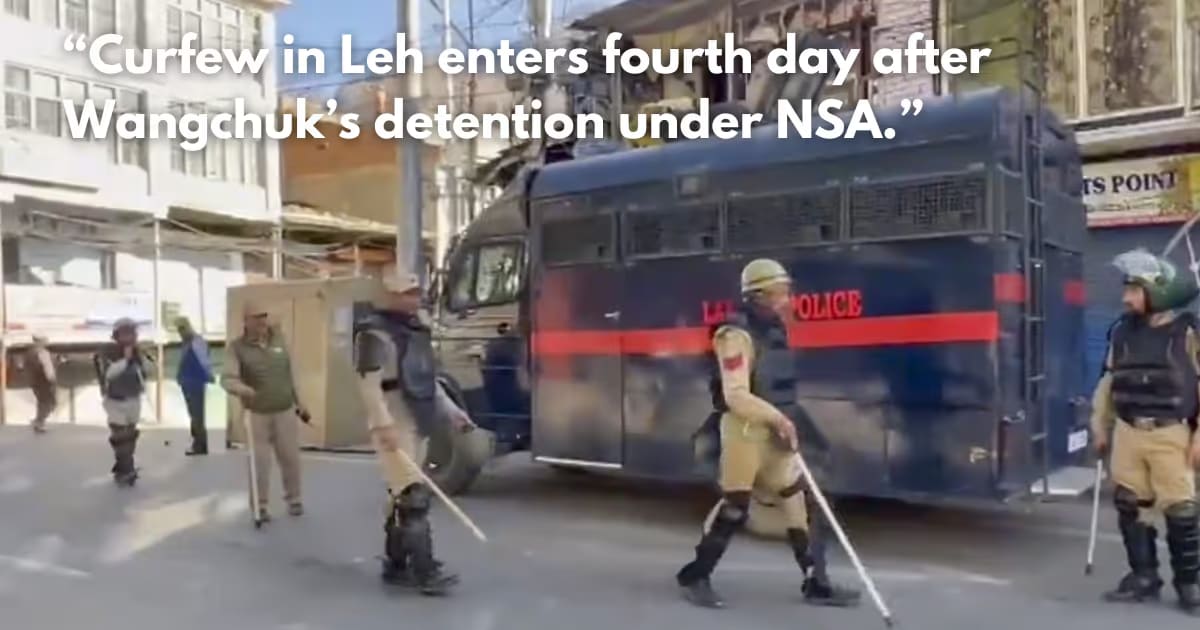


FazTimes Media: Leh has stayed under a strict curfew for the fourth day in a row, as confusion and tension continue in the Union Territory after the arrest of a well-known climate activist, Sonam Wangchuk. Reports indicate that Wangchuk, who was taken into custody under the National Security Act (NSA), might have been sent to Jodhpur Jail in Rajasthan, although the government has not officially confirmed the matter yet.
The ongoing restrictions have stopped daily life completely. Shops are closed, public transport is not running, and schools and colleges are shut. Streets that are usually full of the sounds of tourists and locals are now quiet, with security forces patrolling heavily.
Wangchuk’s arrest happened after the violent clashes on September 24 in Leh, which resulted in four deaths and nearly 70 injuries.
According to police, the violence started when a protest asking for statehood for Ladakh and constitutional protection under the Sixth Schedule turned into a confrontation. Security forces said they had to use force in self-defense when the protestors became aggressive.
The government has blamed Wangchuk for causing the disturbance. The Ministry of Home Affairs (MHA) claims his speeches and public activities led to the situation getting worse. His arrest also happened around the same time that the FCRA license of his NGO, the Students Educational and Cultural Movement of Ladakh (SECMOL), was canceled due to alleged financial issues.
According to Al Jazeera, using the NSA against Wangchuk is a significant event. He is the first person in Ladakh to be detained under the Act since the area became a separate Union Territory in 2019.
In an unexpected action, the Ladakh administration has allowed advisory boards from the Public Safety Act, the Prevention of Illicit Traffic in Narcotic Drugs and Psychotropic Substances Act, and the Prevention of Black Marketing Act to also act as advisory panels under the NSA.
Officials explained this was because of the time-sensitive situation caused by Wangchuk’s arrest.
Chief Secretary Pawan Kotwal issued a notice confirming these changes, showing how seriously the government is treating the unrest. However, legal experts warn that using such wide-ranging powers could push the communities the government is trying to calm further away through talks.
News of Wangchuk’s arrest has caused a big reaction in Ladakh, leading to anger and frustration.
In Leh, people tried to show resistance despite the strong presence of the Indo-Tibetan Border Police (ITBP), Central Reserve Police Force (CRPF), and local police.
Families of the people who died are dealing with loss while being under strict rules.
Two civilians killed in the clashes were cremated on Saturday in ceremonies that were tightly controlled. The authorities limited who could attend the funerals to stop them from becoming large protests.
People described the situation as scary and restrictive. A shopkeeper in Leh, whose store has been closed since the unrest started, said there is a feeling of silence and being unable to move freely. "We are unable to travel freely, and we are uncertain about the resumption of normal life."
Now, officials are checking if outsiders were involved in the violence, including youths from Nepal and Jammu’s Doda district, some of whom were hurt during the clashes. They are also looking into how protesters got petrol bombs, which were used to attack vehicles and offices of the BJP and the Hill Council.
Officials say anyone involved in burning and destroying property could be charged under the Public Safety Act, which allows people to be detained without trial for a long time. Along with Wangchuk, two Congress councilors are also under scrutiny, thereby strengthening the political impact of this crisis.
The unrest has also affected the delicate talks between the government and Ladakh’s two main political and social groups—the Leh Apex Body (LAB) and the Kargil Democratic Alliance (KDA). Both groups have been working together to advocate for full statehood, job reservations, and constitutional protections under the Sixth Schedule, aiming to safeguard Ladakh’s delicate environment and unique cultural identity.
On Friday, a team from the Ministry of Home Affairs met with leaders from both LAB and KDA, with plans for preliminary talks in New Delhi on September 27 or 28. We expect these discussions to pave the way for a high-level committee meeting on four key topics. However, the arrest of Wangchuk has shattered trust between the groups, making meaningful talks more challenging.
Exams have been delayed, and students are told to stay inside. Tourism, which is crucial to Ladakh’s economy, has suffered a lot. Hotel owners say many bookings have been canceled as people avoid the area because of the fear of violence and new restrictions. Local businesses say the long curfew is causing them financial trouble, especially with the arrival of winter, when business usually slows down.
Wangchuk, often called the “climate warrior of the Himalayas,” has long supported sustainable development and conservation in this sensitive region. His arrest under the NSA has worried India’s environmental community, with activists warning that his silence might stop important discussions about climate change, glacier protection, and Ladakh’s unique ecosystem.
According to The Hindu, international NGOs and climate groups are watching the situation closely because of Wangchuk’s global recognition. The controversy might also bring unwanted attention to how India handles dissent, especially in ecologically and strategically important places like Ladakh.
The ongoing curfew and detention of Sonam Wangchuk signal a big change in Ladakh’s political path. Once known for its peaceful protests and push for recognition, the area is now facing strict monitoring and unusual legal actions.
For the people of Ladakh, the quiet streets of Leh mean more than just a lack of everyday life—they show deep worry about whether their hopes will ever be acknowledged. The government is struggling to balance the real concerns of the region’s people with the need to keep order, especially since the area is important for national interests.
According to BBC News, the world is paying close attention. How India handles this situation—whether through talking things out or using force, and whether it chooses security over freedom—will not only affect Ladakh’s future but also how the country is seen as the world’s largest democracy.
Our primary goals at FazTimes Media are to be accurate and confident and adhere to the highest journalistic standards. We check every news story we share against several trustworthy and separate sources to ensure its accuracy.
We have reviewed this report, along with articles from major news outlets worldwide, including BBC News, Reuters, Bloomberg, Al Jazeera, NDTV, The Economic Times, and The Indian Express.
We want to keep the highest standards in global journalism so that our readers can trust the information they acquire.
Link:
https://www.faztimesmedia.com/viewpost/leh-curfew-day-4-sonam-wangchuk-nsa-detention-sparks-tensions


Discussion0
Join the conversation on this story
Loading comments...