
Man Breaches Parliament Security, Caught Scaling Wall
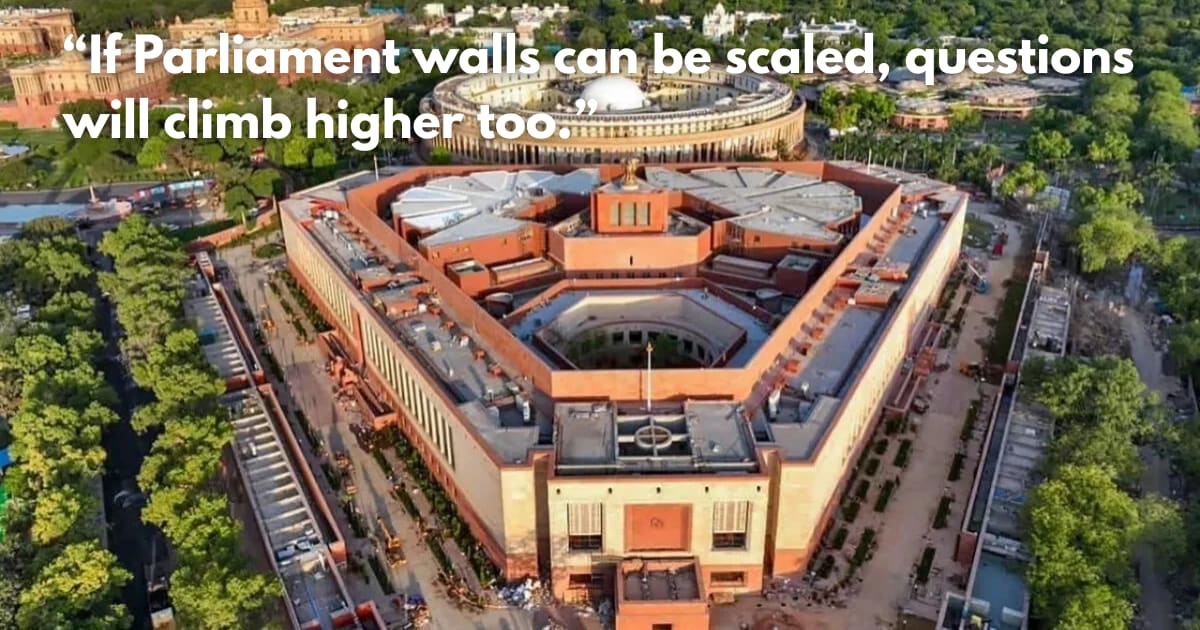


FazTimes Media, New Delhi: In another worrying sign of security weaknesses around India’s main legislative area, a man was caught early on Friday after climbing a tree, scaling a wall that was almost 20 metres high, and entering the Parliament grounds from the Rail Bhavan side. Officials said the person got close to the Garuda Gate of the new Parliament building, just 15 metres away from the wall he climbed, before being stopped by security staff. He was quickly controlled and taken into custody for questioning.
The incident happened during the day and has once again sparked discussions about how well the security measures are working at one of the country’s most protected areas.
A Breach at the Heart of Democracy
For many people, the news has raised a serious question: if a single person can easily get past several layers of security, how safe is Parliament from more dangerous threats? According to The Hindu, initial findings show the man didn’t have any weapons or explosives. Early reports suggest he was acting alone. However, intelligence experts have not completely ruled out any hidden motives until he is fully questioned.
“A serious mistake has been made,” said a senior security official speaking. “Parliament is not just a building; it stands for India’s democracy. We must take any breach, no matter how small, very seriously.”
Not the First Time: A Pattern of Breaches
This is not the first time the Parliament complex has had serious security issues. Earlier this week, the Delhi High Court also asked the Delhi Police to respond to a bail request from one of the accused in that case, Lalit Jha.
Going further back, in 2022, a man in his early twenties climbed over the Parliament wall and entered the Annexe building. CISF personnel quickly caught him. Despite the absence of any dangerous items, the incident demonstrated the determination and resourcefulness of intruders in their attempts to gain access.
Why This Breach Is Concerning Now
What makes this recent breach especially worrying is the timing. It happened just a day after the Monsoon Session of Parliament had ended—a session that was already full of disruptions, strong debates, and political tensions. Some lawmakers say that if the breach had happened while Parliament was in session, the risk could have been much worse.
According to BBC News, India has seen more than 30 serious security breaches at major government buildings in the past ten years. Experts say that while technology, CCTV cameras, and more police presence have helped improve security, the biggest problems still come from “human error” and lack of attention at the local level.
Political Reactions: Concern and Criticism
Some members of Parliament suggested a top-level, bipartisan review of the security at Parliament. “A Parliament is not just a building; it is the heart of our democracy. If something like this can happen here, it shows how poor our security measures are,” said a senior opposition leader, speaking to reporters outside the complex.
Members of the ruling party assured citizens that they are conducting a thorough investigation. They emphasised the swift capture of the intruder and the absence of any harm. Union Home Ministry officials have reportedly asked the Delhi Police and other security agencies responsible for Parliament’s safety to submit a full report.
Public Sentiment: Anger and Anxiety
Many users pointed out that regular people face strict checks and frisking just to enter government offices, yet intruders keep finding ways into the country’s most secure area. “This is a shame for India internationally,” tweeted one user, while another wrote, “If security can’t stop someone from climbing a wall, what’s the point of all the barriers and checkpoints?”
Expert Opinions: What Needs to Change
Security experts believe that India’s Parliament needs a fresh look at its safety procedures. “Security is only as strong as its weakest part,” said retired IPS officer Ajay Mehra in an interview with Al Jazeera. “In this case, physical barriers and perimeter guards seem to be the weakest areas. If someone can climb a tree and scale a wall, then the surveillance must be either blind or not paying attention.”
Other experts suggested using more advanced technology, like motion sensors, thermal cameras, and AI systems that can instantly notify guards of any unusual activity. Some cautioned that no technology can replace the vigilance of on-site security.
What Happens Next
The Delhi Police and central intelligence agencies are now questioning the person who entered the Parliament complex. They are investigating his past, the reasons behind his visit, and any affiliations he may have had.
Since the parliamentary area is very important and symbolises the country’s democracy, the authorities also told the Supreme Court about the incident.
Local government officials in Delhi and the Central Public Works Department, which takes care of the Parliament building, have been asked to look at the wall designs, fencing around the area, and where people can enter. This is to stop such things from happening again.
A Wake-Up Call
Despite the absence of injuries, this event serves as a significant cautionary tale for leaders, security teams, and citizens nationwide. The Parliament is not just a regular government building—it's the heart of India’s democracy. Keeping it safe should be the most important task for the nation.
BBC News reports that many other countries with democracies have had similar problems. For example, people stormed the US Capitol in 2021, and there was a break-in at the Brazilian Congress in 2023. Each time, governments had to improve their security plans. India, which is becoming more important on the world stage and dealing with growing internal challenges, can’t afford to be slow or careless.
Our primary goals at FazTimes Media are to be accurate and confident and adhere to the highest journalistic standards. We check every news story we share against several trustworthy and separate sources to ensure its accuracy.
We have reviewed this report, along with articles from major news outlets worldwide, including BBC News, Reuters, Bloomberg, Al Jazeera, NDTV, The Economic Times, and The Indian Express.
We want to keep the highest standards in global journalism so that our readers can trust the information they acquire.


Discussion0
Join the conversation on this story
Loading comments...