
General
Northern Lights Dazzle US Skies: Aurora Borealis Visible as Far South as Alabama
By Mohamed Areif Mubarack
Published: Nov 12, 2025, 01:55 PM


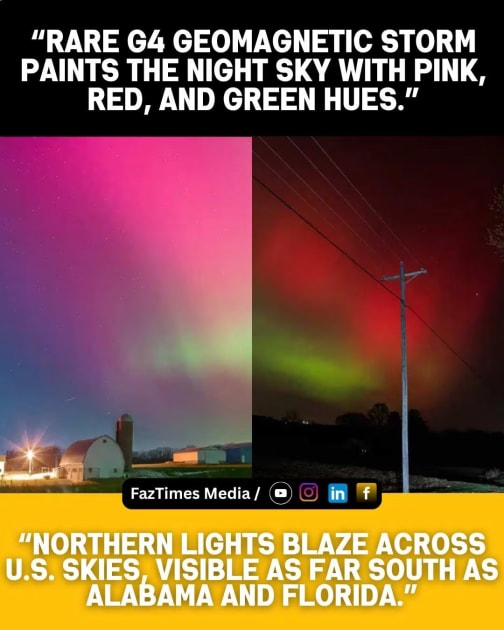
It’s not every night you look up and see the sky bleeding pink, red, and green over Wisconsin—or Alabama, for that matter. But Tuesday night, it happened. Across half the country, from the upper Midwest clear down to the Gulf, the heavens put on one of those shows people will be talking about for decades.
And yeah, it was cold. Really cold. The kind of air that bites your face and fogs up your camera lens. Didn’t matter. People bundled up, dragged kids out of bed, and stood in empty fields just to watch the sky burn. What they saw wasn’t just pretty—it was rare.
Read top trending news on our Faztimes media platform: Click on this Trending news
In Monroe, Wisconsin, the night sky shimmered like a watercolor painting left too long in the rain. The aurora borealis—usually reserved for Alaska, maybe Minnesota on a lucky night—rippled across the dark, streaking magenta and lime across the cold November air.
A few hundred miles south in Bloomington, Indiana, the same ethereal glow stretched over Monroe County’s farmlands. Local skywatchers stared upward in disbelief. “Never seen anything like it,” one amateur photographer muttered, camera still clicking even after midnight.
And it didn’t stop there. Reports poured in from places that rarely see the northern lights—Georgia, Alabama, and even northern Florida. Some folks in Texas caught faint flickers, too, though they probably thought at first their eyes were playing tricks.
If you’re wondering what on Earth (well, above Earth) caused all this—blame the Sun.
Over the past few days, our star has been hurling massive bursts of charged particles—coronal mass ejections, or CMEs—straight at us. Think of them as solar tsunamis: gigantic clouds of plasma and magnetic fields racing through space at blistering speeds.
When these particles collide with the Earth’s magnetic field, they slam into the gases high up in our atmosphere and light them up like neon signs. That’s what creates the aurora borealis in the north—and its southern twin, aurora australis, near the South Pole.
According to NOAA’s Space Weather Prediction Center in Boulder, Colorado, Tuesday night’s storm hit a G4 on their geomagnetic scale. That’s the second-highest level possible—and it almost tipped into G5, the top category.
There’s a catch, of course. Solar storms that strong don’t just make for pretty skies—they mess with things.
Forecasters have been warning about possible power fluctuations, temporary GPS slowdowns, and radio disruptions. In other words, your car’s map might go a little haywire, and pilots might have to rely on the old-fashioned way—looking out the window.
The Space Weather Prediction Center called these “watches at this level very rare,” adding that what we’re seeing now is “the heart of the magnetic cloud passing directly over Earth.” It’s expected to keep doing so through Wednesday night.
And here’s the kicker: another, even stronger CME is already on its way. If forecasts are right, it could push the auroras even further south. Yes—possibly lighting up skies over parts of the Deep South that have never seen anything like it.
Across social media, photos started flooding in by midnight—some grainy, some breathtaking. People in snow boots and pajamas are grinning at the sky. A farmer in Iowa posted a shot of his tractor silhouetted under electric green curtains of light. In Michigan, a couple got engaged under the aurora—talk about timing.
Even meteorologists couldn’t help sounding giddy. “It’s one of the strongest solar storms in decades,” one wrote on X (formerly Twitter). And for once, the hype wasn’t exaggerated.
In the world of space weather, these G4 and G5 events don’t come often. The last comparable one hit back in 2003—remember the Halloween Storms? This one, though, had a twist: it was visible across nearly the entire continental U.S. That’s the kind of thing that sends both scientists and photographers racing into the night.
If you missed last night’s show, don’t beat yourself up. You might just get another shot. NOAA says the final, most energetic CME is barreling toward Earth and could arrive Wednesday evening.
So if you live anywhere with open skies—Kansas, Tennessee, maybe even the northern edge of Mississippi—grab a coat, charge your phone, and get ready. Step away from city lights, let your eyes adjust, and just look up.
The Space Weather Center’s extended forecast suggests temperatures will still be icy, but skies will be mostly clear across large stretches of the Midwest and Plains. Bundle up; it’ll be worth it.
Because when the heavens decide to dance this far south, you don’t sleep through it.
What’s happening up there tonight is more than just a spectacle. It’s a reminder that Earth, for all its noise and cities and satellites, still answers to the Sun’s moods.
Those swirling ribbons of color—born from invisible storms millions of miles away—touch something primal in us. Ancient people saw omens. We see science. But standing there under that glowing sky, feeling small and amazed… well, maybe we’re not so different from them after all.
So here’s hoping the clouds stay away, the power grids stay steady, and the universe keeps showing off a little.
FazTimes Media has been providing you with unique and standard breaking news related to general, business, sports, entertainment, politics, and more.
Reference: You can read more details on this portal, nbcnews.
Link:
https://www.faztimesmedia.com/viewpost/northern-lights-dazzle-us-skies-aurora-borealis-visible-as-far-south-as-alabama


Discussion0
Join the conversation on this story
Loading comments...