
Putin Offers to Mediate Iran-Israel Conflict Amid Escalating Middle East Tensions
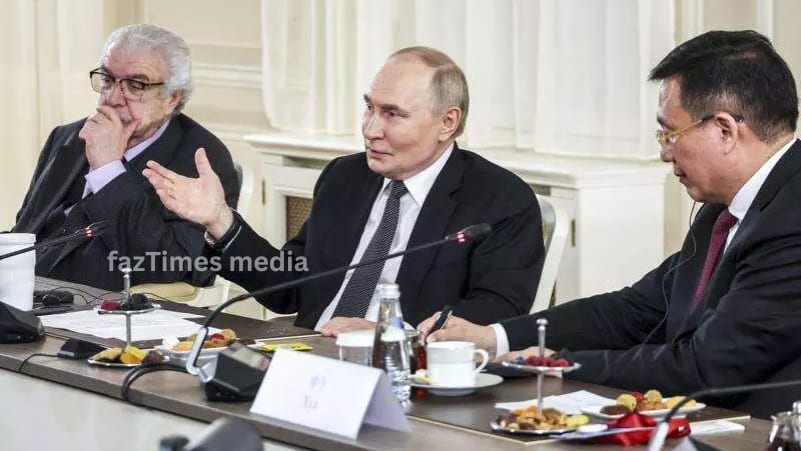
fazTimes media: St. Petersburg, Russia — Putin, the president of Russia, has made a bold offer to help ease tensions between Iran and Israel. He has come up with a strategy to calm things down that takes into account Iran's right to build nuclear weapons peacefully and Israel's long-standing security concerns. His comments were made during a wide-ranging talk with editors of foreign news agencies at the St. Petersburg Foreign Economic Forum. They were a big step forward in one of the Middle East's most deadly fighting zones.
Putin's proposal of Russian mediation is an interesting twist in the geopolitics of the region, especially since the US is thinking about getting more involved in the confrontation between Iran and Israel, which might escalate into a greater war. We don't know if it will succeed or not, but it definitely shows that Moscow wants to stay in charge of dealing with global problems, even as it is fighting its own war in Ukraine.
There is a fragile balance in the Middle East.
Netanyahu noted that the relationship between Iran and Israel was "touchy," but it might yet be fixed. He added, "There might be a way to fix this." The president of Russia indicated that Moscow has already talked to Tehran, Tel Aviv, and Washington about how to strike a peaceful agreement. He made it obvious that they weren't making anyone do anything. "We're just talking about what we think might help us get out of this."
Putin's approach seems to be built on two promises: Iran can keep working on its nuclear program as long as it does it peacefully, and Israel can be sure that nuclear weapons or other threats won't hurt it. This method of thinking is comparable to the Joint Comprehensive Plan of Action (JCPOA), which Russia supported to make happen in 2015.
Russia's power is growing in Iran.
Putin used the ceremony to underline how important it is for Russia and Iran to work together, especially when it comes to nuclear energy. More than 200 Russian engineers are working on two additional reactors at Iran's Bushehr nuclear project. There is already one reactor there.
Putin said that Iran has not asked Moscow for military support with the current crisis, even though there were reports to the contrary. He also emphasized again that the agreement the two countries struck earlier this year does not include any stipulations about defense or weapons support.
He did remark, though, that Moscow has offered to assist Iran in creating a whole air defense system instead of just sending them surface-to-air missile systems like the S-300. Tehran didn't do anything else with that notion.
He seemed to be reacting to what Israel said, which was that Israeli airstrikes last year destroyed Iranian S-300 batteries that Russia had given them.
Iran and Israel: Between Proxy Wars and Red Lines
Israel and Iran have been at war for a long time, and now there are serious strikes in Syria, Lebanon, and maybe even inside Iran itself. Both countries have to deal with difficult alliances, politics at home, and rivalry in the area. Israel sees Iran's expanding military presence and nuclear ambitions as a threat to its very survival. Iran, on the other hand, believes that Israel's actions are a threat to its sovereignty and power in the region.
Ayatollah Khamenei has pledged heavy punishment for Israel's recent attacks on Iranian facilities with planes. He also said that any U.S. support for Israel could inflict "irreparable damage" on the U.S. When asked what Russia would do if Israel killed Khamenei, Putin wouldn't reply. He frowned and added, "I don't even want to think about that."
Putin is walking a tightrope: he criticizes Israel but not the U.S.
Russia has officially acknowledged that Israel's attacks on Iranian land are against international law, but Putin didn't openly criticize the US in his statement at the summit. Analysts suggest that this calm tone might be because Russia wants to be seen as a neutral broker, even if it has clear loyalties.
Putin said something important when he said that Russia and Israel had worked out a deal for Israel's safety. This could suggest that Moscow is still attempting to find a way to balance its tight connections with Iran with its talks with the Israeli administration. Finding the appropriate balance in this circumstance is complicated, especially when Russia and Israel have worked closely in Syria to prevent direct conflicts even though they are both in the same fighting zone.
Ukraine: A Fancy Defense for a Different War
Putin was also asked about Russia's intensified actions in Ukraine, such as the horrible attack on an apartment building in Kyiv that killed 28 people. News organizations from around the world, including the Associated Press, have reported on several civilian deaths. This goes against what Moscow says, which is that it is solely attacking military equipment.
Putin added, "Our strikes are aimed at Ukraine's military-industrial complex, not homes." He didn't trust pictures of civilians who had died because he assumed they were "collateral damage" or "Western misinformation."
He also took the chance to compliment Donald Trump, the former president of the United States. He said that the Russia-Ukraine war "might not have happened" if Trump had stayed in office. This is in line with what Trump indicated during the campaign and suggests that Putin wants to go back to Trump's way of doing things.
Putin's conditions for a ceasefire: Halt Ukraine from getting ready for war.
Putin said he was willing to start new peace negotiations, but he made it plain that Ukraine had to stop gathering soldiers and Western countries had to cease transferring weapons to Ukraine. He stated that Russia may then consider about a 30-day ceasefire plan that Trump is said to support.
Putin also claimed again that he doesn't think Volodymyr Zelenskyy is a real leader anymore because his tenure finished last year. This claim is not true for Kyiv or most Western countries. Putin made a strong point when he said, "If no deal is reached, we will reach our goals through military means." And the terms for peace will be worse in the future.
Please don't launch any long-range missiles, Germany.
Putin made it quite clear to Germany that sending Taurus long-range cruise missiles to Ukraine would place Berlin in direct conflict with Russia. He said that NATO members' fears of a Russian strike on member states were "crazy." He argued that Russia had no need to start a wider conflict because NATO's military budget is far more than Russia's.
But these types of things haven't helped people in Europe calm down. People are still worried about what Russia wants to do in Eastern Europe because of what Russia does on the battlefield and what the Kremlin says.
The Big Picture: Can Putin keep things quiet while he's fighting?
Putin may want to assist in settling the Iran-Israel situation, but he is also still fighting in Ukraine, where a lot of damage and suffering have been reported among civilians by international observers. Some people claim that Russia can't be a mediator since it won't stop fighting in its own war. Moscow has remained a prominent influence in the affairs of both Europe and the Middle East, whether through military alliances, oil diplomacy, or its historical significance.
Dr. Elena Ivanov, a foreign policy expert in Brussels, thinks that Russia's attempt to mediate is "part opportunism and part strategy." "It helps the Kremlin look powerful and legitimate, even though it is being punished and criticized in other parts of the world."
Thoughts for now
We still don't know if Russia's willingness to mediate will really help Iran and Israel talk to each other. Putin, on the other hand, made it clear that Russia wants to be included in significant international talks, even if it doesn't want to be in command of them. Even though Russia has its own challenges, this is still true. The globe is getting more intriguing because of multipolar conflicts and changing alliances. Moscow is doing everything it can to stay significant, even though it has a lot of problems to deal with.
For more in-depth news and opinions on international relations, regional safety, and how to settle international disputes, keep reading fazTimes.


Discussion0
Join the conversation on this story
Loading comments...