
RSS Chief's 75-Year Remark Sparks PM Modi Retirement Debate
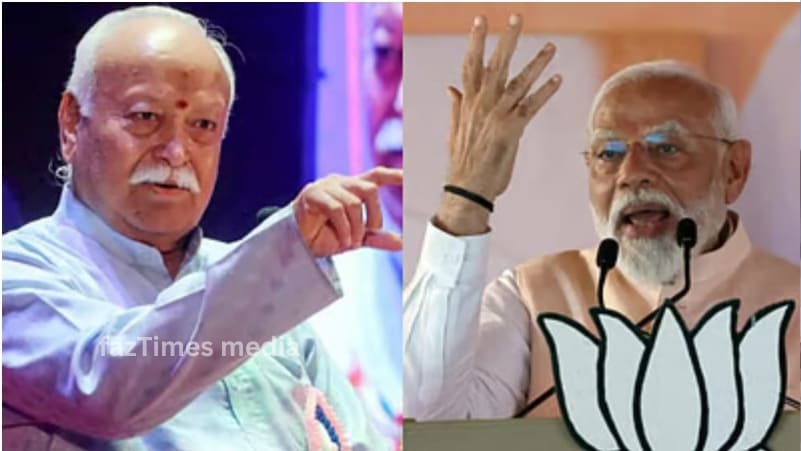
fazTimes media: New Delhi – A single story shared by RSS chief Mohan Bhagwat during a recent book event has sparked a lot of political talk and new discussions about who will lead in the future and what happens when leaders retire in Indian politics. Bhagwat shared that when Pingale was 75, he jokingly said that events like these were not celebrations but a polite way of saying, "Your time is up; let the next generation take over." Despite the intended humor and respect, the comment has ignited a significant political debate.
The Subtext and the Spin
The RSS, often viewed as the main source of ideas for the ruling Bharatiya Janata Party (BJP), has always maintained an informal rule that the usual age to step back from active work is 75. This idea became more noticeable in 2014 when experienced leaders like L. K. Advani and Murli Manohar Joshi were placed in the 'Margdarshak Mandal,' a group that gives advice but doesn't have the power to make decisions.
When Bhagwat mentioned Pingale's joke about being honored at 75, people started to think about what it might mean. But the RSS leaders have tried to stop people from taking it too seriously.
A senior RSS member told The Indian Express, “Pingale’s comment was just showing his modesty, not a hidden message. There are no talks inside the RSS about Bhagwat retiring, and nothing was said about the Prime Minister.”
The BJP quickly reacted to Sanjay Raut's remarks, criticizing him for taking a light comment and turning it into a political issue. Union Home Minister Amit Shah has also said before that the BJP's rules don't set an age limit for leadership.
In an interview from 2023, he stated, "There's no age limit for leaders in our party. What matters is the people's choice, not made-up limits."
What Makes This Remark Politically Important?
Even though both the BJP and RSS have said there is no secret message behind the comment, it's hard to ignore the situation and the timing. Prime Minister Modi is still very popular, especially after winning a third term in 2024. The discussion about leadership changing with generations isn't new, especially since more than 65% of India's population is under the age of 35. People have been talking for years about when and how senior leaders should give way to younger ones.
According to BBC News, it's not straightforward to plan for the next leader in Indian politics. Some regional parties, like DMK and TDP, have moved leadership within families, but national parties often face problems when leaders leave or when power stays too concentrated in one place.
Political analyst Pradeep Bhandari: "The Bhagwat comment is important not because it gives a specific date for retirement, but because it brings up a bigger question: How long should someone stay in power before they step down politely?"
The Pingale Parable: Is It More Than Just a Joke?
It's fascinating how Bhagwat's version of Pingale's story goes beyond just talking about old age. It's really about letting go of pride and not being attached to things. According to The Hindu, Bhagwat said Pingale made sure he stayed calm and not too proud even when people honored him. Such behavior suggests that true leadership is about knowing when to step back and not getting too attached to being in charge.
This idea fits well with the RSS values of "sewa" (service) and "tyaga" (sacrifice). In the past, RSS workers have willingly given up their leadership roles without waiting to be forced out, which shows a strong culture of discipline and moving on when needed.
However, the political landscape presents a more complex picture. The rules aren't as strict, and it's easier to interpret things differently. Especially in a democracy, where people's approval is the main thing, it's not always simple to know when to step aside.
Political Reactions: Split and Strategic
Opposition groups are using this moment to call for new leaders in different parts of the political scene. A spokesperson for Congress, Supriya Shrinate, said in a statement, “There should be rules about when leaders have to step down, just like in other jobs. You can't hold power forever.”
On the other hand, leaders in the BJP are keeping quiet. No major figures have spoken out against Modi’s leadership or suggested any plans for a future leader. The Prime Minister himself has talked about staying in power as long as the people support him, saying, “As long as the people give me strength, I will continue to serve.”
The Road Ahead: Retirement, Relevance, and Realpolitik
As both Mohan Bhagwat and Narendra Modi turn 75, discussions about who will take over are probably going to get more intense, especially within the Sangh Parivar. However, since Modi has such strong control over the party and the government, any leadership changes are likely to be carefully managed and planned out in detail.
Unlike in Western democracies, where age often leads to stepping down from public roles, Indian politics has a history of leaders staying in power for a long time, like Morarji Desai and Atal Bihari Vajpayee.
Age is respected, but it's not usually considered a reason to stop leading, especially if they're still winning elections. As Al Jazeera pointed out in a recent article, “Modi’s image has gone beyond his age—he is viewed more as a national leader than just an old man. But that doesn’t mean the talk about changing generations isn’t important.”
Final Thoughts: Not Just About Modi
While the main attention is on Prime Minister Modi, the bigger picture is about the political culture and how power changes. Important questions are being raised about how long leaders stay in charge, how they are held responsible, and how new leaders come in, especially in a country that is changing quickly.
No matter what Bhagwat meant, his actions have started an important conversation across the country.
And maybe that's what democracies need—constant reminders that even great leaders have to step aside eventually.
At FazTimes, we prioritize accuracy, confidence, and strong journalistic standards. We ensure every news story we share is real by verifying it with multiple trustworthy and independent sources.
We’ve compared this report with coverage from major news outlets around the world, including BBC News, Reuters, Bloomberg, South China Morning Post, Al Jazeera, NDTV, The Economic Times, and The Indian Express.
We are dedicated to maintaining the highest standards in global journalism so our readers can rely on the information they get.


Discussion0
Join the conversation on this story
Loading comments...