
Scientists Detect Most Massive Black Hole Merger Ever: 225 Solar Masses!
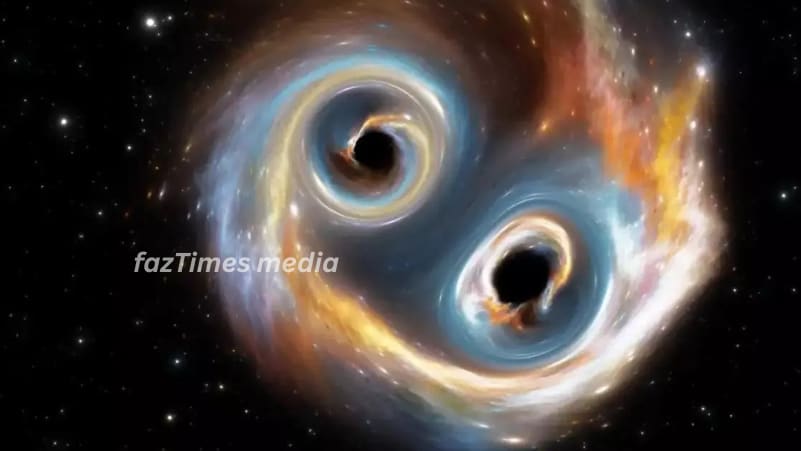
fazTimes media: The largest black hole collision ever observed, a discovery that has caused significant ripples in the scientific community. This huge event happened 10 billion light-years away from Earth, so far that it made scientists rethink what they know about how the heaviest objects in the universe come to be. The collision happened deep in space, involving two black holes that were 103 and 137 times the mass of our Sun. They spun around each other at super high speeds and then smashed together to form one massive black hole with a total mass of about 265 suns.
This big crash created strong gravitational waves—like ripples in space itself—that were detected by the LIGO observatories in Washington and Louisiana on November 23, 2023. Despite their brief duration, the signals contained information from billions of years ago. According to The Guardian, the event is the most powerful and massive black hole collision ever recorded, and it shakes up some of the old ideas in the study of the universe.
A Cosmic Event Beyond Expectations
This huge event isn't just about big numbers—it's about big questions. Until not long ago, black holes of this size were believed to be either very rare or even impossible to form through the usual process of stars dying and collapsing. Researchers discovered that both black holes were spinning at speeds approximately 400,000 times faster than Earth's rotation.
Scientists say this pace is almost as fast as the maximum speed such objects could spin. This has made researchers think these big black holes weren’t made from a single dying star but instead were created when smaller black holes merged over time. “This is the clearest evidence we have of what’s called a hierarchical merger,” said Dr.
Radhika Menon, an astrophysicist at the Inter-University Centre for Astronomy and Astrophysics (IUCAA) in Pune. “One black hole eats another, grows bigger, and then finds another partner to merge with. It’s like cosmic cannibalism on a grand scale.”
Albert Einstein first guessed gravitational waves more than 100 years ago as part of his general theory of relativity. But they weren’t seen until 2015. Since then, studying gravitational waves has become one of the most thrilling areas in modern science. These waves occur when massive objects, such as black holes or neutron stars, accelerate rapidly, particularly when they collide.
They cause tiny ripples in spacetime. Even though these ripples are almost impossible to notice by the time they reach Earth, special tools like LIGO can pick them up. BBC News said this event made the detectors notice a change in length smaller than a proton. That’s a huge accomplishment for science and engineering.
Why This Discovery Matters
In the last ten years, scientists have found more than 300 cases where black holes merged, but this one is special because of how big it is, how fast it spins, and how much energy it released. This event's significance stems from its occurrence in a mass range previously considered impossible.
Scientists used to believe that black holes weighing between 100 and 150 times the mass of our sun couldn’t form normally. That’s because stars of that size would explode in a particular type of supernova called a pair-instability supernova, and that kind of explosion doesn’t leave behind a black hole. But this merger shows that’s not the whole story—or suggests we didn’t understand how stars and black holes grow properly.
Dr. Arun Bhatia of the Indian Institute of Science, a theoretical physicist, stated, "This fundamentally alters our understanding." It shows there’s another way to make such massive black holes, and it probably involves many mergers taking place in crowded star clusters or the centers of galaxies.
A Window into the Ancient Universe
Another fascinating thing is how far away this event took place—about 10 billion light-years. That means we're seeing something that happened 10 billion years ago, when the universe was still quite young. Being able to spot such an old event so clearly shows how powerful gravitational wave astronomy is.
It also gives us new ways to study the early universe, especially how the first stars and galaxies came to be.
“Gravitational waves let us see the universe in a whole new way,” said Dr. Meenakshi Sharma, an astrophysicist at the Tata Institute of Fundamental Research. Dust and gas can block or scatter light, but gravitational waves can pass through anything. It's like having a cosmic stethoscope that listens to the universe's heartbeat.
The excitement from this discovery is just the start. Scientists are already developing new tools like LISA (Laser Interferometer Space Antenna), which the European Space Agency plans to launch in the 2030s. These space-based instruments will help spot even weaker and more distant gravitational waves than before.
At the same time, India’s INDIGO project is preparing to create a LIGO-like observatory in the country. This new knowledge will help detect gravitational waves more closely and increase the worldwide reach of these cosmic events.
Dr. Sharma explained, “When we have detectors on every continent and in space, we’ll be able to locate these cosmic happenings with a lot of precision. It’s not just about black holes—we could also find signals from cosmic strings, dark matter interactions, or even hints about the beginning of time itself.”
What This Means for Local Readers
You might be thinking—how can a black hole merging 10 billion light-years away affect life on Earth? While it doesn’t change your morning tea or traffic in Delhi, this discovery shows how closely linked we are to the universe.
Every element in your body, like carbon, iron, and oxygen, was created inside stars. The black holes we are studying today are the leftovers from those old stars. Learning about their lives and deaths helps us understand where we come from.
Also, India is participating in this research. Universities like IUCAA, IISc, and TIFR are working with scientists around the world. There are also plans for a local LIGO facility, which means the future of Indian astronomy looks promising.
Al Jazeera has reported that the GR-Amaldi meeting in Glasgow will unveil the results from this massive black hole merger. This is a major event for gravitational wave researchers. We expect Indian scientists to play a significant role in sharing their findings.
Final Thoughts
The biggest black hole merger ever seen isn’t just a big event in the sky—it’s a big moment for science, a big question about the universe, and a reminder of how curious humans are. As our tools get better and our ideas grow, who knows what secrets the universe has left to share?
We need to learn the stories of the stars, even if they're millions of years away.
At FazTimes, we prioritize accuracy, confidence, and strong journalistic standards. To ensure every news story we share is real, we verify it with multiple trustworthy and independent sources.
We’ve compared this report with coverage from major news outlets around the world, including BBC News, Reuters, Bloomberg, South China Morning Post, Al Jazeera, NDTV, The Economic Times, and The Indian Express.
Our dedication lies in upholding the highest standards in global journalism, ensuring our readers can trust the information they receive.


Discussion0
Join the conversation on this story
Loading comments...