
General
Taliban Blames 'Irresponsible' Pakistan as Peace Talks Collapse Over Security
By Mohamed Areif Mubarack
Published: Nov 08, 2025, 01:06 PM
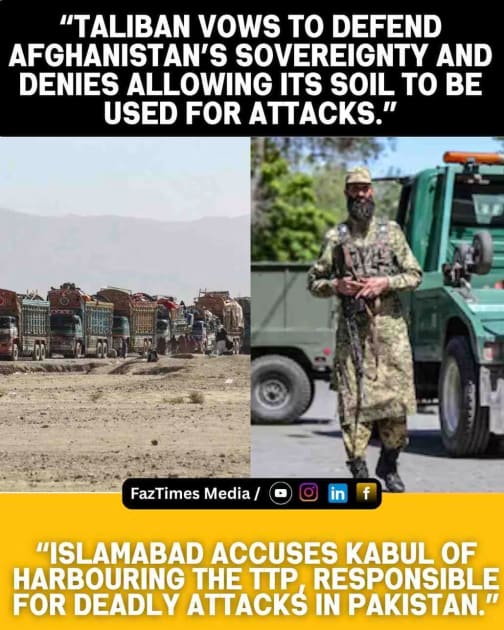


FazTimes Media, Taliban, 08 Nov: Another blow to regional diplomacy has come as the fragile peace talks between the Taliban and Pakistan have ended without results after two days of discussions in Istanbul. The Taliban government has criticized Islamabad for being "irresponsible and evasive" during the meetings while stating they will continue to follow the ceasefire agreement on their disputed border, even as recent clashes have occurred.
Read top trending news on our Faztimes media platform: Click on this Trending news
The discussions, which brought some hope at first, ended late Friday without an agreement. Both sides left the talks sticking to their old positions, showing how deep the mistrust between them still is.
Taliban spokesperson Zabihullah Mujahid said Saturday that the Afghan side came to the talks with honesty and a clear plan, hoping for real and practical solutions from Pakistan to fix ongoing problems. However, he said Islamabad used the talks to avoid blame and didn’t take responsibility for its own security issues.
He added that Pakistan’s actions showed an “irresponsible attitude” that stopped any real progress from happening. Still, Mujahid said the ceasefire remains in effect, and the Taliban has no plans to increase fighting. “Our government has honored the ceasefire and will keep doing so,” he said, stressing that the Taliban has “no plan to start more fighting.”
The Pakistani government hasn’t made a direct response yet. While Islamabad hasn’t responded immediately, officials said the talks didn’t reach any major agreement and admitted there was “no significant progress.” Information Minister Attaullah Tarar told reporters that Pakistan “won’t support any Afghan government actions that harm the Afghan people or the region’s stability.”
The discussions between the two countries collapsed following a series of border clashes that happened during the week.
These clashes led to the deaths of several civilians and injured many more. On the Pakistani side, 23 soldiers were killed in attacks that are believed to have been carried out by the Taliban, with nearly 30 others wounded.
Small communities that straddle this porous border now face constant threats from bombings, blocked roads, and disrupted trade, which are already affecting their daily lives due to poverty and displacement.
A major point of contention between the two nations is Pakistan’s claim that the Taliban has not kept its promises made under the 2021 Doha Agreement. This agreement, which was signed between the Taliban and the United States, helped the Taliban regain control of the country. Islamabad argues that the Taliban promised not to let Afghan territory be used by militant groups that target neighboring countries—a promise that Pakistan says has not been honored.
The Pakistani military says the TTP operates unchecked from Afghan territory, carrying out attacks and then escaping back into Afghanistan.
“Our position is clear,” said Tarar in Islamabad. “Terrorist bases in Afghanistan pose a threat not just to Pakistan, but also to peace in the region. The Taliban government is responsible for ensuring that no group uses Afghan land for acts of violence.”
The Taliban has strongly denied these allegations. Mujahid said the Afghan government “does not provide shelter or support to any foreign militants” and is committed to ensuring that its territory is not used against any country. He added that the Afghan people see Pakistanis as “brothers and friends,” but Afghanistan will “firmly defend its sovereignty and territorial integrity.”
The talks in Istanbul were led by diplomats from Qatar and Türkiye, two countries that have kept open lines of communication with both Kabul and Islamabad. Although the mediators were acknowledged for their efforts, their ability to close the growing gap in trust between the two sides was found to be limited.
Turkish officials voiced their disappointment over the lack of progress but stated that both parties still appeared to be committed to engaging in dialogue. “Each side accuses the other of sheltering militants or triggering conflicts,” explained Dr. Farhad Osmani, a security analyst based in Kabul. “Until these shared concerns are addressed, any mediation will struggle to achieve long-term success.”
The situation inside Pakistan is also becoming more challenging. With increasing violence in the country's northwest, public pressure is growing on the government in Islamabad, which is backed by President Trump, to adopt a stronger position against the Taliban. Some Pakistanis blame the Taliban for not stopping extremist groups, while others criticize their own government for letting relations with Afghanistan worsen after years of strategic cooperation.
In October, the Pakistani military launched cross-border airstrikes in response to TTP attacks that left many security personnel dead. Kabul criticized these strikes as “violations of Afghan sovereignty.” In response, Islamabad claimed the attacks were aimed at “terrorist hideouts” linked to recent bombings in Bannu and Dera Ismail Khan.
Experts highlight that these back-and-forth military actions could lead to a full-scale conflict between the two nations if diplomatic talks completely break down.
The ruling group is focused on showing strength and independence, especially in relation to Pakistan, which has long been accused by Afghans of interfering in their internal matters.
“Many Afghans see this as more than just a border issue,” explained Rahmatullah Ahmadi, an Afghan journalist based in Herat. “It's about pride for the nation. The Taliban doesn’t want to look weak or rely on Pakistan. Defying Islamabad is popular back home, even as the country faces trouble in several areas.”
Afghanistan's economy is struggling, unemployment is high, and aid is decreasing, leaving millions in poverty. Despite these challenges, the Taliban leadership keeps highlighting sovereignty and independence as key values. Mujahid’s recent statements supported this stance: “We will not let any country challenge our independence or use Afghan land for attacks.” Regional and Global Repercussions
FazTimes Media has been providing you with unique and standard breaking news related to general, business, sports, entertainment, politics, and more.
Reference: You can read more details about the above news on this portal, Al Jazeera.
Link:
https://www.faztimesmedia.com/viewpost/taliban-blames-irresponsible-pakistan-as-peace-talks-collapse-over-security


Discussion0
Join the conversation on this story
Loading comments...