
Thailand-Cambodia Border Conflict: 32 Dead, UN & ASEAN Urge Calm
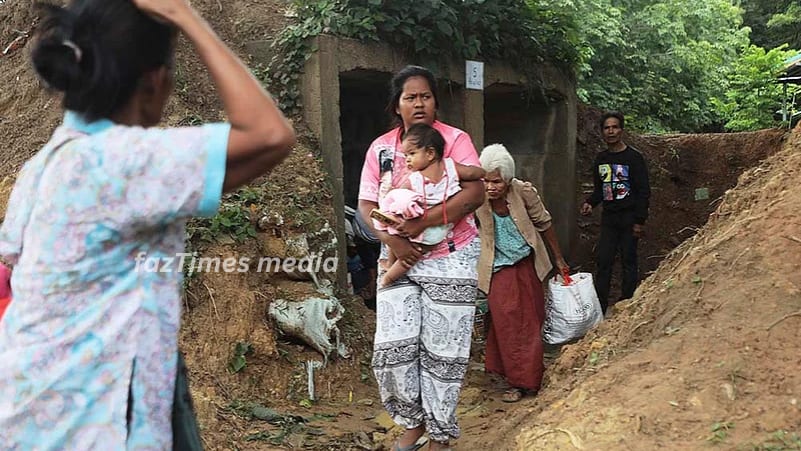
fazTimes media: The border battle between Thailand and Cambodia, which has been ongoing for three days, has claimed the lives of at least 32 people. Over 80,000 civilians have been forced to leave their homes. The latest flare-up, which has its roots in a long-running land disagreement, has gotten the attention of people all over the world. The United Nations and the Association of Southeast Asian Nations (ASEAN) have both called for instant peace and discussion.
The fights start.
A blast on Wednesday hurt five Thai soldiers near the controversial Ta Muen Thom temple area, which has been claimed by both countries for a long time. The incident sparked the fighting. Thai police say that Cambodian landmine forces set off the explosion and that heavy weapons and BM-21 rocket launchers then fired across the border. Thai military sources told BBC News that the attack had nothing to do with them. Cambodia, on the other hand, has denied starting any fighting. Thai troops violated the fragile truce agreement from 2022, prompting Cambodian officials to respond in self-defense.
There have been more deaths, and many people are being forced to move. The Thai Health Ministry reports that more than 58,000 people from four provinces have sought safety in emergency shelters. Simultaneously, Cambodian officials report that their side of the border has forced over 23,000 people to flee their homes.
The number of deaths in Cambodia has risen to 13, including seven civilians and six soldiers. In Thailand, 19 people died, mostly soldiers. Local hospitals and healthcare workers are overworked, particularly in the Surin and Sisaket areas of Thailand, where shelling has damaged medical facilities.
In the province of Oddar Meanchey in Cambodia, schools have been ordered closed, and people have gone to Buddhist temples to stay safe. A mother of two from the area, Srey Roth, said, "We're living in fear." "We hear the shelling every night." We only want peace.
Reactions and diplomatic pressure around the world
The UN Security Council convened a secret emergency meeting in New York on Friday due to the escalating situation. It was said that all 15 member states called for a calm down and asked both sides to commit to a peaceful settlement, but no official statement was made public.
Cambodia's UN ambassador, Chhea Keo, claimed that his country had not started any fighting. He asked, "How could a small country without an air force attack a country with three times as many soldiers?" The Thai UN representative left the meeting without saying anything.
At the same time, Malaysia, which leads ASEAN, offered to act as a mediator. Anwar Ibrahim, the prime minister of Malaysia, said that both sides had agreed in general to end the fighting and pull back their troops, but that the specifics were still being worked out.
Anwar told the press in Kuala Lumpur, "I urged both governments to put dialogue first and avoid more civilian casualties." "We can't let violence decide the future of ASEAN."
On the ground, there is chaos and loss.
Reporters for FazTimes in Surin province are discussing the ongoing humanitarian situation. Over 600 people have now been evacuated to the FazTimes shelter, where volunteers are working hard to provide clean water and basic medicine.
The fire hit Phanom Dong Rak Hospital, where doctors treated hurt soldiers with few supplies. Dr. Nitirat Suksomboon said, "We're short on boots, beds, and trauma kits." "2025 is not the right year for such an incident to happen."
People in the town across the border in Cambodia built homemade bunkers and ran into the hills. A wise monk named Som Raksa said, "Our pagoda can now house 80 people." Every day, we ask for peace, but we need help.
Historical Background
The fight has roots that go back many years. Thailand and Cambodia share an 800-kilometer border that has been a source of conflict for a long time. In a disagreement over the Preah Vihear temple in 1962, the International Court of Justice decided in favor of Cambodia. However, arguments over nearby lands like Ta Muen Thom have not been settled.
The last big flare-up happened in 2011 and killed 20 people over four days. Since then, there have been a few small fights here and there, but they have mostly stayed small until now.
Implications for politics
When Cambodia attacked and hurt civilian hospitals, Thailand's acting prime minister, Phumtham Wechayachai, said that Cambodia might have been committing war crimes. Besides that, he stressed that Thailand had been calm. "We are protecting our people and our land." Cambodia needs to stop making trouble.
Hun Manet, the new prime minister of Cambodia after his father, Hun Sen, faces a lot of pressure to show power while still protecting Cambodia's independence. Experts suggest that the outcome of this fight could significantly impact his political reputation.
The Road Ahead: António Guterres, the secretary-general of the UN, made a strong plea for quiet. He told them, "The violence has to stop." "All sides must put talking over fighting as the priority." People who don't agree with politics should never have to deal with the consequences.
People on both sides, as well as global powers and regional partners, are now putting a lot of pressure on them to back away from the edge. However, a great deal of mistrust exists, necessitating clear mechanisms to monitor the situation.
"This is not just a territorial fight," said Thai political scientist Dr. Jirawat Chanwong. It's about national pride, staying alive in politics, and seeing how united ASEAN is in the modern world. As both sides think about what to do next, one thing is clear: the people stuck in the middle of the fighting are the real losers.
At FazTimes, we prioritize accuracy, confidence, and strong journalistic standards. To ensure every news story we share is real, we verify it with multiple trustworthy and independent sources.
We’ve compared this report with coverage from major news outlets around the world, including BBC News, Reuters, Bloomberg, South China Morning Post, Al Jazeera, NDTV, The Economic Times, and The Indian Express.
Our dedication lies in upholding the highest standards in global journalism, ensuring our readers can trust the information they receive.


Discussion0
Join the conversation on this story
Loading comments...