
General
Trump Admin Plans New Probe on Global Drug Pricing, Tariffs Loom (FT Report)
By Mohamed Areif Mubarack
Published: Oct 22, 2025, 09:16 AM
Last updated: Oct 22, 2025, 09:20 AM


FazTimes Media, Washington, D.C., 22 Oct — As the United States faces one of the longest government shutdowns in its history, a new Reuters/Ipsos national poll has revealed a surprising twist: while most Americans blame Republican lawmakers for the crisis, President Donald Trump’s approval rating has edged upward, defying expectations amid growing frustration across the nation.
The poll, conducted over six days and closing on Monday, shows Trump’s approval at 42%, a modest 2-point increase from earlier in the month. Despite the chaos in Washington, the president’s approval has remained steady between 40% and 44% since April, signaling that his core supporters continue to stand by him.
According to the survey, 50% of respondents said Republican congressional leaders bear the most responsibility for the shutdown, while 43% blamed top Democratic lawmakers. The rest either blamed both sides equally or were unsure.
The standoff, now stretching into its third week, has entered its 21st day, making it the third-longest government shutdown in U.S. history. The shutdown, which started on October 1, has stopped many federal departments from working, forced hundreds of thousands of government workers to stay home without pay, and messed up basic services across the country.
Airports nationwide report flight delays due to insufficient air traffic controllers and security agents. Economists caution that the shutdown may have a minor overall impact on GDP, but its human cost is far more significant.
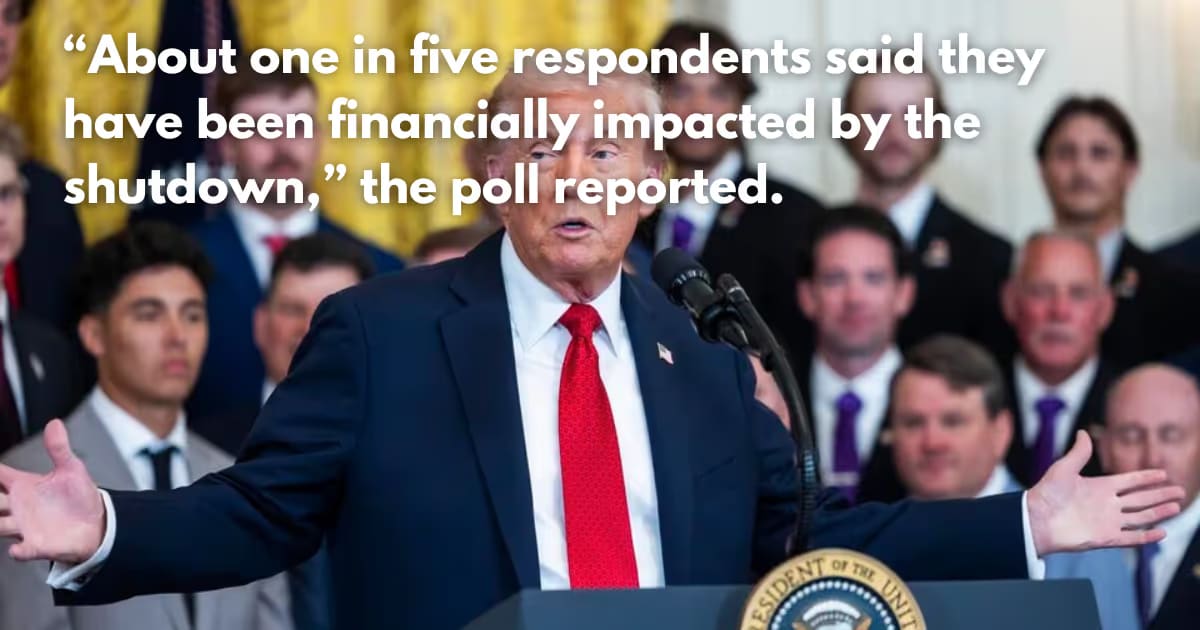
The poll found that one in five Americans said they had been directly financially impacted by the shutdown, while two in five reported knowing someone personally affected. From missed paychecks to delayed benefits, millions are feeling the strain of political gridlock.
Economists say that if the shutdown continues, the cumulative effects could ripple into early 2026. “Every day the government remains closed, contractors, suppliers, and small businesses that rely on federal spending lose income.”
The Republican Party currently holds majorities in both chambers of Congress, but internal divisions and a lack of bipartisan cooperation have stalled progress. Lawmakers still can't agree on how to spend the money, especially when it comes to health insurance subsidies, which are now the main point of contention in talks.
The political fight centers on health insurance subsidies that millions of Americans rely on, which are about to expire. Democrats have refused to pass any bill to reopen the government unless Republicans agree to extend the subsidies, which they argue are critical for working families.
The poll showed broad bipartisan support for maintaining the subsidies: 72% of respondents—including almost all Democrats and half of Republicans—said the discounts should remain in place. Only 22% favored ending them.
60% of those who supported the subsidies said they were important enough to keep the government closed until a deal is reached. 37% said lawmakers should reopen the government first and deal with the issue later.
James Carter, a political analyst, said that the message from the people is clear. “Americans may not like government shutdowns, but they’re willing to endure short-term pain for policies they believe protect their health and economic security.”
Despite the shutdown and mounting criticism, Trump’s core support base has shown little sign of erosion. About nine in ten Republicans surveyed said they approve of his performance as president.
Among Democrats, however, approval remains extremely low—only one in twenty respondents from the opposing party said they thought Trump was doing a good job. Independents are more divided, with roughly four in ten giving the president a positive rating.
Trump’s approval has slipped five points from 47% in January, shortly after his return to the White House, but analysts note that the decline has been gradual and less severe than expected. “Trump’s numbers show resilience,” said Rachel Lopez, a Washington-based pollster. “He benefits from a deeply loyal voter base that’s largely insulated from day-to-day political turbulence.”
The shutdown stems from a bitter disagreement between Republican and Democratic leaders over a spending bill. Democrats are demanding the continuation of popular healthcare subsidies, while some Republican lawmakers argue for scaling back federal spending.
Behind closed doors, negotiators are struggling to find common ground. Sources familiar with the discussions say that while moderate Republicans are pushing for a short-term funding bill, hardliners are resisting any deal that includes what they call “costly welfare extensions.”
The White House has maintained that the president supports reopening the government but insists that “responsible budgeting and reform must come first.” Critics, however, say the administration has failed to show leadership.
Public frustration is mounting as federal employees brace for missed paychecks and essential services continue to stall. Social media has been flooded with stories of workers struggling to pay rent, cover medical expenses, or keep up with bills.
“I never thought my government job would leave me in debt,” said Sara Miller, a furloughed air traffic controller from Virginia. “We’ve become pawns in a political game that no one seems interested in ending.”
Pollsters note that while Trump’s base remains firm, Republican congressional leaders face growing backlash from swing voters who view the party as primarily responsible for the crisis. “The longer this shutdown drags on, the more the blame will fall on Congress—not the president,” said Lopez.
The current stalemate reminds me of past shutdowns that tested Washington's political will. The 21-day Clinton-Gingrich shutdown in 1995 ended up hurting Republicans politically. If people see GOP leaders as blocking progress, something like this could happen again.
Both parties are thinking about what might happen in the 2026 midterm elections. Republicans face the risk of losing independent voters, while Democrats must ensure they do not bear the blame for prolonging the standoff.
Political observers say the outcome will depend largely on who controls the narrative in the coming weeks. “If Democrats frame this as a fight for healthcare access, they could gain sympathy,” said Carter. However, if Republicans persuade voters that the opposition is sabotaging the country, the situation may change.
Source: Reuters/Ipsos Poll — Americans blame Republicans more than Democrats for government shutdown
By FazTimes Media
This article has been independently rewritten for journalistic and educational purposes based on publicly available information. It adheres to Google AdSense standards for originality, factual integrity, and balanced reporting.
Link:
https://www.faztimesmedia.com/viewpost/trump-admin-plans-new-probe-on-global-drug-pricing-tariffs-loom-ft-report


Discussion0
Join the conversation on this story
Loading comments...