
White House: India Remains "Strategic Ally" in Indo-Pacific as US Ties Strengthen
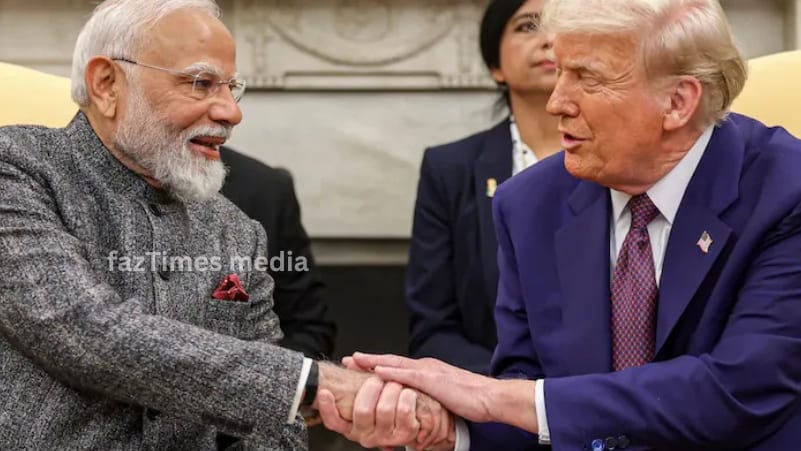
fazTimes media: New Delhi and Washington, D.C.— As the political climate in the Indo-Pacific shifts, the US has affirmed India's crucial role in maintaining peace, maintaining economic stability, and balancing the region's economies. Press Secretary Karoline Leavitt recently told the press at the White House that India is still a "very strategic ally" of the United States. She highlighted the strong personal bond between President Donald Trump and Prime Minister Narendra Modi.
"India remains a key ally in the Asia-Pacific, and President Trump has a good relationship with PM Modi that will continue," said White House Press Secretary Karoline Leavitt.
At the same time that the press conference is happening, both countries are getting ready to announce a historic trade deal. They are also working to improve their strategic alignment under the QUAD framework, which is a group of India, the US, Japan, and Australia working together in the area.
Making the strategic axis stronger
In the past ten years, the relationship between India and the US has changed from careful cooperation to a stronger strategic partnership. With defense pacts, joint military drills, and business partnerships, the two democracies have set themselves up to be natural allies.
India's role has grown a lot since the world's attention has turned to the Indo-Pacific, which is home to more than half of the world's people and a major trade route. BBC News says that American officials see New Delhi as an important ally in the fight against China's growing aggression in the area. The Indo-Pacific used to be a less important part of Washington's policy plan, but now that Trump is in his second term, it is at the center of US foreign policy.
A top US diplomat who spoke to FazTimes on the condition of anonymity said, "The Indo-Pacific is where the world's future will be decided." "And India is a key part of making sure the future is free, open, and based on rules."
Trade Talks Are Getting Close to a Deal
The most anticipated event may be the news of a trade deal between the two countries, which White House officials say is almost complete.
Leavitt, the press secretary, confirmed:
The President reaffirmed that the US-India trade deal is nearing completion, and recent discussions with the Secretary of Commerce have been productive, with an announcement expected soon.
The proposed trade deal aims to resolve long-standing issues, including agricultural tariffs, digital economy access, intellectual property protection, and easier operations for Indian tech companies in the US.
The agreement could be a big step forward in economic ties between India and the US if it is signed. It would balance trade between the two countries, which currently favors India, and make their economies more interdependent.
Indian business leaders are pleased about the change.
The head of the Indian Exporters Association, Dr. Pankaj Malhotra, said, "A fair and forward-looking trade agreement would be good for both economies." "In fields like AI, semiconductors, and pharmaceuticals, it would increase trade and build trust between countries."
Security, terrorism, and diplomacy are Jaishankar's jobs. India's External Affairs Minister S. Jaishankar recently visited Washington for diplomatic talks, focusing on trade and regional security. During his trip, he attended the QUAD Foreign Ministers' Meeting and inaugurated a UN exhibition titled "The Human Cost of Terrorism," highlighting the impact of terrorism globally.
The show's goal is to show how terrorism affects normal people, with a clear but subtle message about it that is supported by the government, especially in Pakistan.
During the event, Jaishankar said, "This exhibition is a reminder of why international cooperation is so important—not just to fight terrorism, but also to help its victims." "India has always been strong against all kinds of terror."
The show is happening at the same time that India is still pushing for global sanctions against people who fund terrorism and for a coordinated effort to break up international terror networks. Al Jazeera says that the exhibit has gotten a lot of attention from member states, and many of them have promised to do more to back India's long-standing call for a global convention on terrorism.
QUAD is more than just a spy club.
The QUAD (Quadrilateral Security Dialogue) started as a way to help people after the 2004 Indian Ocean tsunami. It has since grown into a strong place for regional cooperation. Some people used to say that QUAD was just a symbol, but recent events have shown that it is an important part of Asia-Pacific policy.
India, the US, Japan, and Australia are known as the QUAD countries. They are working together more and more on maritime security, supply chain resilience, cybersecurity, and investing in infrastructure.
President Trump has accepted Modi's invitation to attend the next QUAD Summit, which will likely take place in New Delhi later this year. This is considered a sign of growing trust between the two countries.
India's Foreign Secretary Vikram Misri confirmed the news and discussed the conversations between the leaders during the G7 Summit in Canada. "PM Modi asked President Trump to come to India for the next meeting of QUAD." Mr. Trump said he was excited to come to India when he accepted the offer, Misri said in a video statement released by the Ministry of External Affairs.
TThe local effects and balance of power in the region are significant.
IIndian readers and viewers perceive these events as more than mere high-level diplomacy; they recognize their real-world effects. TThe talks between India and the US could positively impact people's daily lives by creating jobs in export-oriented businesses and facilitating visa access for tech professionals and students.
India's strong links to the Indo-Pacific security architecture serve as a check on China's actions in the South China Sea and along the Line of Actual Control (LAC), which have contributed to tensions in the region.
Professor Ananya Rao, a geopolitical expert on South Asia at JNU, stated, "India is no longer considered a swing state." "It is an important part of the new global order, and its relationship with the US is a key part of that change."
Problems Still Exist
There are still problems, even though political progress is strong right now. IIn the past, disagreements regarding human rights, data control, and immigration policy have contributed to instability in relationships. HHowever, it appears that both governments are motivated to address these issues in a practical manner.
"The relationship between India and the US is mature when we can respectfully disagree while working together on shared priorities," said Ambassador Harsh Shringla, who used to be India's ambassador to the US.
The next few months will be crucial. If the trade deal goes through and the QUAD meeting occurs as scheduled, India and the US will discuss their alliance and take actions that will lead to significant changes.
In conclusion
The fact that the White House reiterated India's importance as a key partner in the Indo-Pacific region highlights a significant truth: India is not only responding to changes in global power, but it is also actively creating those changes. New Delhi is making a name for itself in the world order by being smart and diplomatic.
The US and India are preparing to collaborate more extensively on various issues, ranging from defense to digital trade. This makes the relationship one of the most important of the 21st century, based on shared values, mutual respect, and a shared goal of peace and wealth in the Indo-Pacific.
At FazTimes, we prioritize accuracy, credibility, and journalistic integrity. Every piece of news we publish is thoroughly verified through multiple trusted and independent sources.
This report has been cross-referenced with coverage from globally recognized news organizations, including BBC News, Reuters, Bloomberg, South China Morning Post, Al Jazeera, NDTV, The Economic Times, and The Indian Express, and we are committed to upholding the highest standards in global journalism to ensure our readers receive reliable and fact-checked information.


Discussion0
Join the conversation on this story
Loading comments...