
White House Pushes for Nobel Peace Prize for Trump, Citing India-Pakistan Conflict
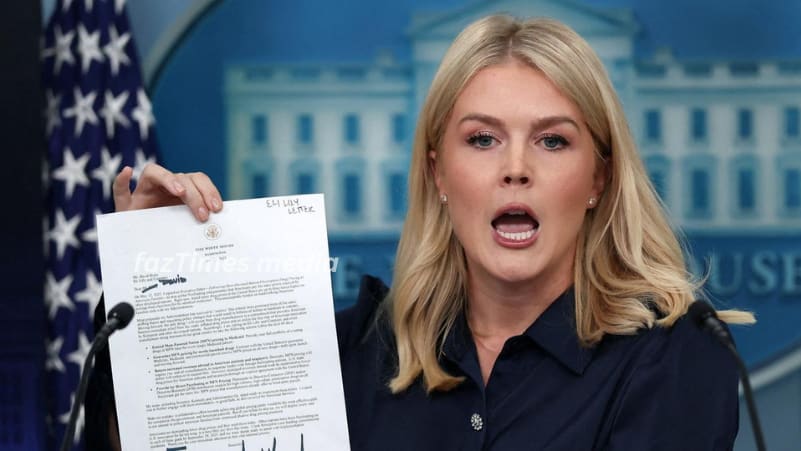
FazTimes media: NEW DELHI/WASHINGTON – The White House has made a controversial statement, saying U.S. President Donald Trump "deserves" the Nobel Peace Prize because of his work in ending global conflicts, including helping to ease tensions between India and Pakistan. This comment, made by White House Press Secretary Karoline Leavitt during a press briefing, has caused strong reactions from Indian officials, who say there was no foreign involvement in the recent ceasefire agreement with Pakistan.
Leavitt said, “It’s well past time that President Trump was awarded the Nobel Peace Prize. He has helped end multiple conflicts, including those between Thailand and Cambodia, Israel and Iran, Rwanda and the DRC, India and Pakistan, and more. In six months, the President has either brokered or helped reach at least one peace deal or ceasefire every month.”
While the Trump administration talks about a “new age of American diplomacy,” Indian leaders have quickly clarified that the India-Pakistan ceasefire was a decision made independently, without any outside influence.
Since May 10, when Donald Trump said on social media that India and Pakistan had agreed to a full and immediate ceasefire after what he described as a long night of secret talks, he has repeated this claim more than 30 times. He also said that if the two countries kept the peace, there would be more trade opportunities for them.
However, Indian Prime Minister Narendra Modi denied these claims during a speech in Parliament earlier this week. He said that no foreign leader had reached out to him to ask for a stop to Operation Sindoor, which is India’s recent military action following a terror attack on April 22 that killed 26 civilians.
Modi said, “India has never allowed any third party to interfere in our bilateral matters. Our decisions are based on our own national interests and security needs.”
India’s External Affairs Minister S. Jaishankar also made it clear that there was no communication between Modi and Trump between April 22 and June 16—the period Trump claims to have helped arrange the ceasefire.
He added, “There was no outside suggestion or involvement. The ceasefire was a strategic decision made through direct military talks with Pakistan and with input from our national security team.”
Operation Sindoor: The Catalyst
A terrorist attack on April 22 in Pahalgam, which is in the Kashmir region controlled by India, led to Operation Sindoor. This was a military action by India across the border to destroy suspected terrorist training camps near the Line of Control. For about three weeks, heavy artillery battles and increased air monitoring caused concern among people that the conflict between the two nations might escalate.
In early June, both countries agreed to a temporary stop in fighting. However, Indian officials said this agreement came from direct talks between military leaders, not because of pressure from other countries.
Al Jazeera reported that Pakistan’s foreign minister, Bilawal Bhutto Zardari, also said that Pakistan wasn’t aware of any American involvement in the talks.
This supports India’s claim that the ceasefire was reached through mutual understanding between the two sides.
What Is Behind Trump’s Nobel Push?
Trump's claim that he brought peace between India and Pakistan is part of a bigger effort to build support before the U.S. midterm elections. With foreign policy being a major topic in his administration, the White House has highlighted Trump’s supposed achievements in diplomacy.
“President Trump has taken a straightforward, results-focused approach to foreign policy. He doesn’t just talk about peace—he makes it happen,” said Press Secretary Leavitt on Fox News earlier this week.
However, many experts and fact-checkers are not convinced.
According to BBC News, several of Trump’s claims about successful peace agreements—including between Israel and Iran—are either not confirmed or are blown out of proportion. The BBC pointed out that the tensions between those two countries are still as strong as ever, and there has been no official peace agreement.
Nobel Prize: Not Just About Claims
The Nobel Peace Prize is given by the Norwegian Nobel Committee to people who have made significant contributions to peace. When considering who gets the prize, they look at real achievements, not just words or promises.
Dr. Ingrid Lunde, a professor of international relations at the University of Oslo, said to FazTimes Media,
“Just saying there will be a ceasefire or claiming that diplomacy worked doesn’t mean someone automatically gets the Nobel Prize. The Committee wants to see ongoing peace efforts, proof that things are working, and lasting change.”
The relationship between India and Pakistan is calm right now because of the ceasefire, but it is still not very stable. Experts believe the situation is still risky, and true peace hasn’t been achieved yet.
In India, the effort to get Trump a Nobel Prize—especially because it involves the delicate relationship between India and Pakistan—has caused a mix of laughter and worry. A leader from the Congress party, Shashi Tharoor, posted on Twitter in a joking way:
"If giving out peace prizes is all about imaginary diplomacy, then why stop at the Nobel?
Why not give him a Grammy for his speeches as well?"
Some groups and experts are saying that when foreign countries discuss peace without recognizing what's happening locally, it can mess up the real situation of security in the region.
Col. (Retd.) R. K. Sharma, who used to work in defense, said:
"Peace in South Asia can't be decided from Washington or Oslo. It has to come from serious talks, building trust, and working together with neighboring countries."
The June ceasefire between India and Pakistan is important—not because of outside help, but because it was one of the few times recently when both armies chose to calm things down instead of making matters worse.
Sources in India’s defense system say the decision to stop fighting came after top-level evaluations showed that continuing the conflict could lead to bigger violence and trouble from the international community, especially because of the number of civilians affected in both countries.
“Both sides knew they were getting too close to a big problem. We decided to be calm—not because we had to, but because we knew it made sense,” said an Indian Army official who asked not to be named.
Conclusion: Peace Must Speak for Itself
While President Trump may have made strong statements on the campaign trail in the U.S. about "solving" issues like the India-Pakistan conflict, the reality in South Asia is far more complex.
India has said it doesn't want any foreign help in dealing with its issues, especially with Pakistan. This indicates that India has always believed its problems with Pakistan should be handled directly between the two countries, without outside interference. Whether or not Trump thinks he deserves a Nobel, achieving real peace in the region needs cooperation from the countries involved, patience, and above all, trust.
According to BBC News, there is no official record or international proof that the U.S. was involved in the India-Pakistan ceasefire that happened earlier this year. Currently, the world needs more real action and less talk when it comes to peace.
It's clear that just making big claims doesn't make someone a peacemaker, especially in a region as sensitive and complex as South Asia.
FazTimes Media will keep watching the changes in diplomatic talks and provide you with accurate updates on what's happening in South Asia and other parts of the world.
At FazTimes, we prioritize accuracy, confidence, and strong journalistic standards. To ensure every news story we share is real, we verify it with multiple trustworthy and independent sources.
We’ve compared this report with coverage from major news outlets around the world, including BBC News, Reuters, Bloomberg, South China Morning Post, Al Jazeera, NDTV, The Economic Times, and The Indian Express.
Our dedication lies in upholding the highest standards in global journalism, ensuring our readers can trust the information they receive.


Discussion0
Join the conversation on this story
Loading comments...