
Why China Builds AI Centers on the "Roof of the World": Tibet's Strategic Advantage
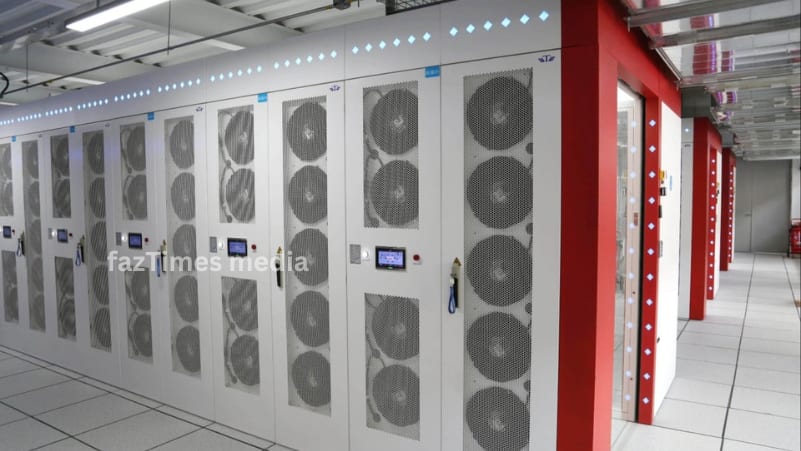
fazTimes media: China's new Yajiang-1 computing center is now operational, located in a historic Tibetan area along the Yarlung Tsangpo River. This center is part of China's plan to make the region a hub for sustainable supercomputing.
As the first major hub of the "Eastern Data, Western Computing" project on the Tibetan Plateau, the facility uses the harsh environment to make huge artificial intelligence (AI) training tasks, which take millions of processing hours a year, much more energy efficient.
China wants to build more AI centers like Yajiang-1, which is 3,600 meters (11,800 feet) above sea level. They plan to use the country's natural cold, its plenty of solar power, and its creative waste heat recovery to do this.
Shannan, a city in the Tibet Autonomous Region, will host the center's first phase. It will have more than 256 advanced computing servers, which will give it a total processing power of 2,000 petaflops, which is a unit of floating-point operations per second.
The Yajiang-1 computing center was built by a partnership between the Tibet Yarlung Zangbo Computing Technology Company and the local government. It aims to become a leader in high-altitude computing and digital economies.
Han Shuangshuang, the company's general manager, said in an interview that Yajiang-1 will drive innovation in areas like AI, self-driving cars, smart healthcare, and monitoring the environment in high-altitude regions.
Han Shuangshuang said, "We've already formed partnerships to advance these areas," in an interview with a science and technology newspaper.
In 2022, China launched the Eastern Data, Western Computing project. The goal is to move data processing from the eastern regions, where there's high demand, to the western areas, which have plenty of renewable energy. The national effort sets up data centers in the west so that eastern China can handle offline analytics, storage, and computing tasks that aren't urgent.
Yajiang-1 leverages Tibet's unique environment to sustain operations. Its high elevation makes it naturally cold and low in oxygen, which lowers the need for cooling. Also, it has a lot of green energy sources, such as solar, hydro, and wind power, which lowers the cost of running the business.
However, a report from the local government recognized the conflict between the program's economic and technological needs and the unique and valuable environment of the area.
The new data center, located 3,600 meters above sea level, uses a unique system to reduce its environmental impact. It combines solar power, waste heat recovery, and efficient cooling to balance computing needs with eco-friendliness.
The Shannan report says that the integrated approach has a power efficiency rating below 1.3, which is the best in the business. This means that the approach uses 40% less energy than traditional data centers.
The 2,000-petaflop center would train AI for about 4 million hours a year in eastern China once it was fully set up and able to hold or do something. This would save 320 million kilowatt-hours (kWh) of energy and 280,000 tons of carbon dioxide each year.
According to the report from the Investment Bureau, the environmental impact was further reduced by the fact that 25,000 square meters (270,000 sq ft) of on-site solar panels produced 48 gigawatt-hours of clean power each year. The data center also uses a system that turns waste heat from servers into warmth for nearby buildings, saving around 12,000 tons of coal every year.
Initially, the Eastern Data, Western Computing project included eight national hubs, but it only included two western regions, Ningxia and Gansu. The project is now expanding to include Tibet with the addition of Yajiang-1.
Han said the Yajiang-1 project is a key part of Tibet's plan to become a major computing hub, connecting Lhasa to other important cities in the region like Nyingchi and Qamdo.
At FazTimes, we prioritize accuracy, credibility, and journalistic integrity. Every piece of news we publish is thoroughly verified through multiple trusted and independent sources.
This report has been cross-referenced with coverage from globally recognized news organizations, including BBC News, Reuters, Bloomberg, South China Morning Post, Al Jazeera, NDTV, The Economic Times, and The Indian Express, and we are committed to upholding the highest standards in global journalism to ensure our readers receive reliable and fact-checked information.



Discussion0
Join the conversation on this story
Loading comments...