
General
Women Protest at UP Vidhan Bhavan Over 'I Love Muhammad' FIR
By Saquib Ansari
Published: Sep 22, 2025, 09:02 AM
Last updated: Sep 22, 2025, 12:14 PM
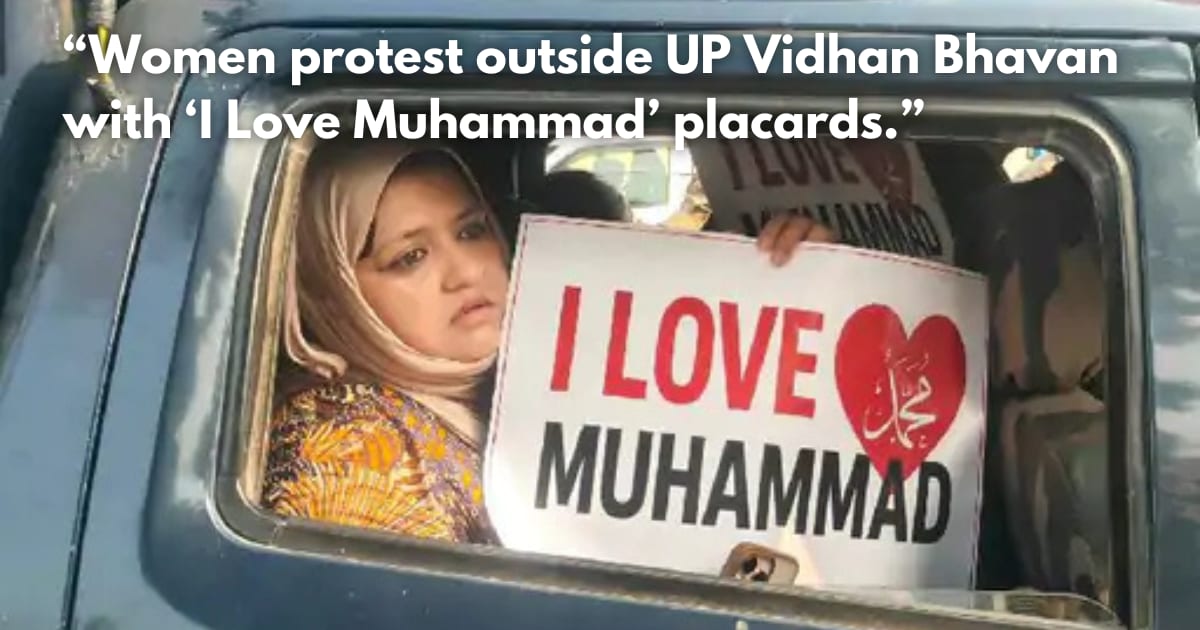


FazTimes Media, Lucknow — In a striking show of defiance, Muslim women gathered outside the Uttar Pradesh Vidhan Bhavan on Saturday to protest against a recent police case that has stirred controversy across the state. Holding placards inscribed with “I Love Muhammad”, the demonstrators demanded justice and questioned the selective application of law in matters of faith.
The protest came just days after more than two dozen people were booked for allegedly disturbing communal harmony during Milad-un-Nabi processions. The charges have been criticised by activists, opposition parties, and members of the Muslim community, who see the FIR as discriminatory and politically motivated.
The immediate trigger for the demonstration was the filing of an FIR against 26 individuals who had displayed posters and banners expressing love for Prophet Muhammad during recent Milad-un-Nabi celebrations. Police alleged that the act amounted to disturbing communal peace, invoking provisions under sections of the Indian Penal Code.
For many Muslims, however, the case represented something much deeper — an attack on their right to religious expression. The protesters argued that the FIR criminalised an act of devotion, something they believe should never have been linked to law-and-order concerns.
Sumaiya Rana, daughter of renowned poet Munawwar Rana, led the protest. Speaking to reporters, she called the FIR “unconstitutional” and accused the state government of singling out Muslims. “Law in Uttar Pradesh has become selective. It applies differently to different communities, and Muslims are being unfairly targeted,” she said.
The demonstration began peacefully with women chanting slogans in support of the Prophet and holding banners highlighting their demands. But tensions flared when police attempted to disperse the crowd. Several women were briefly detained and later released at Eco Garden.
Authorities defended their actions, saying the gathering had no prior permission. A senior police official told local media that “no one will be allowed to take the law into their hands or disrupt peace in the state capital.”
Still, the incident has added fuel to a larger debate about freedom of expression, religious rights, and the state’s role in regulating public demonstrations.
The protest has quickly taken on political overtones. Opposition parties have accused the Bharatiya Janata Party (BJP)-led government of double standards. Samajwadi Party spokespersons claimed that the ruling party was “weaponising law enforcement against minorities” while remaining silent on provocative activities by fringe right-wing groups.
According to Al Jazeera, rights activists argue that the controversy reflects a broader pattern in which Muslim practices are scrutinised under the lens of law and order, while other groups are often given more leniency.
The Congress Party, too, criticised the FIR, calling it an “unjustifiable use of state power against peaceful religious expression.”
For the women who took to the streets, the protest was about more than just one case. Many participants said they felt their faith was being criminalised.
Nazia Khan, one of the women present at the Vidhan Bhavan, told FazTimes: “Carrying a placard that says ‘I Love Muhammad’ is not a crime. It is an expression of devotion, no different from people publicly displaying their love for their gods. Why are we being punished for our faith?”
Others highlighted the irony of booking people during Milad-un-Nabi, a festival observed to celebrate the birth of the Prophet. “This is a day of peace and unity for us. To link it with communal disharmony is unjust,” said Shabnam, another protester.
Legal experts have also weighed in on the controversy. Some argue that the FIR may not stand in court, given that expressions of religious sentiment are protected under constitutional guarantees of free speech and the right to practise religion.
As reported by BBC News, several constitutional lawyers noted that while the state is entitled to prevent activities that may provoke violence, it must demonstrate clear evidence that the act in question had a “direct and imminent” link to disorder. In the case of the “I Love Muhammad” banners, such proof appears weak.
Senior advocate Prashant Bhushan tweeted, “How can expressing love for a religious figure be considered communal or unlawful? This is a dangerous precedent for freedom of expression.”
The demonstration in Lucknow has inspired similar conversations across India. Social media platforms have been flooded with hashtags supporting the women protesters, while others criticised the act as “provocative”.
Reports indicated smaller gatherings in cities like Kanpur and Aligarh, but none could match the magnitude of the Lucknow protest. Community leaders are now debating whether to launch a broader movement to challenge the FIR and defend what they call their “constitutional rights of faith”.
What stood out most was the visible role of women at the forefront of this protest. Conservative societies often limit women's public participation in politics, making their leadership both symbolic and powerful.
“This is not just about one. It is about dignity and our place in this country as equal citizens," said Sumaiya Rana, the protest leader.
Observers believe that the involvement of women adds a unique moral weight to the demonstration, challenging stereotypes and highlighting the intersection of faith, identity, and rights.
The controversy raises larger questions about the state of communal relations in India. The FIR and subsequent protests reveal the fragile balance between religious freedom and state regulation in an increasingly polarised environment.
According to The Hindu, incidents like these contribute to a growing sense of alienation among Muslims in Uttar Pradesh, a state that has frequently been at the centre of communal flashpoints. Critics warn that unless handled sensitively, such actions may deepen mistrust and hinder social harmony.
The BJP government in Uttar Pradesh, led by Chief Minister Yogi Adityanath, now faces a delicate balancing act. It must maintain law and order while addressing claims of religious bias.
Political analysts believe the state’s approach in this case may influence upcoming electoral dynamics, particularly in constituencies with significant minority populations.
The “I Love Muhammad” protest in Lucknow has emerged as more than a local demonstration—it has become a flashpoint in the national conversation about faith, freedom, and fairness in governance.
For the women who stood outside the Vidhan Bhavan with their placards, the issue was deeply personal, tied to their faith and identity. For the state, it is a test of whether the law can be applied impartially in a charged political atmosphere.
As the debate unfolds, one question lingers: in a country that prides itself on its secular and democratic ethos, can expressions of devotion be treated as a threat to harmony? Or should they be embraced as part of India’s pluralistic character?
According to Al Jazeera, the answers may shape not only the immediate outcome of this case but also the broader trajectory of religious freedom and communal relations in India.
Link:
https://www.faztimesmedia.com/viewpost/women-protest-at-up-vidhan-bhavan-over-i-love-muhammad-fir


Discussion0
Join the conversation on this story
Loading comments...