
Air India AI171 Cockpit Audio Deepens Crash Mystery: New Details Emerge
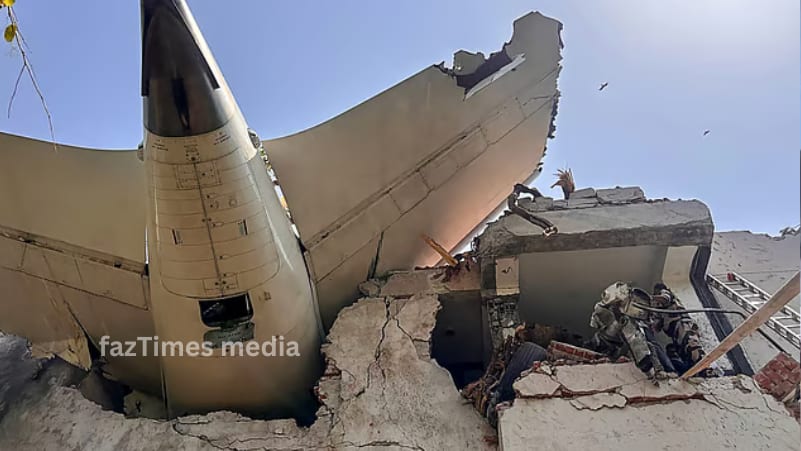
fazTimes media: Dubai/New Delhi — A month after the deadly crash of Air India flight AI171, new troubling information from the plane’s cockpit audio has come to light, making the mystery of why a Boeing 787 Dreamliner crashed just before takeoff from Ahmedabad to London even worse. A preliminary report from India’s Aircraft Accident Investigation Bureau (AAIB), released on Saturday, says the fuel cutoff switches on the aircraft were suddenly turned on, causing both engines to stop working within seconds.
The accident resulted in the loss of 260 lives, making it the deadliest aviation disaster in the past ten years.
The cockpit voice recorder shows a strange conversation between the two pilots right before the crash.
One pilot asks, “Did you cut off the fuel?” and the other says no. The AAIB hasn’t yet figured out which pilot said what, but this confusing exchange is now the main focus of the growing investigation.
An Inexplicable Shutdown
The Boeing 787, considered one of the safest large planes in use, was speeding down the runway for takeoff when, according to the report, both fuel cutoff switches turned off almost at the same time. These switches are important safety parts that control the fuel going to the engines. When they shut off, they stop the engines from producing power. The plane lost its ability to stay in the air right after taking off, leaning to the left and going down towards the nose before crashing into an empty field just 3 kilometers away from the runway.
Even though air traffic control tried hard to reach the crew, they couldn’t get the plane under control.
“This wasn’t because of a mechanical problem, at least not based on what we know so far,” said Saj Ahmed, Chief Analyst at Strategic Aero Research. “The main question is—why did those fuel switches turn off in the first place?”
Cockpit Conversation Raises Questions
The audio from the cockpit, now included in the public summary released by the AAIB, is short but revealing.
The audio from the cockpit raises more questions than it answers, as one pilot appears confused and the other denies the statements made. “Did you cut the fuel?” One voice is heard asking. “No! I didn’t do it,” replies the other. A few seconds of silence pass, and then the sound of cockpit alarms goes off. This unsettling exchange has led investigators and aviation experts to wonder if the issue was a mistake made by the pilots, a misunderstanding, or possibly a technical problem that caused something to happen by accident.
“As reported by BBC News, investigators are now looking into the possibility that there was a communication issue in the cockpit or that something was accidentally triggered during a routine checklist,” which is usually done before takeoff and includes checking systems related to fuel management.
Human Error or System Problem?
Aviation professionals are exercising caution before making hasty conclusions. The data from the Enhanced Airborne Flight Recorder (EAFR) covers almost 50 hours of flight records before the incident, but there's nothing there that shows any problems with the fuel system.
Rupa Mehta, an aviation expert, told Al Jazeera, “We need to remember that looking into aviation accidents is complicated. It's easy to blame someone early on, but these investigations take a long time, sometimes even months.”
Mehta said that several things could be to blame, like what was happening in the cockpit, pilot tiredness, mistakes in following checklists, or even a problem with the electronic engine control system. “There have been very few cases where software issues caused strange actions in the cockpit,” she said.
Boeing hasn't officially commented on the findings yet, but people inside the company say they are watching the situation closely. The 787 Dreamliner, which started flying in 2011, has a favorable safety history overall.
Saj Ahmed shared via FaceTime, “For airlines in the Gulf Cooperation Council and Asia that use the 787, this report doesn’t mean they need to make any quick changes right now.
The plane is still one of the most dependable aircraft, having flown over 1.5 billion passengers worldwide without any major issues.” However, the event has led some airlines in the Middle East and Asia to briefly check their pre-flight checklists, especially the steps involved in starting up the engines.
A safety officer from the RTA in Dubai explained, “It’s just a careful step we’ve taken. Until the full report comes out, we’ve told our crew to make sure they double-check the fuel switch procedures.”
A History of Silent Protocols
This isn't the first time that poor communication in the cockpit has been involved in serious aviation accidents.
In 2010, the crash of Air India Express Flight 812 in Mangalore was partly because of pilot tiredness and not working well together. The disappearance of Malaysian Airlines Flight MH370 in 2014 raised questions about potential violations of cockpit rules, although the exact cause remains unknown.
According to The Indian Express, internal sources at Air India say both pilots on AI171 had more than 10 years of experience and together had flown over 8,000 hours on Boeing planes. The flight commander had just completed a skills check, only two weeks before the crash.
A country is grieving and looking for answers. The families of those who died are asking for a clear and quick investigation. Last week, a public event was held in Ahmedabad, where more than 1,000 people gathered, many still waiting for the bodies of their loved ones to come back. Sangeeta Patel, who lost her husband and two kids on flight AI171, said, “We are devastated. We don’t want people to be blamed—we want to know the truth. Someone should be held responsible.”
India’s Civil Aviation Minister, Rajeev Bansal, has said they will be open and work with other countries in the probe. The Aircraft Accident Investigation Bureau is also working with the U.S. National Transportation Safety Board and Boeing’s experts to dig deeper into what happened.
What’s Next?
The full investigation is expected to go on for the rest of the year, and a final report is likely to come out by early 2026. This detailed report will include data from simulations, evaluations of human factors, and any suggestions to stop similar accidents from happening again.
In the meantime, Air India has put four other 787 planes on hold for thorough checks, but the airline says the delay is just a “precautionary step” and not because of any major system problems. There are still many unanswered questions in the early report, but one thing is certain: the mystery surrounding flight AI171 remains unsolved.
As the worldwide aviation world keeps watching, passengers and families are waiting for the truth, hoping such a serious mistake—whether from people or machines—doesn’t happen again.
At FazTimes, we prioritize accuracy, confidence, and strong journalistic standards. We ensure every news story we share is real by verifying it with multiple trustworthy and independent sources.
We’ve compared this report with coverage from major news outlets around the world, including BBC News, Reuters, Bloomberg, South China Morning Post, Al Jazeera, NDTV, The Economic Times, and The Indian Express.
We are dedicated to maintaining the highest standards in global journalism so our readers can rely on the information they get.






Discussion0
Join the conversation on this story
Loading comments...