
Business
EU Seeks Closer India Ties, Flags Concerns Over Russian Links
By Saquib Ansari
Published: Sep 18, 2025, 09:14 AM
Last updated: Sep 18, 2025, 10:39 AM
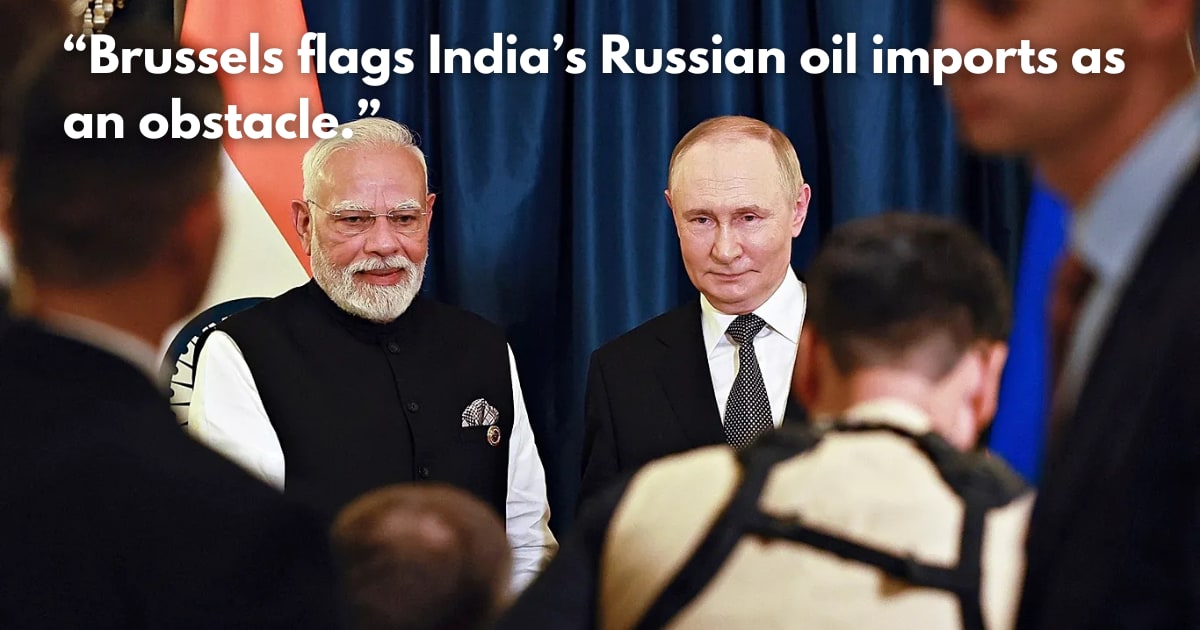



FazTimes Media: The European Union (EU) has launched a broad initiative to enhance collaboration with India in the areas of defence, trade, and technology, referring to New Delhi as a “strategic partner” in an uncertain global landscape. Nevertheless, Brussels expressed concerns about India’s ongoing close relationship with Russia, warning that energy imports and military engagements with Moscow might complicate deeper ties. The announcement was made on September 17, when the European Commission and the EU’s High Representative for Foreign Affairs released a document outlining a “strategic EU-India agenda”. This initiative comes amid the EU’s reassessment of global alliances in light of security challenges brought on by the Ukraine war and rising tensions with Russia and China.
A Call for Stronger Cooperation → Push for Deeper Ties
The EU paper emphasised that collaboration with India is not optional but essential in the current environment. “In a world marked by complex security threats, economic fragility, and rapid technological change, closer EU-India cooperation is more important than ever,” the joint statement said.
The agenda includes enhanced dialogue on defence, cybersecurity, and counterterrorism, while also aiming to expand joint projects in renewable energy, digital infrastructure, and climate action.
The Russia Factor → Russia’s Role
Despite the enthusiasm, Brussels did not hesitate to highlight certain issues. The EU warned that India’s deep economic and military ties with Russia could hinder progress in the partnership. “Russia’s war of aggression against Ukraine poses an existential threat to European security. For the EU, any enablement of this war must be addressed,” the document stated.
Concerns have been raised over India’s large-scale imports of Russian crude oil, often refined and exported globally, as well as New Delhi’s participation in joint military exercises with Moscow. This year, India joined Russia’s Zapad drills near NATO borders in Eastern Europe, a move that raised eyebrows in Brussels.
At a press conference in Brussels, EU foreign policy chief Kaja Kallas openly questioned India’s choices. “If you want closer ties with us, then why participate in exercises that are an existential threat to us? We are not taking this situation lightly,” she remarked.
However, India asserts that strategic autonomy and sustained defence cooperation guide its relationship with Russia. Analysts note that the EU’s challenge lies in accepting India’s balancing act while still deepening its engagement. “India’s Russia policy is not going to change overnight. Europe knows this, but they are still willing to invest political capital because losing India to Moscow or Beijing would be far worse,” said Dr Rakesh Sharma, a New Delhi-based foreign policy expert.
Security and defence as the "backbone." → Security as the Backbone
Kallas described defence and security cooperation as the “backbone” of the new agenda. This includes negotiations for an agreement on the exchange of classified information, expanded naval cooperation in the Indo-Pacific, and joint efforts between European and Indian defence industries.
There are also proposals for capacity-building programmes to prevent sanctions evasion, especially through Russia’s so-called “shadow fleet” of oil tankers, which use Indian ports and financial networks to move energy supplies.
The EU is also keen to prevent the re-export of European-origin goods from India to Russia, particularly technology items that could be used in battlefield systems.
Trade Talks Move in parallel. → Trade Runs Alongside
While defence dominates the agenda, trading remains a crucial area of engagement. Negotiations are underway for a long-pending EU-India Free Trade Agreement (FTA), which Brussels hopes to finalise within the year.
European Commissioner for Trade Maroš Šefčovič highlighted the scale of opportunities. “It’s about strategic choices. And clearly, India is a strategic partner from any perspective you look at,” he said, noting that the EU is already one of India’s largest trading partners.
The FTA has the potential to significantly boost sectors such as pharmaceuticals, digital services, renewable energy, and manufacturing, while also creating opportunities for India's agricultural exports to Europe. The EU's outreach occurs as the United States is urging both India and Europe to take firmer stances against Russia.
Washington has already imposed 25% tariffs on certain Indian products in response to New Delhi's ongoing oil trade with Moscow.
This incident places the EU in a delicate position: it must align with U.S. sanctions policies while maintaining relations with India, which Washington views as a key partner in its Indo-Pacific strategy. Kallas herself admitted that "completely decoupling India from Russia may not be realistic, given their shared history."
Instead, Europe appears to be adopting a gradual approach: deepening ties where possible while encouraging India to reduce its reliance on Moscow over time.
Our primary goals at FazTimes Media are to be accurate and confident and adhere to the highest journalistic standards. We check every news story we share against several trustworthy and separate sources to ensure its accuracy.
We have reviewed this report, along with articles from major news outlets worldwide, including BBC News, Reuters, Bloomberg, Al Jazeera, NDTV, The Economic Times, and The Indian Express.
We want to keep the highest standards in global journalism so that our readers can trust the information they acquire.
Link:
https://www.faztimesmedia.com/viewpost/eu-seeks-closer-india-ties-flags-concerns-over-russian-links



Discussion0
Join the conversation on this story
Loading comments...