
Russian Leader Claims Nations Ready to Arm Iran with Nuclear Warheads
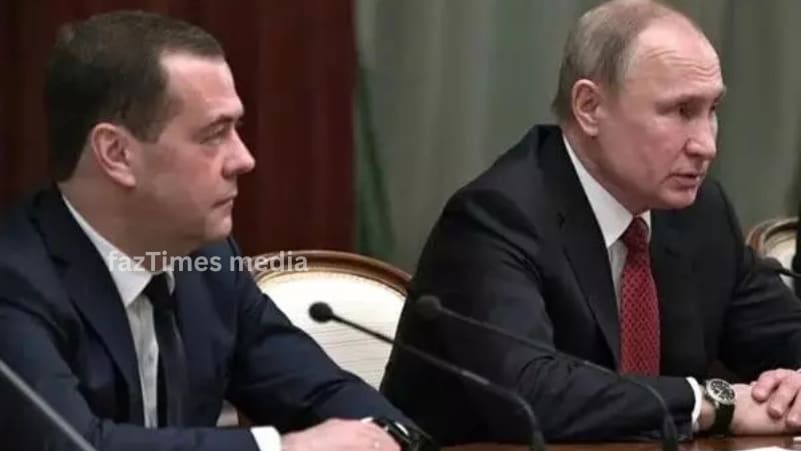
fazTimes media: In an exasperating improvement that may alter the worldwide energetic control, former Russian President and current Appointee Chairman of the Russian Security Committee, Dmitry Medvedev, has expressed that “many countries” are willing to supply Iran with atomic warheads. His comments follow U.S. airstrikes on Iran’s atomic offices, which have raised tensions within the Middle East and frightened ambassadors around the world.
Even though Medvedev did not uncover the names of the nations purportedly providing atomic support to Iran, his explanation through Russian state media has started a strong theory and concern among ambassadors and intelligence authorities. His comments suggest a potential breakdown of the worldwide understanding against atomic proliferation that has formed worldwide security since the Cold War.
Medvedev Criticizes Trump
Medvedev, too, took a solid poke at U.S. President Donald Trump, blaming him for beginning a perilous strife within the locale. “He came to control promising peace but has presently plunged the United States into a war that might immerse the whole Middle East,” the Russian pioneer expressed, concurring with reports from NDTV.
He addressed the adequacy of the U.S. operation, named Operation Midnight Pound, recommending that Iran’s key atomic facility is either intaglio or has, as it were, seen minor harm. “The enhancement of atomic fabric, and presently we can say it through and through, the long-term generation of atomic weapons will continue,” Medvedev claimed.
Effects of the U.S. Strikes
The U.S. airstrikes centered on three major atomic sites in Iran: Isfahan, Fordow, and Natanz. These destinations have been under universal examination, particularly since Iran expanded uranium enrichment after the 2018 collapse of the Iran nuclear deal.
Despite the emotional pictures from the strikes, free examiners and atomic specialists have echoed Medvedev’s view. They recommend that the harm may not have altogether deterred Iran’s atomic aspirations. Lackey pictures discharged after the strikes show a few harmed structures, but there was no sign of broad or irreversible damage.
An articulation from Iran’s National Atomic Security Framework Center affirmed that radiation levels remained typical and there was “no sign of contamination.” This was afterward confirmed by the International Atomic Energy Agency (IAEA).
Araghchi, moreover, declared a critical trip to Moscow to meet Russian President Vladimir Putin, showing a fortifying of ties between Tehran and Moscow. Russia may be a companion of Iran. We continuously counsel, particularly in minutes like these, he said.
This speedy discretionary coordination between Russia and Iran has raised concerns about an almost modern alliance shaping in restriction to Western influence, encouraging separate worldwide strategies.
Territorial Pressures: Affect on Israel and the Past
The effect of the struggle is, as of now, being felt in Israel. Israeli authorities affirmed that blasts happened in different cities due to retaliatory attacks and rocket strikes launched by Iran. Civilian fear has taken hold in parts of the nation, especially in Tel Aviv and Haifa, where discussions of attack sirens have become an alarming portion of the lifestyle.
Israeli Prime Minister Benjamin Netanyahu attested, “We will proceed with our operations in both Iran and Gaza until our vital targets are accomplished. Israel will not be dragged into a war of attrition.” Be that as it may, examiners caution that if the showdown proceeds, the chance of it escalating into a bigger territorial war increases. Bunches like Lebanon’s Hezbollah and Syria’s equipped local armies might end up included.
Atomic Multiplication: Genuine Danger or Feign?
Medvedev’s comments about nations conceivably willing to supply Iran with atomic weapons raise critical questions: who are these nations, and how genuine is the danger?
Most nuclear-armed countries are signatories to the Settlement on the Non-Proliferation of Atomic Weapons (NPT), which entirely precludes exchanging atomic weapons or technology to non-nuclear countries. Iran is additionally a signatory, despite the fact that its compliance has been questionable for a long time.
Within the high-stakes domain of discretion, mystery bargains and clandestine activities can happen. A few accept that North Korea or rowdy groups inside Pakistan’s military may be involved in Medvedev’s dubious articulation. Be that as it may, no strong proof has developed so far.
Suggestions for the World
For conventional individuals, particularly in regions currently tormented by strife and instability, the impacts of this emergency are huge. Oil costs have as of now spiked, with Brent unrefined crossing $110 per barrel in the midst of fears that Iran might near the Strait of Hormuz, a significant energy route, in striking back.
In India and other countries that depend on imports, this may lead to higher fuel costs, expansion, and increased financial strain. The Indian Service of Outside Issues has called for limitations from all parties and a prompt focus on discretionary discourse.
In an articulation released Monday, the service said, “India remains profoundly concerned about the acceleration of military activities within the Middle East. We encourage all included parties to prioritize peace and return to negotiations.”
Conclusion: A Perilous Intersection
The world presently faces a risky intersection. What started as a focus on strikes has heightened into a broader strife including atomic dangers, intermediary wars, and potential breaches of international law. Medvedev’s explanations may serve as both publicity and political technique, but they highlight a more profound truth: belief among world powers is at an all-time low, and the delicate frameworks set up to anticipate fiasco are under exceptional weight.
For nearby perusers and citizens all over, the trust is that reason wins. History shows that clashes of this scale are eccentric and regularly irreversible. The following activities taken by Washington, Tehran, Tel Aviv, and Moscow seem to shape not only the long run of the Middle East but also worldwide peace within the 21st century.
fazTimes media will proceed to supply confirmed, fact-checked upgrades as this story advances.






Discussion0
Join the conversation on this story
Loading comments...